
A Chinese podcast · Same story, 4 levels
State Farm 拒赔屋顶,一年少赔十四亿美元:最先反对的,是它自己的代理人
State Farm Denied Roof Claims to Save $1.4 Billion
About this story
Unsealed Oklahoma court documents allege State Farm systematically cut roof-damage payouts, keeping $1.4 billion in a single year — and its own agents wrote letters trying to stop it. Chinese listening practice at four levels. HSK 3 Chinese listening practice.
This is an HSK 3-4 Chinese listening episode that runs about 6 minutes. The full Mandarin script is shown with tap-for-pinyin and a line-by-line English translation, so you can listen and read at once — comprehensible input in the sense of Stephen Krashen's i+1 theory. It teaches 12 key vocabulary words such as 机会、普通、计划 and walks through 3 grammar patterns, each explained in English with examples. The same news story is retold at 4 difficulty levels — use the level selector above to find the version that is challenging but still understandable for you.
Read at your level
原文Read the complete story in Chinese. Reveal pinyin and English only when you need them.
English transcript reference
Let's start with a number: one point four billion dollars.
That is how much one American company held back in a single year.
Held back from whom?
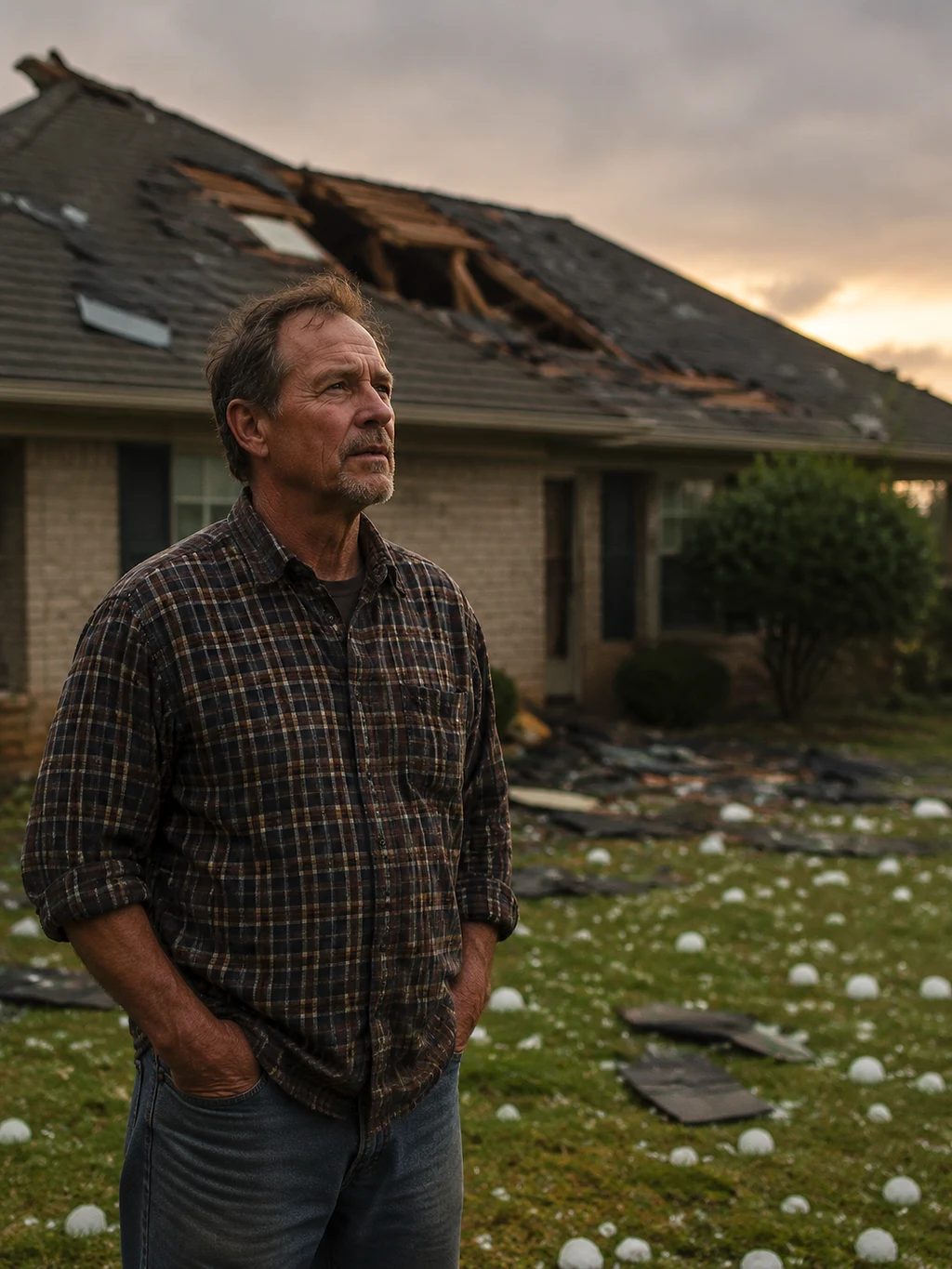
From ordinary people whose roofs had been smashed by hail.
The company is called State Farm, the largest home insurer in America.
This August, an American court made it hand over its internal documents.
What was written in those documents has made a lot of Americans very angry.
Let's lay the story out clearly first.
In the middle of America, hail falls every summer.
Hail is chunks of ice that fall from the sky, some as big as small stones.
It slams into the roof, and the roof breaks.
Once the roof breaks, rain leaks down into the house.
At that point your only option is to replace the roof.
How much does a new roof cost?
In America, roughly ten to thirty thousand dollars.
An ordinary person cannot produce that kind of money.
So Americans buy home insurance.
You pay the insurance company every month, and when something happens, the company pays you.
That is the whole reason insurance companies exist.
State Farm has been in this business for over a hundred years.
It has a famous line that many Americans have heard since childhood:
We pay what we owe, not a penny more, not a penny less.
It is because of that line that Americans trusted it.
But starting in 2020, the way things were done inside the company changed.
In June 2020, State Farm tried out a new program in Texas.
By the end of that year, the program had been rolled out across the whole country.
What the program was aimed at was roofs.
A manager at the company said something that is now written into the court documents.
She said: replacing the entire roof is our single biggest opportunity.
"Opportunity" here means: a place where money can be saved.
In her view, the company was paying out too much on roofs.
So how much had it been paying before?
Before, when a hundred people came to State Farm for a new roof after hail, about eighty-five of them got one.
The company produced an internal figure: the national average is only eight to ten percent.
So their goal was to push their own eighty-five down toward that number.
Do you hear the problem?
Whether one person's roof is actually broken should be a question about the roof.
Now it became a question about a percentage.
So how exactly was it pushed down?
The documents spell it out clearly.
First, add reviewers.
Before, an adjuster could decide on the spot; now a full replacement had to go up for another look.
Second, run training.
They built a training course teaching adjusters how to open the conversation with a customer.
The course was called "the Art of the Conversation."
Put plainly, it taught staff how to turn "we'll replace it" into "we'll patch it up."
Third, build dashboards.
The company built screens tracking that number day after day.
Wherever replacement rates ran high, that region got questioned.
And the result?
The effect was obvious.
Before 2020, for every roof repaired, about five point six roofs were fully replaced.
By 2023, that number had dropped to two point one.
Over one year, the company paid out one point four billion dollars less.
Here is the interesting part: the first people who felt something was wrong were State Farm's own employees.
In America, State Farm's insurance is sold through more than nineteen thousand agents.
These agents live locally, and their customers are their neighbors.
When a house is damaged, the customer's first call goes to them.
In 2021, several agents wrote letters to the company.
One of them wrote: that old line of ours — we pay what we owe, not a penny more, not a penny less — is not true anymore.
He said: we are paying out very little now, and customers have to argue with us for a long time to get money that was theirs to begin with.
Another agent said the claims department had become like a secret society, and they could not get answers about anything.
The company received those letters.
The program did not stop.
Eventually the matter reached the courts.
In Oklahoma, more than a thousand cases have been filed against State Farm.
The state's attorney general stepped in as well and sued the company directly.
A judge ordered State Farm to hand over eight hundred thousand internal documents.
State Farm argued they were all company secrets and could not be made public.
This August, the judge agreed to release thirty-one of them first.
Those thirty-one documents are the source of everything we have described.
Separately, the manager who drove the program is due to be questioned for a third time.
The finance chief who oversaw the money back then later became the head of the company, and he has to testify too.
And what does State Farm itself say?
The company says all of this was normal business management.
The company also says it has paid out over a billion dollars locally, and that it has always been helping communities.
That is not entirely wrong either — insurance companies really do pay out claims every day.
And one thing is genuinely true: in recent years, some contractors deliberately talk small problems up into big ones so the insurer pays more.
An insurer wanting to get that under control is a reasonable thing.
The problem is that what the documents set was a number that had to be brought down.
And that number has nothing to do with how badly your roof is actually broken.
This November and December, the first cases go to trial.
One last thing.
Insurance is a strange kind of thing.
When you hand over the money, you get nothing back except a sentence.
Whether that sentence is worth anything, you only find out on your hardest day.
Think about it: if on that day the company tells you no, what can you do?
Listen again
Try it without the transcript and notice what sounds clearer.
What vocabulary does this episode teach?
词汇HSK 3. The executive called roof replacement 我们最大的一块机会 — the script then asks whose opportunity it really was.
HSK 3. 普通人拿不出这么多钱 — the reason insurance exists at all.
HSK 3. The internal programme launched in 2020: 一个新计划.
HSK 2. 就是因为这句话,美国人相信它 — the slogan is what earned the trust.
HSK 2. Used to gloss 机会 in context: 在这里的意思是:能省钱的地方。
HSK 3. The closing question turns on it: 你有什么办法?
The domain word. 这就是保险公司存在的意思 — you pay in, and the company pays out when something happens.
The industry term for paying out on a policy. 理赔员 is the adjuster who decides.
What the entire programme was aimed at: 这个计划盯着的,就是屋顶。
Glossed as 从天上掉下来的冰块,有的像小石头那么大。
The people who sell the policies and live in the same town as their customers — and who objected first.
The second step of the programme: a training course called 对话的艺术.
* beyond level超纲词
What grammar patterns appear in this episode?
语法A 让 B + verb
The causative. A makes or causes B to do something. Common in spoken Chinese for reporting what a court, a company or an event forced someone to do.
文件里写的东西,让很多美国人非常生气。
美国的法院让它交出了公司内部的文件。
法官让 State Farm 交出八十万份内部文件。
The standard spoken definition frame — "X is just Y". Use it to gloss a hard word right after you say it, which is what this episode does throughout.
冰雹就是从天上掉下来的冰块。
这就是保险公司存在的意思。
说白了,就是教员工怎么把「换新」说成「修一修就行」。
本来应该……,现在……
Contrasts what should be the case with what is actually happening. It is how the episode lands its central criticism without editorialising.
一个人的屋顶到底破没破,本来应该看屋顶。现在变成了看一个百分比。
保险公司想把这种情况管住,本来是合理的。
Proper nouns
专有名词Sources
来源Free account
Keep learning from this story
Create a free account to keep saved words and your preferred level together.
- Keep words with their story context
- Remember your preferred level
- Build your vocabulary over time