
A Chinese podcast · Same story, 4 levels
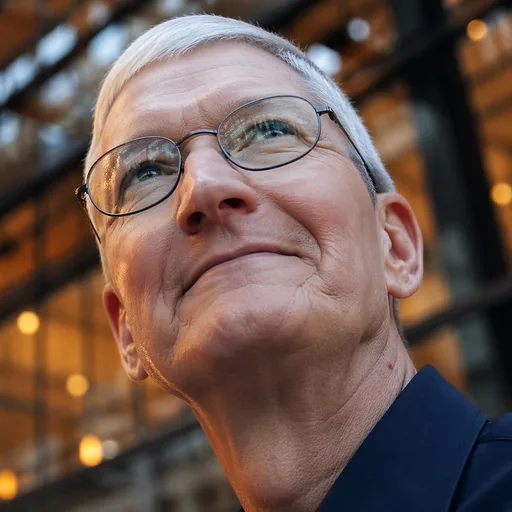
Tim Cook的谢幕:一封关于邮件的信、一个四万亿美元的交接、和苹果第三纪元的开始
Tim Cook Steps Down; John Ternus Takes Apple Over
About this story
Tim Cook hands Apple's $4 trillion empire to John Ternus, ending a 15-year era and opening the company's third chapter. HSK 5-6 Chinese listening practice.
This is an HSK 5-6 Chinese listening episode that runs about 7 minutes. The full Mandarin script is shown with tap-for-pinyin and a line-by-line English translation, so you can listen and read at once — comprehensible input in the sense of Stephen Krashen's i+1 theory. It teaches 12 key vocabulary words such as 苹果、市场、利润 and walks through 3 grammar patterns, each explained in English with examples. The same news story is retold at 4 difficulty levels — use the level selector above to find the version that is challenging but still understandable for you.
Read at your level
原文Read the complete story in Chinese. Reveal pinyin and English only when you need them.
English transcript reference
When it comes to Apple, it has had only two CEOs in the past twenty years.
Yesterday, the third one arrived.
Tim Cook officially announced he will step down as Apple CEO on September first this year.
His successor is John Ternus, Apple's Senior Vice President of Hardware Engineering.
Cook will transition to executive chairman.
This is the power transfer at the world's most valuable company.
Four trillion dollars.
Over two billion active devices.
Hundreds of thousands of employees.
A supply chain spanning three continents.
A CEO change, at a company of this scale, is not a personnel move.
It is the dividing line of an era.
Cook's farewell letter is a very interesting text.
He didn't list financial data.
Didn't boast about market cap growth.
He talked about emails.
He said for fifteen years, the first thing he did every morning was read user letters.
Someone wrote that Apple Watch detected a heart irregularity, called emergency services, and saved his life.
Someone wrote that they captured the most beautiful photo of their life on a mountain top with iPhone.
Someone wrote that FaceTime let them see their father's face one last time before he passed.
Cook said these emails are the most precious thing from his fifteen years.
Not the stock price.
Not the applause at product launches.
But those genuine, intimate thank-yous from strangers.
This way of expressing himself is very "Cook."
He was never a stage-type leader.
Not Jobs's kind of natural orator.
Not Musk's kind of controversy machine.
He is a quiet, systematic, detail-obsessed operator.
His superpower isn't imagination.
It's execution.
And he chose to summarize his fifteen years with emails.
Not with numbers.
This itself tells you what kind of person he is.
Now let's look at the legacy of these fifteen years.
The financial numbers don't need much explanation.
Annual revenue grew from just over 100 billion in 2011 to over 400 billion now.
Market cap grew from about 300 billion to four trillion.
Apple became the first four-trillion-dollar company in human history.
These numbers have almost no precedent in business history.
But what are the truly defining decisions of the Cook era?
I would say there are three.
The first is custom chip design.
Apple announced in 2020 it would abandon Intel and move to its own ARM-architecture chips.
The M-series and A-series chips gave Apple's Mac lineup a decisive lead in performance and efficiency.
This decision wasn't made by Cook alone.
But he approved it.
He bore the risk.
He bet on a new path when it was uncertain whether Intel would bounce back.
Six years later, this may be Apple's most correct technical decision of the decade.
The second is the strategic rise of services.
Cook transformed Apple from a pure hardware company into a hardware-plus-services hybrid.
Apple TV+, Apple Music, iCloud, Apple Pay, App Store.
These services together contribute over 100 billion in annual revenue.
And their profit margins are far higher than hardware.
This means even if iPhone sales have a bad year.
Apple still has a stable, high-margin revenue base.
This business model resilience was built by Cook.
The third is global supply chain management.
Before becoming CEO, Cook was Apple's COO.
His greatest skill is supply chain.
Under his management Apple can produce and deliver hundreds of millions of devices on time every year.
This scale of precise execution is achievable by only a handful of companies worldwide.
But the Cook era also left some unresolved questions.
AI is the biggest one.
While OpenAI, Google, and Meta compete fiercely on large language models.
Apple's Apple Intelligence has been criticized as "too conservative," "too late," "not aggressive enough."
Siri to this day remains something most users mock.
Apple's position in generative AI is far below its position in chips and hardware.
The China market is another.
Huawei's return put Apple under unprecedented competition in China's premium phone market.
Market share has been declining continuously for the past two years.
And Apple's dependence on Chinese manufacturing makes this problem even more complicated.
You need Chinese factories to produce.
But Chinese competitors are beating you using the methods you taught them.
This is a structural contradiction.
Vision Pro is another unresolved question.
Technically very advanced.
But market acceptance fell far below expectations.
Pricing too high.
Content ecosystem insufficient.
Will it become Apple's version of Google Glass?
Or will it find its place in the next generation product?
Ternus must answer this question.
John Ternus is fifty-one.
Joined Apple in 2001.
A twenty-five-year insider.
Hardware Engineering SVP since 2021.
He was involved in iPad's early development.
He led the birth of AirPods.
He oversaw all hardware iterations of iPhone, Mac, Apple Watch in recent years.
He is an engineer.
Not a performer.
Choosing him over someone with an AI or services background.
Shows Apple's board believes hardware remains the company's core.
Jo-Ellen Pozner's analysis is direct.
She says this means Apple is "doubling down on hardware."
Maybe in the coming years we'll see new device categories.
Maybe foldable screens.
Maybe lightweight AR glasses.
Maybe things we can't yet imagine.
But Jason Snell pointed out a longer-term challenge.
Apple's dependence on Chinese manufacturing "will take decades to resolve."
This isn't something one CEO can complete in one tenure.
Ternus needs to start.
But won't finish it.
Cook chose a very elegant way to leave.
Not forced out during a crisis.
Not having to leave due to health issues.
Actively passing the baton at the company's best moment.
Market cap at an all-time high.
Product lines complete.
Financially healthy.
Team stable.
This is the best gift a CEO can give their successor.
Jobs couldn't do this back then.
He passed the baton from a hospital bed.
Cook had the chance to do it more gracefully.
He did it.
From Jobs to Cook was one kind of handoff.
From "irreplaceable genius" to "efficient executor."
From Cook to Ternus is another kind of handoff.
From "operations master" to "product engineer."
Each handoff redefines this company's character.
Jobs-era Apple was an artist.
Cook-era Apple was a businessman.
What will Ternus-era Apple be?
Maybe an engineer.
A builder.
A maker in the truest sense.
That remains to be seen.
But regardless.
Apple's third era has begun.
Listen again
Try it without the transcript and notice what sounds clearer.
What vocabulary does this episode teach?
词汇The world's most valuable tech company. Makes iPhone, Mac, etc.
HSK 1-4. market.
HSK 1-4. profit.
HSK 1-4. factory.
HSK 1-4. commerce; commercial.
HSK 1-4. income.
The top boss of a company.
To leave an official position.
To take over a position from someone.
A board position above CEO but not in daily operations.
Total value of a company on the stock market.
Physical products you can touch (phones, computers, etc).
* beyond level超纲词
What grammar patterns appear in this episode?
语法Proper nouns
专有名词Sources
来源Free account
Keep learning from this story
Create a free account to keep saved words and your preferred level together.
- Keep words with their story context
- Remember your preferred level
- Build your vocabulary over time