
A Chinese podcast · Same story, 4 levels
洛杉矶女议员拒绝“性小屋”提议
LA Councilmember Traci Park Rejects “Public Sex Huts” Proposal
About this story
A Los Angeles proposal for public sex huts, Traci Park's blunt rejection, and the city's 45,194 homeless residents. HSK 5-6 Chinese listening practice.
This is an HSK 5-6 Chinese listening episode that runs about 5 minutes. The full Mandarin script is shown with tap-for-pinyin and a line-by-line English translation, so you can listen and read at once — comprehensible input in the sense of Stephen Krashen's i+1 theory. It teaches 18 key vocabulary words such as 建议、问题、讨论 and walks through 6 grammar patterns, each explained in English with examples. The same news story is retold at 4 difficulty levels — use the level selector above to find the version that is challenging but still understandable for you.
Read at your level
原文Read the complete story in Chinese. Reveal pinyin and English only when you need them.
English transcript reference
In August 2026, Los Angeles councilmembers held a meeting.
Many people were at the meeting place, including reporters and homeless people.
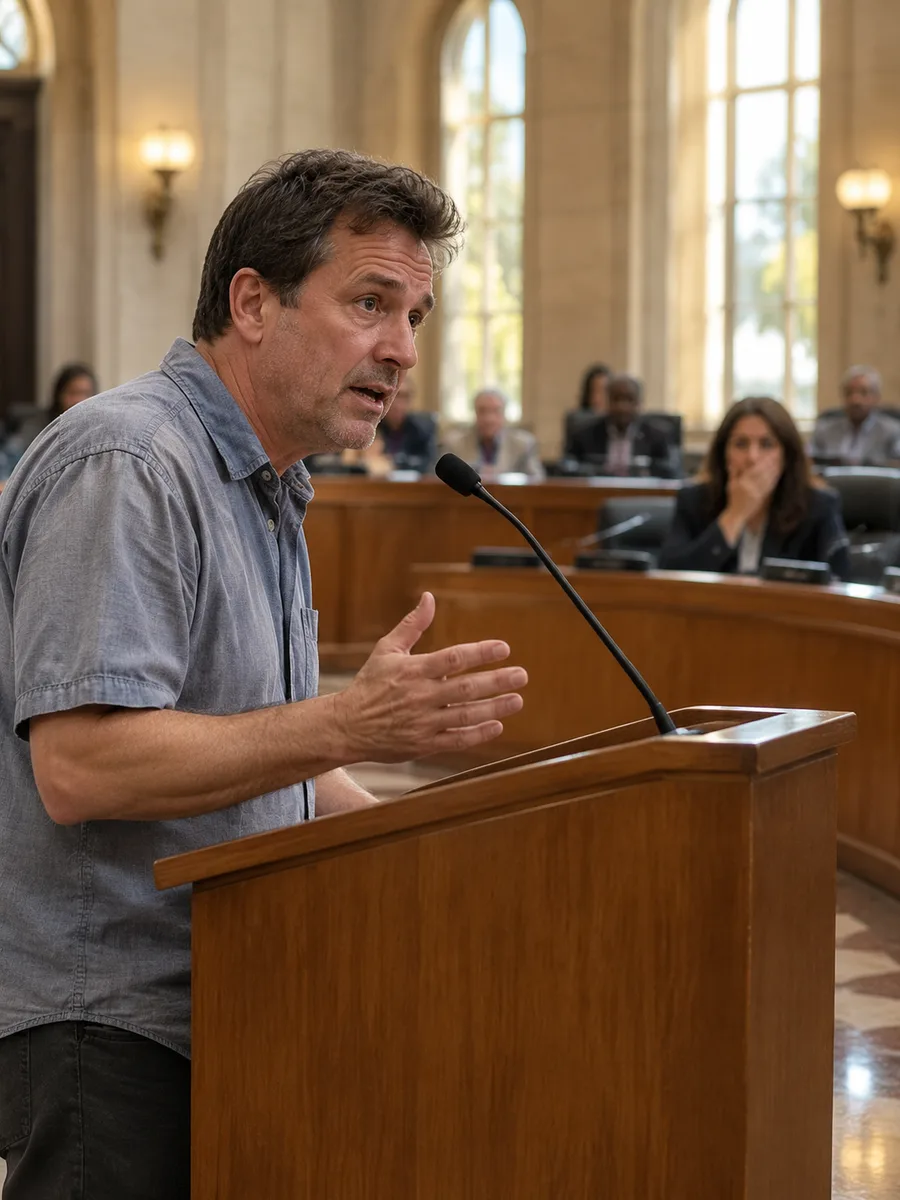
A man walked to the front and made a suggestion that surprised many people.
He said Los Angeles could use taxpayers' money to open free clinics for homeless people.
These clinics would have private rooms where homeless people could obtain sexual release.
He explained that sexual release could be alone, or with another person, with both people's consent.
He believed sexual release could reduce stress and improve mood.
He also said rich and poor people could have the same opportunity.
He said this is equality.
After he finished, some people laughed, and some disagreed.
Someone made his words into a video, and many people are watching it.
The video is very short but very clear.
Los Angeles Councilmember Traci Park saw this video.
The place where she works is Venice Beach.
She posted a video titled 'Things That Only Happen in Los Angeles.'
She said: no, we are not doing public sex huts.
She said the councilmembers are not discussing this suggestion.
She did not laugh; her face was very serious.
She said this is not a joke.
The person who made this suggestion is just an ordinary person, not a councilmember.
Los Angeles's homelessness problem has lasted for many years.
Statistics from 2026 say Los Angeles has 45,194 homeless people, and Los Angeles County has 73,040.
These 45,000 people all want a home.
The 73,040 people in the county also want a home.
Five years ago, Los Angeles passed a rule banning homeless people from living in tents in parks.
This rule has been in place for five years.
During those five years, many people still had no home.
Five years later, councilmembers decided to lift the tent restrictions at more than twelve parks and public spaces.
Those more than twelve parks are only a few of Los Angeles's many parks.
Ten councilmembers agreed with this decision, and three opposed it.
Los Angeles has fifteen councilmembers.
Park was not among the ten who agreed.
Traci Park, Imelda Padilla, and Monica Rodriguez voted against it.
Park said: we have already spent billions of dollars on housing and services for homeless people.
The people of Los Angeles have put up a lot of money.
They have the right to expect results.
Billions of dollars still have not solved this problem.
These few sentences brought a strange suggestion back to a larger problem: people without homes want homes, not sex huts.
Many media outlets are also discussing this video.
It shows that one person's words can quickly become known to many people.
On August 28, 2026, this video was seen by many people.
Why would this suggestion make a city nervous?
The reason may be in the numbers.
Los Angeles County has more than 70,000 homeless people, but the city has very few places to live.
Living in tents in parks is still a problem many people discuss.
Supporters say homeless people also need a place to sleep.
Opponents say parks must be safe and quiet for the people who live there, and accessible.
Many people liked her video, not only because she said no to sex huts, but also because she showed more people a larger problem: people without homes want homes, not sexual services.
This sentence is very simple, but very difficult.
Some people say this is a good suggestion.
More people say this is not a joke.
They believe people without homes first need a place to sleep.
Sexual health is also important, but it is not the most urgent problem right now.
For people without homes, where to sleep tonight is more important than sex.
Whether there will be work tomorrow, and whether there will be money next week, are also things they think about every day.
These problems cannot be solved by a clinic.
Housing, work, doctors, and mental health — all these problems are connected.
To solve them, money, politics, and a multi-year plan are all important.
A video cannot solve these problems.
But it can change the way many people discuss the problem.
This may be the great role of Traci Park's video.
She did not talk about a complex plan; she simply rejected a suggestion she considered strange.
But many people agree with her because they feel the same way.
They see tents every day, and they see the government spend a lot of money on housing without obvious results.
But this matter also tells us: in a democracy, everyone can speak at a meeting, but what one person says is not law.
A suggestion only becomes policy when many councilmembers agree.
That is why Park specifically said the councilmembers are not discussing this suggestion.
Without that sentence, many people might think Los Angeles is really discussing public sex huts.
Many people do not know this distinction.
When they see the video, they think Los Angeles is implementing public sex huts.
A video can make people aware of one thing, and it can also keep them from knowing the real situation.
A short video can be seen by many people faster than a policy document.
But this does not mean the video has no value.
It got many people discussing a local news story and showed more people how serious the homelessness problem is.
For Los Angeles, a very big problem is not public sex huts; it is that 45,000 people have no home.
What they want is not a clinic, but a home they can live in for many years.
A home is safety, respect, and a new beginning.
This is not a problem a video can solve.
But a video can get more people to discuss it.
This may be the role of this video.
The next time someone makes a strange suggestion at a meeting, we can first ask: whose suggestion is this, and will the councilmembers really agree to it?
In Los Angeles parks, the tents are still there.
People without homes are still waiting for a real home.
Listen again
Try it without the transcript and notice what sounds clearer.
What vocabulary does this episode teach?
词汇HSK 4. A suggestion or piece of advice. 一个让很多人吃惊的建议 = a suggestion that surprised many people.
HSK 2. A problem or question. 无家可归问题 = the homelessness problem.
HSK 3. To discuss. 没有在讨论这个建议 = are not discussing this suggestion.
HSK 2. A place. 她工作的地方 = the place where she works; 睡觉的地方 = a place to sleep.
HSK 2. A public park. 在公园里住帐篷 = live in tents in parks.
HSK 3. To agree. 两个人都同意 = both people consent; 十个议员同意 = ten councilmembers agreed.
HSK 3. To solve a problem. 解决这个问题 = solve this problem.
HSK 2. To hold an opinion: 认为 + clause = believe that. 他认为… = he believed that...
HSK 2. An affair or matter. 这个事情也告诉我们 = this matter also tells us.
HSK 2. Possible or perhaps. 原因可能在数字里 = the reason may be in the numbers.
HSK 4. Equality or equal treatment. 他说,这就是平等 = he said this is equality.
Beyond HSK 5. An elected member of a council or legislature. 洛杉矶的议员 = Los Angeles councilmembers.
Beyond HSK 5. A video. 这段视频很短 = this video is very short.
Beyond HSK 5. A person who pays taxes. 纳税人的钱 = taxpayers' money.
Beyond HSK 5. A clinic or small medical office. 不要钱的诊所 = free clinics.
Beyond HSK 5. Literally 'no home to return to'. 无家可归的人 = homeless people.
Beyond HSK 5. A tent. 在公园里住帐篷 = live in tents in parks.
Beyond HSK 5. A place open to the public. 公园和公共场所 = parks and public spaces.
* beyond level超纲词
What grammar patterns appear in this episode?
语法可以 + 动词
可以 before a verb says something is possible or permitted: 'can' or 'may'.
洛杉矶可以拿纳税人的钱,为无家可归的人开一些不要钱的诊所。
我们可以在开会的时候说话。
不只是…,也…
不只是…,也… means 'not only..., but also...'. The second clause adds a further reason or fact.
不只是因为她说不要性小屋,也因为她让更多人看到一个更大的问题。
如果…,…
如果 introduces a condition ('if'). The result or question comes in the second clause.
如果没有这句话,很多人可能觉得洛杉矶真的在讨论公共性小屋。
当…的时候
当…的时候 means 'when...' and frames the time of the main action.
当下一次有人在开会的时候说出奇怪的建议,我们可以先问:这是谁的建议,议员们真的会同意它吗?
对…(来)讲
对…来讲 means 'for someone' or 'from someone's point of view'. It puts the person first, then the judgment.
对没有家的人来讲,今天晚上在什么地方睡觉,比性更重要。
要…,才…
要…,才… says that only if the first condition is met does the second result follow: 'must..., only then...'.
一个建议要有很多议员同意,才是政策。
Proper nouns
专有名词Sources
来源- L.A. councilwoman shoots down 'sex huts' for the homeless
- 'Public sex hut' program proposed during Los Angeles City Council meeting
- Wild proposal in city council meeting aimed at creating public 'sex huts' for LA homeless
- Public 'S*x Huts' for Homeless? LA Councilmember Traci Park's Blunt Response Goes Viral
Free account
Keep learning from this story
Create a free account to keep saved words and your preferred level together.
- Keep words with their story context
- Remember your preferred level
- Build your vocabulary over time