
A Chinese podcast · Same story, 4 levels
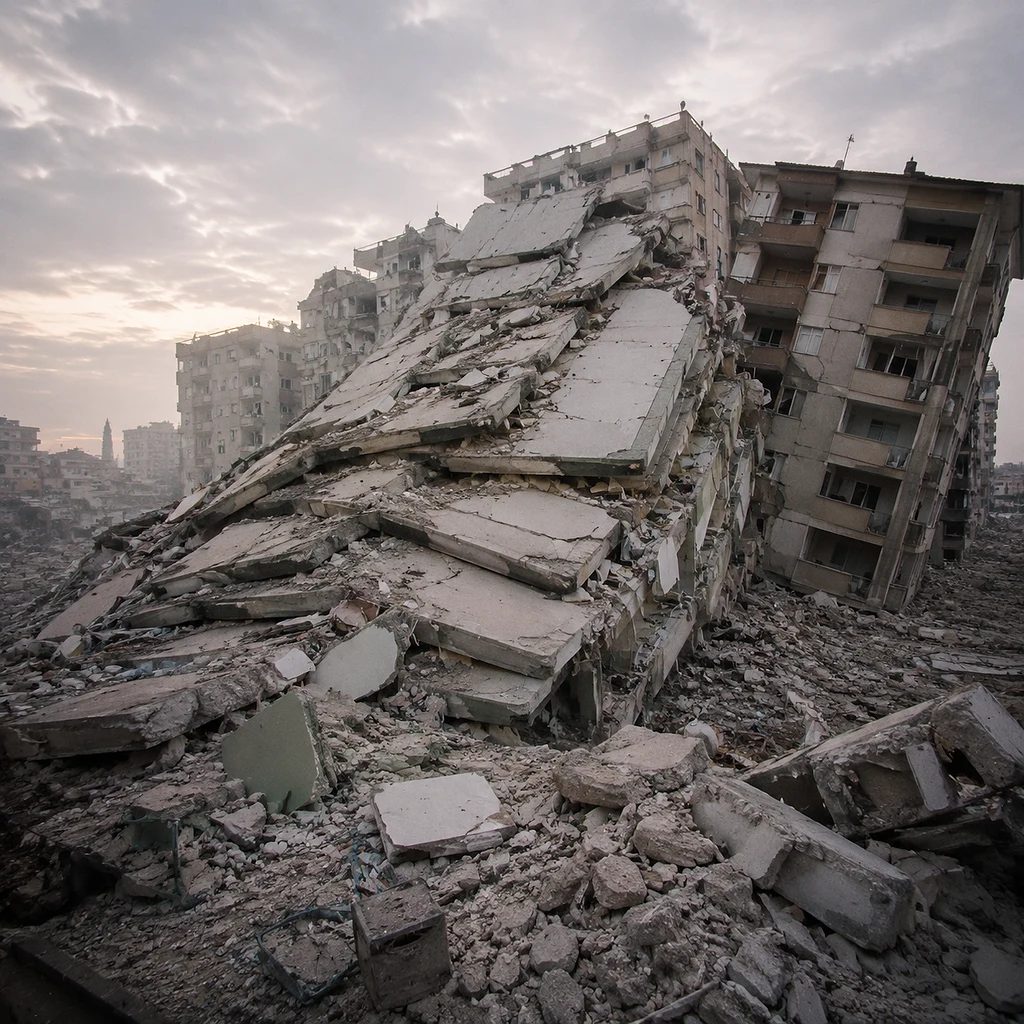
39秒里的两次大地震:委内瑞拉,为什么伤亡这么大?
Venezuela Earthquake: Two Quakes in 39 Seconds
About this story
The June 2026 Venezuela earthquakes explained: twin quakes 39 seconds apart, Caracas high-rises collapsing, the fragile buildings behind the toll, the golden 72 hours, and the global rescue. HSK 2 Chinese listening practice.
This is an HSK 2 Chinese listening episode that runs about 3 minutes. The full Mandarin script is shown with tap-for-pinyin and a line-by-line English translation, so you can listen and read at once — comprehensible input in the sense of Stephen Krashen's i+1 theory. It teaches 14 key vocabulary words such as 难过、为什么、旁边 and walks through 7 grammar patterns, each explained in English with examples. The same news story is retold at 4 difficulty levels — use the level selector above to find the version that is challenging but still understandable for you.
Read at your level
原文Read the complete story in Chinese. Reveal pinyin and English only when you need them.
English transcript reference
Today we'll talk about a deeply saddening event.
Just this month, a big earthquake struck a country.
That country is Venezuela — far from China, on the other side of the globe.
It was evening; many people had just gotten home.
No one expected a great earthquake to come.
And it came not once, but twice.
The first quake was big; about forty seconds later, the second was even bigger.
Together, the ground kept shaking for over a minute.
An earthquake this big and this long, buildings can hardly withstand.
Hardest hit were the capital and the nearby coastal city.
The capital is a big city called Caracas.
It has many tall, large buildings.
When the quake hit, some high-rises collapsed in an instant.
One building had more than twenty floors.
After the quake, the whole building was gone.
The people inside had no time at all to escape.
So far, this earthquake has killed more than a thousand people.
Several thousand more were injured.
Even more heartbreaking: many, many people are buried below and still cannot be found.
So, a question arises.
Why did this earthquake kill so many people?
Experts say the quake's size is one reason.
But there's another reason, even sadder.
It's that many buildings there were simply not built sturdily.
Some were very old; some were built too fast and poorly.
So when the big quake hit, they couldn't hold.
After an earthquake, the most important thing is saving people.
Because for those buried below, the more time passes, the smaller the chance of survival.
So the first three days are especially, especially important.
These three days are often called the 'golden 72 hours'.
To make the most of them, many countries around the world came to help.
They sent rescue teams, brought machines and dogs, and searched together for those still alive.
At this point, I'd like to talk with you.
This happened in a faraway place.
It seems we're just watching distant news.
But this time, among the dead were eight Chinese people.
You see, the world's events are often not so far away.
Finally I want to ask you a question.
Earthquakes, fires — these we rarely think about day to day.
But if one day it really comes, would you know what to do?
Listen again
Try it without the transcript and notice what sounds clearer.
What vocabulary does this episode teach?
词汇HSK 3 考纲词. 一件很让人难过的事 = a deeply saddening event.
HSK 1-2. why.
HSK 1-2. side / beside.
HSK 1-2. problem / question.
HSK 1-2. news.
HSK 1-2. hour.
HSK 1-2. place.
一个国家发生了很大的地震 = a big earthquake struck a country.
这个国家叫委内瑞拉,在地球的另一边 = the country is Venezuela, on the other side of the globe.
在地球的另一边 = on the other side of the globe.
受伤最重的,是首都 = hardest hit was the capital.
首都是一个很大的城市,叫加拉加斯 = the capital is a big city called Caracas.
又高又大的楼 = tall, large buildings; 有一栋楼 = there was a building.
有的高楼,一下子就塌了 = some high-rises collapsed in an instant.
* beyond level超纲词
What grammar patterns appear in this episode?
语法谁也没想到 ... (no one expected...)
Sets up a sudden, unforeseen event.
谁也没想到,大地震来了。
不是一次,而是两次 (not once, but twice)
不是 X,而是 Y corrects to the real situation.
它一来就是两次。
Verb + 不住 / 顶不住 (cannot withstand)
Verb + 不 + complement = unable to.
房子很难顶得住。
它们就顶不住了。
越 ... ,就越 ... (the more..., the more...)
Co-varying quantities.
时间越长,活下来的机会就越小。
被叫做 / 被埋 (passive with 被)
Marks the subject as acted upon.
常常被叫做黄金七十二小时。
被埋在下面。
为了 + Goal (in order to)
States purpose.
为了抢这三天,全世界很多国家,都来帮忙了。
如果有一天 ... ,你知道怎么做吗?(if one day..., would you know what to do?)
A hypothetical question for the close.
但如果有一天,它真的来了,你知道自己应该怎么做吗?
Proper Nouns
专有名词Free account
Keep learning from this story
Create a free account to keep saved words and your preferred level together.
- Keep words with their story context
- Remember your preferred level
- Build your vocabulary over time