
A Chinese podcast · Same story, 4 levels
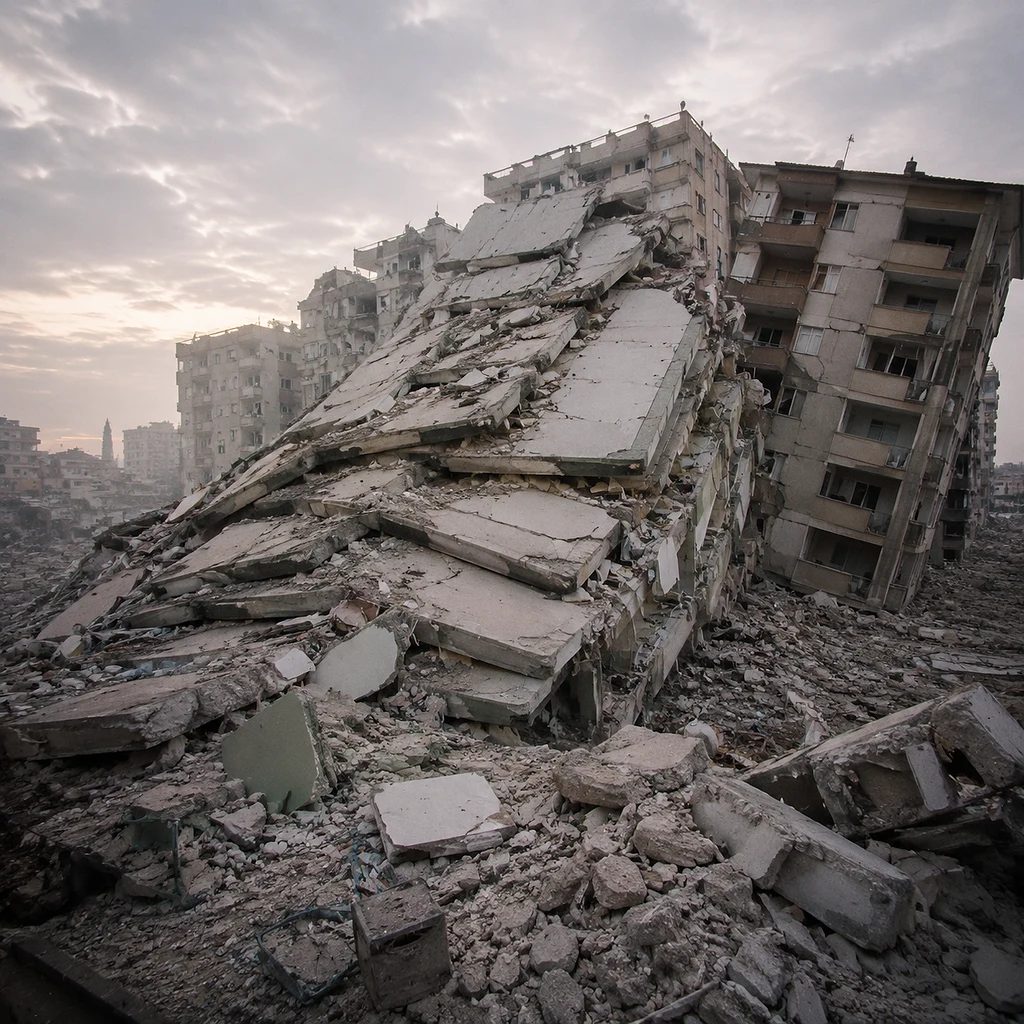
39秒,两次强震,上千生命:委内瑞拉地震,是天灾,还是人祸?
Venezuela Earthquake: Two Quakes in 39 Seconds
About this story
Advanced Chinese listening practice. A reflective account of the June 24 2026 Venezuela earthquakes: the twin Mw 7.2/7.5 quakes, the pancake collapse of Caracas high-rises, the soft-story buildings and weak construction behind the toll, the golden rescue window, the global response, and the question of 天灾 versus 人祸. HSK 5-6 Chinese listening practice.
This is an HSK 5-6 Chinese listening episode that runs about 4 minutes. The full Mandarin script is shown with tap-for-pinyin and a line-by-line English translation, so you can listen and read at once — comprehensible input in the sense of Stephen Krashen's i+1 theory. It teaches 14 key vocabulary words such as 专业、标准、质量 and walks through 7 grammar patterns, each explained in English with examples. The same news story is retold at 4 difficulty levels — use the level selector above to find the version that is challenging but still understandable for you.
Read at your level
原文Read the complete story in Chinese. Reveal pinyin and English only when you need them.
English transcript reference
Today we'll talk about a heavy matter — the great earthquake that just struck Venezuela.
Venezuela lies in northern South America, half a world away from us.
Yet this time, its pain made the whole world hold its breath.
It happened on the evening of June 24th.
It was the most ordinary moment of the day — people leaving work, heading home, preparing dinner.
And yet, in that instant, the earth beneath their feet began, without warning, to shake violently.
What was truly deadly was the earthquake's 'rhythm'.
It came not once but twice: first a magnitude 7.2, then, just thirty-nine seconds later, a fiercer 7.5 right behind it.
The two surges of energy stacked together, keeping the ground shaking for over a minute.
It is the strongest earthquake Venezuela has suffered since 1900.
And its deadliest blow fell on the most densely populated areas — the capital, Caracas, and the adjacent port city of La Guaira.
Caracas is a bustling metropolis, its downtown bristling with high-rises.
When the quake struck, several high-rises collapsed thunderously, like toy blocks, before everyone's eyes.
One of them, a building of more than twenty floors, was razed to the ground in mere seconds.
The residents inside had no time even for a word of farewell.
As of now, the disaster has claimed more than 1,400 lives.
Over three thousand are injured, and tens of thousands displaced.
Most agonizing of all, tens of thousands remain buried deep under the rubble, their fate unknown.
And so a heavy question confronts us: why was this earthquake so deadly?
The sheer energy of the quake is, to be sure, one reason.
But almost every expert points to another, more painful truth — the buildings.
People often say: what kills is usually not the earthquake, but the architecture.
A great many of the local buildings were flawed from the start.
Some were old and neglected; others were thrown up in a years-ago building boom that sacrificed quality for speed and quantity.
There is also an especially dangerous design: the ground floor hollowed out into a parking lot or shops, leaving a wide, open space.
When such a building meets a strong quake, the upper floors lose their support and pancake down, layer upon layer, like stacked biscuits — the very culprit that buried countless people.
Seen this way, this tragedy is, I fear, not merely a 'natural disaster'.
After an earthquake, time itself is life.
For those trapped under the rubble, every passing hour dims the hope of survival a little more.
And so the first seventy-two hours after a disaster — the 'golden rescue window' — are a race against every second.
To race against death, the whole world moved quickly.
Mexico, Spain, France, the UK, Chile — dozens of countries — sent professional rescue teams at once.
With search dogs and life-detection devices, they comb the mountains of rubble inch by inch for any faint sign of life.
Speaking of this, I want to talk with you about a deeper layer.
A disaster like this, on the far side of the globe, seems to have no intersection with our lives.
But on the list of this earthquake's victims are the names of eight Chinese compatriots.
In that moment you suddenly realize: in today's world, no one is truly an island.
At the end of the show, I want to leave you two questions.
First, we habitually call earthquakes 'natural disasters'.
But when fragile buildings bury people who could have survived, how much of it is really an avoidable 'man-made disaster'?
Second, disaster always happens 'elsewhere' — until, one day, it arrives.
If that moment truly comes, are you and the ones you love really prepared?
These two questions have no standard answer.
But they are worth our — yours and mine — serious reflection.
Listen again
Try it without the transcript and notice what sounds clearer.
What vocabulary does this episode teach?
词汇HSK 1-4. major / specialty / field of study.
HSK 1-4. standard.
HSK 1-4. quality.
HSK 1-4. fragile; vulnerable.
HSK 1-4. city.
HSK 1-4. country.
HSK 1-4. world.
让整个世界都屏住了呼吸 = made the whole world hold its breath.
毫无征兆地剧烈摇晃起来 = began to shake violently without any warning.
更猛烈的七点五级紧随而至 = a fiercer magnitude 7.5 followed right behind.
落在了人口最密集的地方 = fell on the most densely populated areas.
数栋高楼…轰然倒塌 = several high-rises collapsed thunderously.
上万人流离失所 = tens of thousands displaced.
被深埋在废墟之下,生死未卜 = buried deep under the rubble, their fate unknown.
* beyond level超纲词
What grammar patterns appear in this episode?
语法然而就在这一刻,... (and yet, in that very moment...)
A dramatic pivot to the turning point.
然而就在这一刻,脚下的大地,毫无征兆地剧烈摇晃起来。
不是 X,而是 Y:... (not X but Y, namely...)
Corrects then specifies.
它不是一次,而是两次:先是一场七点二级的强震……
固然是 ... ,但 ... (is admittedly..., but...)
Concedes one point to stress another.
地震本身的能量巨大,固然是原因之一。但几乎所有专家都指向了另一个真相——房子。
一旦 ... ,便 ... (once..., then...)
Marks an irreversible trigger.
这样的楼一旦遭遇强震,上方楼层便会失去支撑。
从这个角度看,... (seen from this angle...)
Reframes to draw a conclusion.
从这个角度看,这场悲剧,恐怕不只是一场天灾。
没有谁是真正的 X (no one is truly X)
A universal statement for emphasis.
在今天这个世界,没有谁是真正的孤岛。
这两个问题,没有标准答案。但是它们,值得你我,认真地想一想。
The channel's signature normal-level close.
这两个问题,没有标准答案。但是它们,值得你我,认真地想一想。
Proper Nouns
专有名词Free account
Keep learning from this story
Create a free account to keep saved words and your preferred level together.
- Keep words with their story context
- Remember your preferred level
- Build your vocabulary over time