
A Chinese podcast · Same story, 4 levels
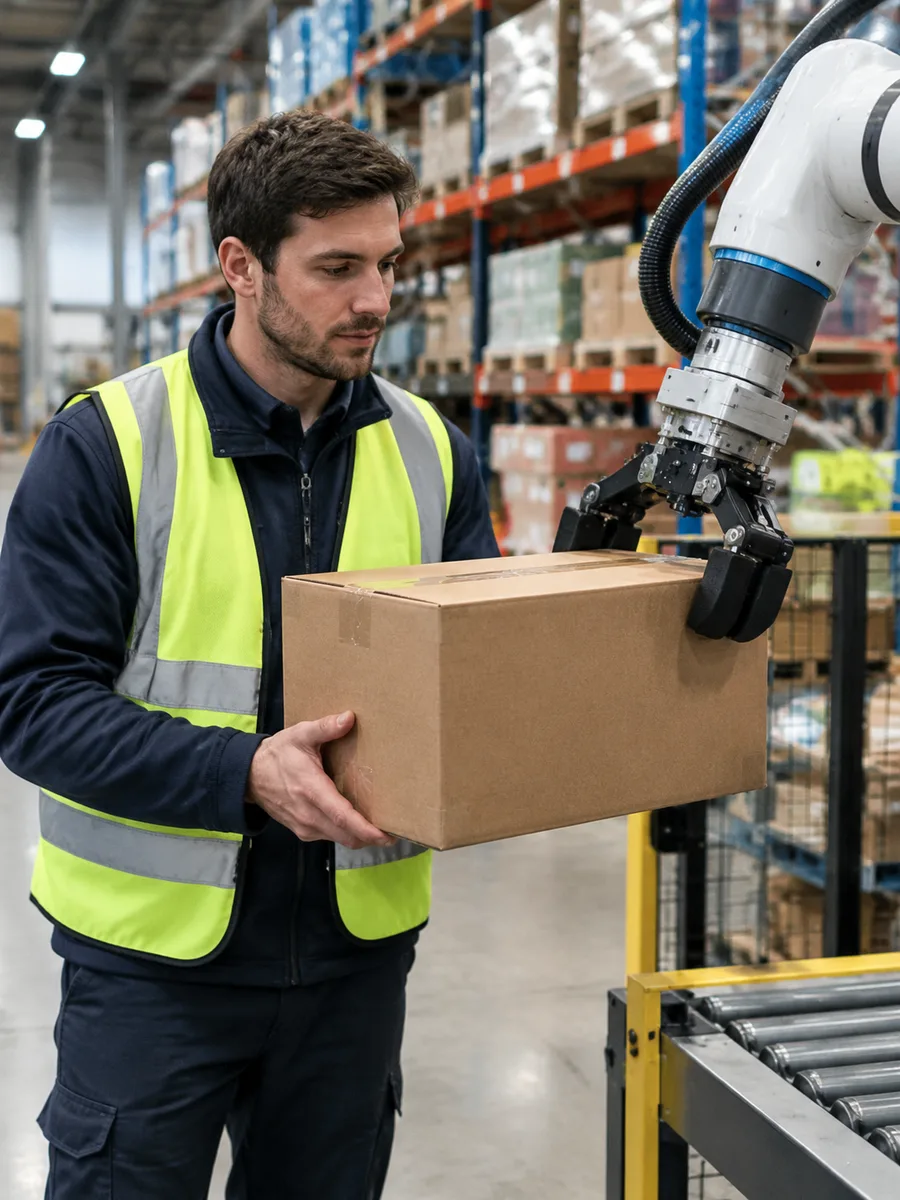
沃尔玛的机器人,为什么搬不好箱子?
Walmart Robots Struggle With Everyday Goods
About this story
HSK 1 Chinese listening. Walmart warehouse robots meet problems with boxes and frozen goods, while workers adapt packaging and keep goods moving.
This is an HSK 1 Chinese listening episode that runs about 3 minutes. The full Mandarin script is shown with tap-for-pinyin and a line-by-line English translation, so you can listen and read at once — comprehensible input in the sense of Stephen Krashen's i+1 theory. It teaches 12 key vocabulary words such as 东西、工作、可以 and walks through 4 grammar patterns, each explained in English with examples. The same news story is retold at 4 difficulty levels — use the level selector above to find the version that is challenging but still understandable for you.
Read at your level
原文Read the complete story in Chinese. Reveal pinyin and English only when you need them.
English transcript reference
Walmart bought robots, but people still have to move things.
Do you know Walmart?
Walmart is a very big store.
When you go to Walmart, you can buy many things.
But how do things get to the store?
These things have to come from a warehouse.
A warehouse is a big building for keeping things.
In your house, there are tables and chairs.
In the big building that is a warehouse, there are very many things.
These things need to go to many, many stores.
In the past, people moved these things.
Moving things means holding things and going to a place.
The things are in front, and you hold the things and go to the back — this is called moving things.
People move things, the things come to the store, and then you can buy things.
But there are too many things to move.
Walmart wants to use robots to move things.
A robot is a machine that can work.
The TVs and computers in your home are all machines.
Machines can help people work.
Walmart wants robots to help people move things.
With robots, what else do people have to do?
People still have to watch the boxes.
A box is a thing for holding things.
A big box can hold many things.
A small box can hold small things.
The boxes Walmart used for many years were very big.
But robots cannot use these big boxes.
Walmart needs to use new boxes.
The new boxes are smaller than before.
People have to use these new boxes to hold things.
Walmart bought robots, but people still have to check whether the boxes are good.
Only when the boxes are good can the robots' work go well.
But even when the boxes are good, there is still another problem.
Some things are too big, and the robots still cannot do the work well.
These big things still need people to move them.
Robots can also break down.
When broken, they cannot work well.
If the computer in your home breaks, you cannot use it to work.
If a robot breaks, people have to repair it.
Once repaired, the robot can work.
Now, Walmart's robots can do many jobs.
But even with robots, people still have to move things and repair machines.
Only when people do people's work well can robots do robots' work well.
Think about it: you want to buy things, but the robots in the warehouse break down — will you wait for someone to repair them, or ask someone to help?
Listen again
Try it without the transcript and notice what sounds clearer.
What vocabulary does this episode teach?
词汇HSK 1. A very common noun for physical things or belongings. In this script it appears many times: 搬东西, 买东西, 放东西.
HSK 1. Can be a noun or verb. Common phrases: 做工作, 找工作, 机器人工作.
HSK 1. Used before a verb to express ability or permission: 你可以买东西了.
HSK 1. A place where you buy things. In the script: 沃尔玛是一个很大的商店.
HSK 1. 电 (electric) + 脑 (brain). In the script: 你家里的电视、电脑,都是机器.
HSK 1. Used for knowing a person, place, or thing: 你认识沃尔玛吗?
A large building for storing goods. The script explains it as 放东西的大房子.
A machine that can work. 机器 (machine) + 人 (person). Central topic of the script.
To move something heavy or bulky from one place to another. The script defines it: 搬东西,是拿着东西,去一个地方.
A container for holding things. The script explains: 箱子,是放东西的东西.
To fix something broken. In the script: 机器人坏了,人要来修.
Describes something not working properly. In the script: 机器人也会坏.
* beyond level超纲词
What grammar patterns appear in this episode?
语法要 + Verb + 来 + Verb
Expresses necessity: something must be done in order to achieve a goal. 要 means 'need to', and 来 connects the means to the purpose.
这些东西,要从仓库来。
人要用这些新箱子来放东西。
沃尔玛想用机器人来搬东西。
是 + Noun + 的 + Noun
A simple definition pattern: 'A is a B that...' Used to explain what something is.
仓库,是放东西的大房子。
箱子,是放东西的东西。
Noun + 里,有 + Noun
Expresses existence: 'In [place], there is/are [thing].' 里 means 'inside'.
你的房子里,有桌子,有椅子。
仓库这个大房子里,有很多很多东西。
大箱子里,可以放很多东西。
Expresses that only under a certain condition can a result happen. 只有...才... means 'only if... then...'.
箱子好了,机器人的工作才会好。
人做好人的工作,机器人才能做好机器人的工作。
Proper nouns
专有名词Sources
来源Free account
Keep learning from this story
Create a free account to keep saved words and your preferred level together.
- Keep words with their story context
- Remember your preferred level
- Build your vocabulary over time