
A Chinese podcast · Same story, 4 levels
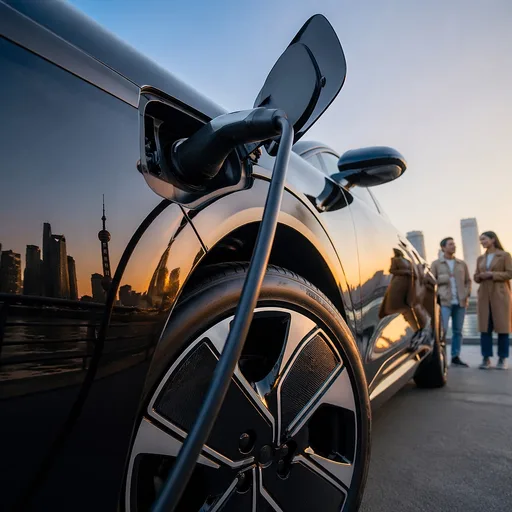
中国的电动车,为什么比特斯拉便宜?
Chinese EVs Beat Tesla on Manufacturing Cost
About this story
A simple story about Xiao Ming asking why Chinese cars are cheap — comparing China's car shops with Tesla in America. HSK 1 Chinese listening practice.
This is an HSK 1 Chinese listening episode that runs about 7 minutes. The full Mandarin script is shown with tap-for-pinyin and a line-by-line English translation, so you can listen and read at once — comprehensible input in the sense of Stephen Krashen's i+1 theory. It teaches 14 key vocabulary words such as 商店、告诉、觉得 and walks through 4 grammar patterns, each explained in English with examples. The same news story is retold at 4 difficulty levels — use the level selector above to find the version that is challenging but still understandable for you.
Read at your level
原文Read the complete story in Chinese. Reveal pinyin and English only when you need them.
English transcript reference
Speaking of buying cars, let's look at Xiao Ming.
Xiao Ming is a student.
He is also a person.
He wants to buy something.
What does he want to buy?
He wants to buy a car.
Because he wants to drive.
Drive to school.
Drive to work.
So, Xiao Ming goes to the store.
This store is very big.
There are many things in the store.
There are many cars in the store.
Xiao Ming is very happy.
He looks around inside the store.
He sees many cars.
There is a car in front.
There is also a car behind.
There is a car on the left.
There is also a car on the right.
Xiao Ming sees a red car.
This car is very beautiful.
This car is very new.
He also sees a white car.
That car is also very beautiful.
That car is also very new.
Xiao Ming likes both of them.
He wants to buy the red car.
He also wants to buy the white car.
But he can only buy one.
He asks the person at the store.
He says: "Hello."
"How much is this car?"
The store person says: "Hello."
"The red car costs very little."
"The white car costs a lot."
Xiao Ming hears this and really wants to know.
Why are they different?
Both cars are very good.
Both cars are very new.
Why does one cost little?
Why does one cost a lot?
Xiao Ming asks: "Why?"
The store person sits down.
He says to Xiao Ming: "I will tell you."
"There are three reasons here."
"The first reason is making the car."
"Making red cars, we make a lot."
"Look here."
"There are many red cars here."
"We make them every day."
"We make them in the morning, we make them in the afternoon."
"We made one hundred."
"We made one thousand."
"Making a lot makes it fast."
"Making a lot means the cost is low."
"This is a big principle."
"Think about it."
"You go buy apples."
"You buy one apple."
"The apple is expensive."
"You buy many apples."
"The apples are not expensive."
"Making cars is the same."
"White cars, we make few."
"So white cars are very expensive."
Xiao Ming listened and nodded.
He said: "I understand."
"Is there more?"
The store person said: "There is more."
"The second reason is the parts."
"Look at this car."
"What is inside the car?"
"There are seats in the car."
"There are computers in the car."
"There is glass in the car."
"Making red cars is different."
"These things are all made by ourselves."
"The people who make the car also make the seats."
"The people who make the car also make the computers."
"They don't go out to buy them."
"They make them themselves."
"Making them yourself costs very little."
"Look at the white car."
"Their seats are bought."
"Their computers are bought."
"Bought from other stores."
"Buying things costs a lot of money."
"So the white car is very expensive."
"Because they don't make it themselves."
Xiao Ming said: "Is this true?"
The store person said: "It is true."
"Cooking yourself costs very little."
"Eating at a restaurant costs a lot."
"That is the principle."
Xiao Ming said: "I understand."
"Is there more?"
The store person said: "There is one more."
"The third reason is people."
"Making cars needs people."
"Needs many people."
"For making red cars, the people are very good."
"There are many people here."
"They like to learn very much."
"They know how to make cars."
"They work very fast."
"But, they don't ask for much money."
"In China, there are many people."
"Everyone can work."
"Making white cars is different."
"The people there are few."
"The people there want a lot of money."
"If people want a lot of money."
"The car will cost a lot of money."
"This is also a reason."
Xiao Ming thought for a while.
He said: "So it is like this."
"It's not because the car isn't good."
"It is because they make a lot."
"It is because they make things themselves."
"It is because the people are different."
The store person says: "Correct."
"There is one more point."
"Some people say it's because others give money."
"It is because the government gives money."
"Actually, that's not right."
"The money given is very little."
"This is not the big reason."
"The big reason is making it oneself."
"The big reason is making a lot."
Xiao Ming is very happy.
He thinks the red car is very good.
He thinks this car is not expensive.
Does he have a lot of money?
He does not have a lot of money.
So he likes the car that costs little.
He says to the store person: "Thank you."
"I like the red car."
"I will buy this car."
"This car is very beautiful."
"This car is very good to drive."
"This car is not expensive."
Xiao Ming drove home.
He is very happy.
He tells his dad.
He tells his mom.
He says: "I bought a car."
"This car cost very little."
"Because we make a lot."
"Because we make it ourselves."
"Because the people are very good."
What is this story about?
It speaks of "electric cars".
That is, cars that don't use gas.
Chinese cars are very cheap.
Foreign cars are very expensive.
For example, Tesla.
Why are Chinese cars cheap?
Because they make a lot.
Because the parts are made by themselves.
This is not because the government gives money.
It is because the factories are very impressive.
Listen again
Try it without the transcript and notice what sounds clearer.
What vocabulary does this episode teach?
词汇A common place where goods are sold.
Used to introduce information given to someone.
Used to express an opinion or physical sensation.
Adjective describing something with a high price.
Adjective describing something with a low price.
Conjunction used to introduce a reason.
Verb meaning to comprehend something.
Noun referring to the explanation for why something happens.
Refers to the logic or truth behind something.
Material used for windows; here refers to car windows.
The governing body of a nation or state.
A place where goods are manufactured.
Adjective often used to praise someone's ability or describe something intense.
A specific term for vehicles powered by electricity rather than gasoline.
* beyond level超纲词
What grammar patterns appear in this episode?
语法This pattern expresses existence, meaning 'There is/are [Object] in/at [Place]'.
商店里有很多车 (There are many cars in the store)
前面有一个车 (There is a car in front)
A conjunction pair meaning 'Because ... therefore ...'. It connects a cause with its result.
因为他想开车 ... 所以,小明去商店 (Because he wants to drive... so Xiao Ming goes to the store)
因为做得多 ... 苹果就不贵 (Because you buy a lot... the apples aren't expensive)
The 'Complement of State' structure. It describes how an action is performed or the state resulting from the action.
做得多 (Make a lot / Made in large quantities)
工作很快 (Work very fast)
This construction emphasizes a specific detail (like the agent, time, or manner) of an action or state that is already known to exist.
东西是自己做的 (The things were made by ourselves)
是因为做得多 (It is because we make a lot)
Proper nouns
专有名词Sources
来源Free account
Keep learning from this story
Create a free account to keep saved words and your preferred level together.
- Keep words with their story context
- Remember your preferred level
- Build your vocabulary over time