
A Chinese podcast · Same story, 4 levels
漳州"泡药杨梅"事件:一颗水果背后的产业危机
Zhangzhou Bayberry Scandal Hurts Growers
About this story
Zhangzhou Bayberry Scandal Hurts Growers. HSK 4 Chinese listening practice.
This is an HSK 4 Chinese listening episode that runs about 6 minutes. The full Mandarin script is shown with tap-for-pinyin and a line-by-line English translation, so you can listen and read at once — comprehensible input in the sense of Stephen Krashen's i+1 theory. It teaches 12 key vocabulary words such as 季节、害怕、安全 and walks through 4 grammar patterns, each explained in English with examples. The same news story is retold at 4 difficulty levels — use the level selector above to find the version that is challenging but still understandable for you.
Read at your level
原文Read the complete story in Chinese. Reveal pinyin and English only when you need them.
English transcript reference
Today we'll talk about
a piece of news from May.
This news
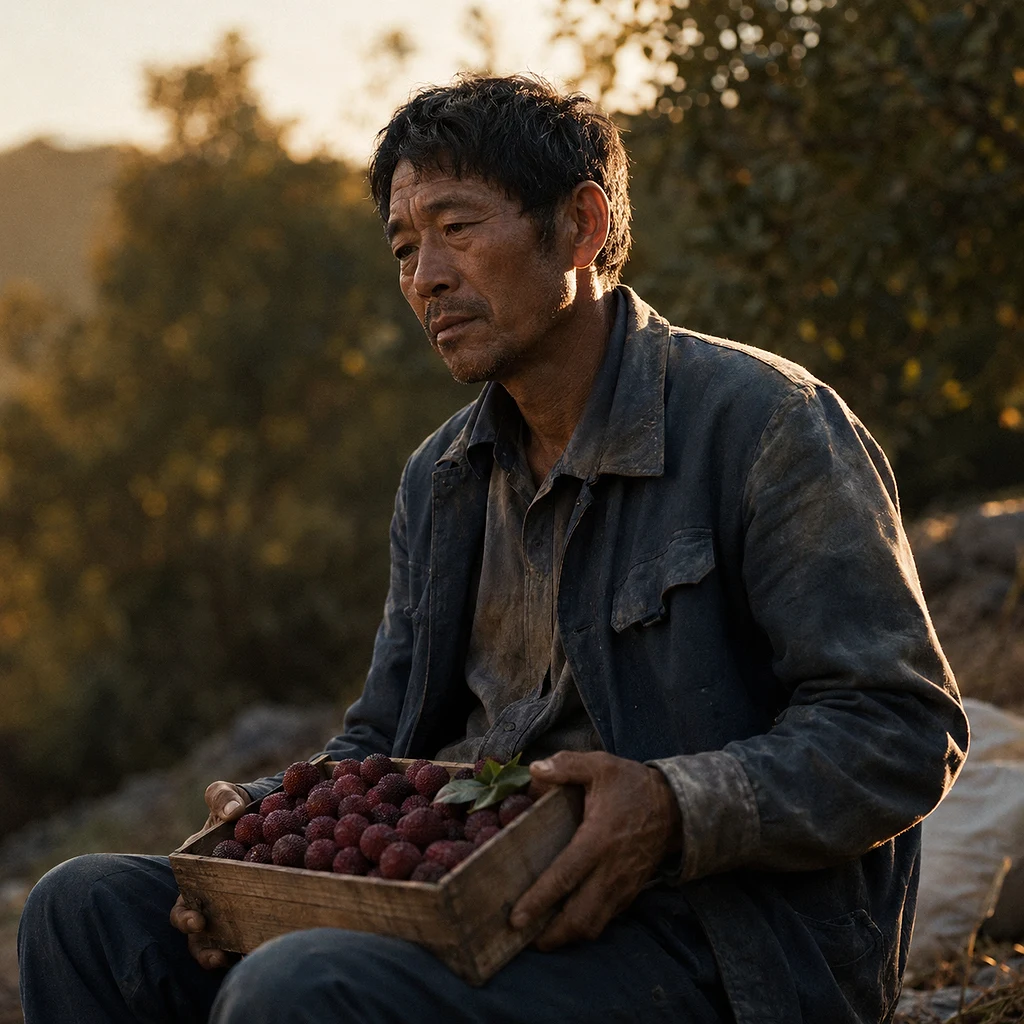
is about a kind of fruit —
yangmei (bayberry).
Have you eaten yangmei?
It's a fruit very characteristic
of southern China.
Red,
small,
both sweet and sour in flavor.
Every year from May to June
is yangmei's best season.
But yangmei has one trait,
and it is the key to this news:
it cannot be kept long.
After being picked from the tree,
in two or three days
it begins to go bad.
Because it cannot be kept,
selling yangmei becomes very hard.
If the road is long,
the yangmei is ruined;
if it doesn't sell,
the yangmei is also ruined.
So
the farmers who grow yangmei
are under enormous pressure.
For the whole year
they live off these few weeks.
Alright,
the background is done;
let's look at the news.
Around May 15,
CCTV and many media outlets
reported a story.
It happened in Fujian Province,
in Zhangzhou City's
Longhai District.
Specifically two towns:
Fugong Town and Baishui Town.
There are several places there
in the yangmei business.
We call them "procurement points."
A "procurement point"
is a middleman that, from farmers,
buys yangmei
and then sells it on.
The media discovered
that these procurement points
took the yangmei
and soaked it in a chemical liquid.
The "chemical liquid" here
was not actually medicine.
It was two kinds
of food additives.
The first
is called "dehydroacetic acid sodium" (脱氢乙酸钠),
a preservative —
something that keeps food from spoiling.
The second
was a bottle of sweetener —
a chemical that makes things taste sweeter.
And this bottle of sweetener
had no label,
no production date,
and no quality certificate.
Media call this kind of thing
a "three-no product" (三无产品).
According to state regulations,
both of these additives
are not allowed
to be used on fresh fruit.
So
what these procurement points did
was illegal.
As soon as the news came out,
the authorities reacted very fast.
On May 20
and 21,
Zhangzhou City issued
an official notice.
The notice said:
the confirmed
problem procurement points
were five in all.
On site,
225 kg of problem yangmei was seized,
along with more than 20 kg of additives.
And from the market,
540 kg was also recovered.
In the end:
twelve cases were filed,
five people were criminally detained.
"Criminal detention"
means the kind of handling that can land you in prison.
This matter
was handled fairly quickly.
But
the real trouble
was just beginning.
As soon as the news broke,
the whole yangmei market
collapsed.
In those days,
the whole country was saying:
"Yangmei has a problem.
"Don't buy it for now.
Think about it —
this was supposed to be yangmei's
most profitable few weeks.
Now, suddenly,
no one dares to buy.
Many livestream sellers
of yangmei
were notified of "illegal selling"
and had to refund consumers.
What hurts more is this:
those affected
were not only Zhangzhou.
Zhejiang also has lots of yangmei.
And Zhejiang yangmei
is more famous,
and had never had
this kind of problem at all.
But consumers,
seeing yangmei, were afraid;
they could not tell
which one was from Zhangzhou
and which from Zhejiang.
The result —
Zhejiang fruit farmers
also could not sell.
On May 23,
a Zhangzhou fruit farmer
was livestreaming online.
As he sold yangmei,
he cried.
He said
his family had grown yangmei for decades
and had never used 药水 (chemical liquid).
But because of this news,
all his yangmei
was stuck in his hands.
This video
made many people sad.
Speaking of this,
I want to share
a thought of my own.
What this matter
most makes one ask is:
why did it happen?
Why did the procurement points
take the risk
to use illegal additives?
The answer,
in fact, is related to yangmei
itself.
Yangmei's shelf life
is too short.
Two or three days and it's bad.
For procurement points
and people who transport it,
this is
a huge problem.
Illegal additives
can let the yangmei
last a few more days.
And the money
can be a bit more, too.
So this temptation
has always been there.
But illegal is illegal.
To earn a few more days' money
by making consumers eat unsafe things —
that is absolutely not okay.
More importantly,
this case teaches us:
in business,
the most valuable thing
is not the goods —
it's "trust."
A market's trust,
to build it,
takes many years;
to lose it
can take just
a few bad people.
And once trust is gone,
everyone is hurt —
including those
who did nothing wrong.
Finally I ask you:
when you buy things,
what do you care about the most?
Is it cheap?
Is it good-looking?
Or
whether you trust
the one selling?
Think about it.
Okay.
That's all for today.
Talk tomorrow.
Listen again
Try it without the transcript and notice what sounds clearer.
What vocabulary does this episode teach?
词汇Season. Every May-June is yangmei's best 季节, but only for a few weeks — the structural pressure behind the scandal.
To fear. 消费者看到杨梅就害怕 — 'consumers, seeing yangmei, were afraid' to buy, even from regions unrelated to the scandal.
Safe. The episode's hard line: 让消费者吃下不安全的东西,是绝对不可以的 — making consumers eat unsafe things is absolutely not okay.
To affect. 受影响的,不只是漳州 — those affected were not only Zhangzhou; the impact spread far wider.
Important. The closing turn: 更重要的是,这件事告诉我们 — 'more importantly, this case teaches us': the most valuable thing in business is trust.
Problem, question. Two-to-three-day shelf life is 一个非常大的问题 — a huge problem for collectors and transporters.
A procurement point. Beyond HSK3. The episode glosses it: 从农民那里收杨梅,再卖出去的中间商 — middlemen who buy from farmers and resell.
Additive (in food). Beyond HSK3. Two illegal 添加剂 were soaked into the yangmei: a preservative and an unlabeled sweetener.
Preservative. Beyond HSK3. The episode glosses it: 让食物不容易坏 — 'keeps food from spoiling.' 脱氢乙酸钠 is the specific one used.
A 'three-no product.' Beyond HSK3. The episode glosses it: no label, no production date, no quality certificate — zero accountability.
Criminal detention. Beyond HSK3. The episode glosses it: 会进监狱的那种处理 — 'the kind of handling that can land you in prison.'
Trust. Beyond HSK3. The episode's analytical core: 最值钱的东西,不是货,是"信任" — the most valuable thing is not goods, but trust.
* beyond level超纲词
What grammar patterns appear in this episode?
语法X 一出,Y
一 + verb marks a fast, immediate result — once X happens, Y follows at once. The episode uses it for how the news instantly collapsed the market.
新闻一出,整个杨梅市场,就崩了。
新闻一出来,官方反应非常快。
不只是 A,B 也…
Expands a claim from one example to a wider group. The episode uses it to show the damage spread beyond Zhangzhou.
受影响的,不只是漳州。
浙江也有很多杨梅。
对…来说 frames a statement from a specific viewpoint. The episode uses it to explain why the short shelf life is so painful for the middlemen.
对收购点和运输的人来说,这是一个非常大的问题。
为了 X,Y
为了 introduces a purpose, often a self-serving one being criticized. The episode uses it to call out the moral logic of the cheaters.
为了多赚几天的钱,让消费者吃下不安全的东西,是绝对不可以的。
Proper nouns
专有名词Free account
Keep learning from this story
Create a free account to keep saved words and your preferred level together.
- Keep words with their story context
- Remember your preferred level
- Build your vocabulary over time