
A Chinese podcast · Same story, 4 levels
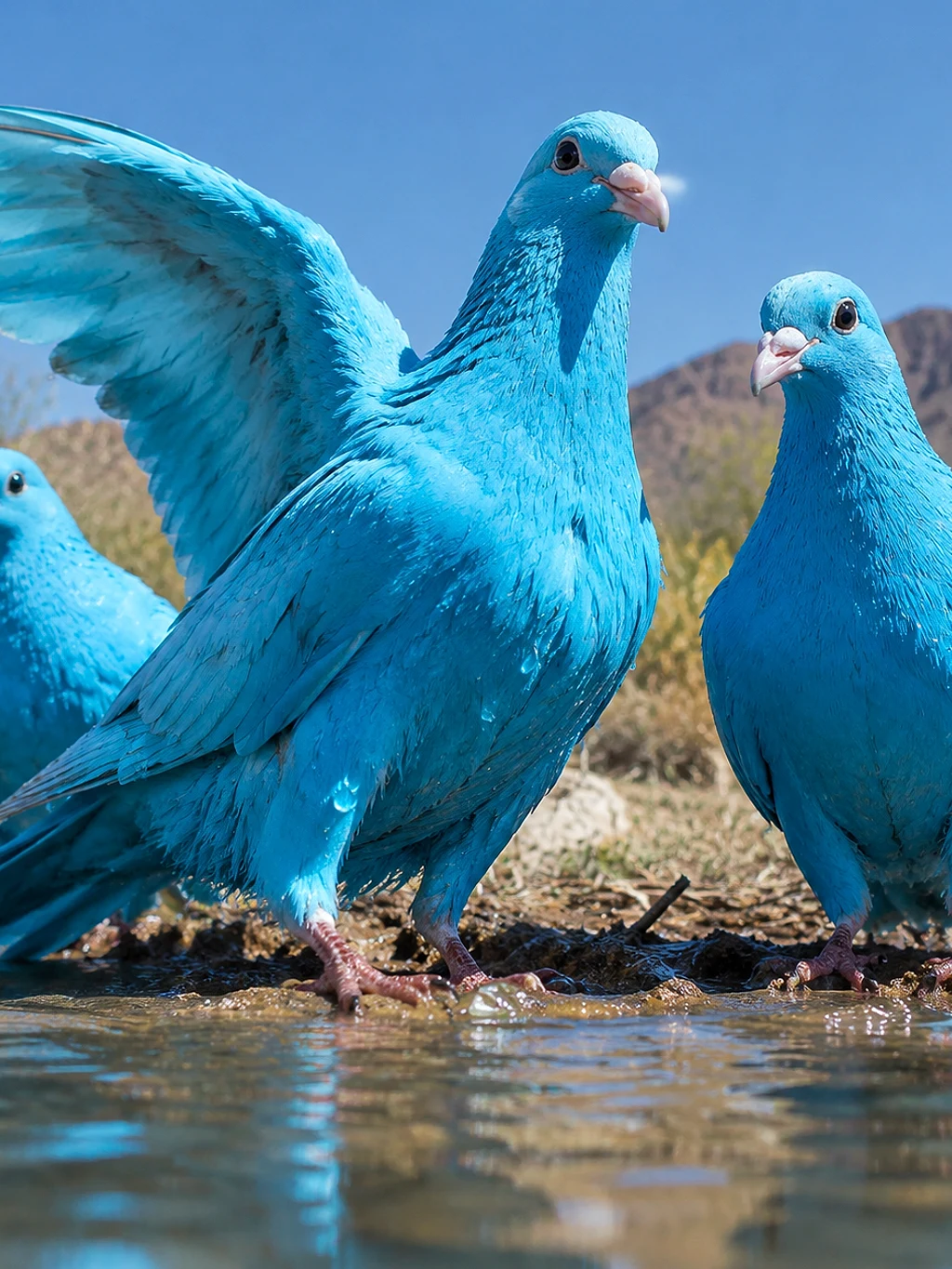
他们把白鸽染成蓝色放上了天:几天后有人在河边找到它们,蓝色怎么洗都洗不掉
Blue-Dyed Gender-Reveal Doves Found Days Later
About this story
An Arizona couple had a dove-release company dye white doves blue for a gender reveal in July 2026. Days later the birds showed up along the Salt River, a wildlife rehabilitator washed them again and again, and the dye would not come out. Chinese listening practice at four levels. HSK 5-6 Chinese listening practice.
This is an HSK 5-6 Chinese listening episode that runs about 6 minutes. The full Mandarin script is shown with tap-for-pinyin and a line-by-line English translation, so you can listen and read at once — comprehensible input in the sense of Stephen Krashen's i+1 theory. It teaches 12 key vocabulary words such as 判断、结构、物质 and walks through 3 grammar patterns, each explained in English with examples. The same news story is retold at 4 difficulty levels — use the level selector above to find the version that is challenging but still understandable for you.
Read at your level
原文Read the complete story in Chinese. Reveal pinyin and English only when you need them.
English transcript reference
This episode is about something that happened in Arizona this July.
It is small — no injuries, no lawsuit — but it lays out an increasingly common problem very cleanly.
Some background first.
Southern Arizona has a desert climate: extreme summer heat, and a sky that stays bright and nearly cloudless most of the year.
A local couple were expecting a baby, and had a certain following on social media.
They were preparing a gender reveal party.
This kind of party has become quite popular in America over the past decade: instead of announcing the baby's sex directly, the parents stage a visual moment and let the people present work it out.
The standing colour convention is blue for a boy, pink for a girl.
The trouble is that the format has kept escalating.
It started with cutting a cake and looking at the colour inside.
Then came coloured smoke, coloured powder, coloured balloons.
Then came versions with more visual impact — and real accidents: a 2017 gender reveal in Arizona set a forest alight, burned close to twenty thousand hectares, and left the man responsible ordered to pay more than eight million dollars.
What this couple chose was a white dove release.
They contacted a small local company that keeps doves and works weddings, shop openings, and memorial events, releasing flocks into the air.
White doves climbing into the sky really does photograph well, and it really is many people's idea of a proper ceremonial moment.
But this couple added one request: since it is a boy, could the doves be blue.
The company agreed, and coloured the birds with food dye.
On the day, it worked beautifully.
A flock of blue birds rose, the guests looked up, every phone came out, and the photos were posted the same day.
If the story ended there, it would just be a harmless piece of social media.
It did not end there.
A few days later, someone found several blue birds on a stretch of riverbank along the Salt River.
No native species in that area is that colour.
The witness photographed them and posted it, and it spread quickly.
A local woman who has worked in wildlife rescue for years got a call and went out.
She knew at a glance: these were not some rare species. They were domestic doves — the ones released at that party.
She took back the ones she could catch and tried to wash the dye out.
The first wash did not remove it, nor did the second, and after repeated washing the blue was still bound to the feathers.
Even at this point, many people's first reaction is still: but isn't a blue bird beautiful?
It is beautiful, and the beauty is precisely the problem.
This needs unpacking in three layers.
The first layer is visibility.
When a white dove is in flight, it is genuinely hard to pick out overhead.
The sky is bright, the clouds are white, and white against that background is itself camouflage.
Blue is the opposite: against a bright sky it makes a strong contrast, and can be locked onto from hundreds of metres away.
For a bird flying over open country, that difference decides whether a raptor spots it early.
The second layer is physiology.
Birds preen their feathers with their beaks every day; it is a necessary act for maintaining flight.
Anything bound to the feathers gets ingested during that process.
A bird's respiratory system is structurally different from a mammal's and is far more sensitive to airborne particles and volatiles.
Add a very small body mass, and the same absolute dose is worth dozens of times more to a dove than it would be to a person.
The company has since stressed that the dye was food grade and non-toxic.
That is very likely true, but it does not answer the question being asked.
"Safe to swallow" and "safe to apply to an animal that flies on its feathers and ingests whatever is on their surface" are two entirely different judgements.
The third layer concerns what this particular batch of doves is for, and it is the easiest one to miss.
Release doves are homing pigeons.
They are not single-use props. Once released they navigate home themselves, sometimes ten-odd kilometres, sometimes tens of kilometres.
The entire business model rests on those birds coming back.
Colouring them adds an extra risk factor to every single bird, on the one stretch of the job it has to do alone.
Very few people are thinking about that when they place the order.
Once the story got out, the criticism online was fierce.
The company's owner responded: the dye was food grade and non-toxic; it was the first time she had coloured birds; she will not do it again.
That last sentence is the only settled outcome this story currently has.
Let me be clear: there was no malice here.
Nobody set out to harm those birds.
A couple about to become parents wanted one afternoon to look a little better; a small company wanted to meet a customer's request. Both of those are ordinary.
What deserves attention is the shape of it — the decision is made at the party, the cost comes due on the riverbank, and the people making the decision never see the moment it comes due.
You can find that same shape in a lot of places: a photo shoot, a wedding, a video concept, with the cost pushed onto a party that is not present and cannot speak.
This is not a story that needs an apology from anyone. It is a story about asking one more question before you place the order.
Two questions to leave you with.
The first is concrete: if you owned that company and a customer paid extra to have the birds coloured, would you take the job?
The second is bigger: when something is "just for the look" and "only this once", on what basis do we decide whether it costs anything at all?
Listen again
Try it without the transcript and notice what sounds clearer.
What vocabulary does this episode teach?
词汇HSK 4. 是两个完全不同的判断 — the sentence that dismantles the "non-toxic" defence.
HSK 5. 值得注意的是这件事的结构 — the episode's real subject is the shape, not the incident.
HSK 5. 羽毛上附着的任何物质,都会在梳理过程中被摄入。
HSK 5. Colouring the birds adds a risk factor to a journey each one makes alone.
HSK 5. 公司方面后来强调用的是食用色素 — what they chose to emphasise is itself the tell.
HSK 5. 相当于对人类的几十倍 — the comparison that makes body mass concrete.
The reader the sky actually has. Visibility is only a problem because of this.
The mechanism: preening moves whatever is on the feathers into the bird.
同样的绝对剂量 — identical amount, wildly different meaning at a dove's body mass.
The comparison that explains why avian lungs are the wrong thing to reason about from human intuition.
决策在派对上做出,代价在河滩上兑现 — the whole argument in one sentence.
HSK 6. 事情曝光之后 — and the only settled outcome was a promise not to repeat it.
* beyond level超纲词
What grammar patterns appear in this episode?
语法A 等于 B
Amounts to. Used to restate an action as what it actually does, stripping away how it was described.
给它们上色,等于在这段必须独自完成的路程上,给每一只都加了一个额外的风险系数。
……,而……
And yet, by contrast. 而 joins two clauses where the second turns on the first — tighter and more written than 但是.
漂亮,而漂亮恰恰是问题所在。
决策在派对上做出,代价在河滩上兑现,而做决策的人不会看到兑现的那一幕。
这不是……的故事,它是……的故事
Rejects one framing and supplies another. Placed at the end, it tells the listener what to take away without moralising about it.
这不是一个需要谁道歉的故事,它是一个需要在下单之前多问一句的故事。
Proper nouns
专有名词Sources
来源Free account
Keep learning from this story
Create a free account to keep saved words and your preferred level together.
- Keep words with their story context
- Remember your preferred level
- Build your vocabulary over time