
A Chinese podcast · Same story, 4 levels
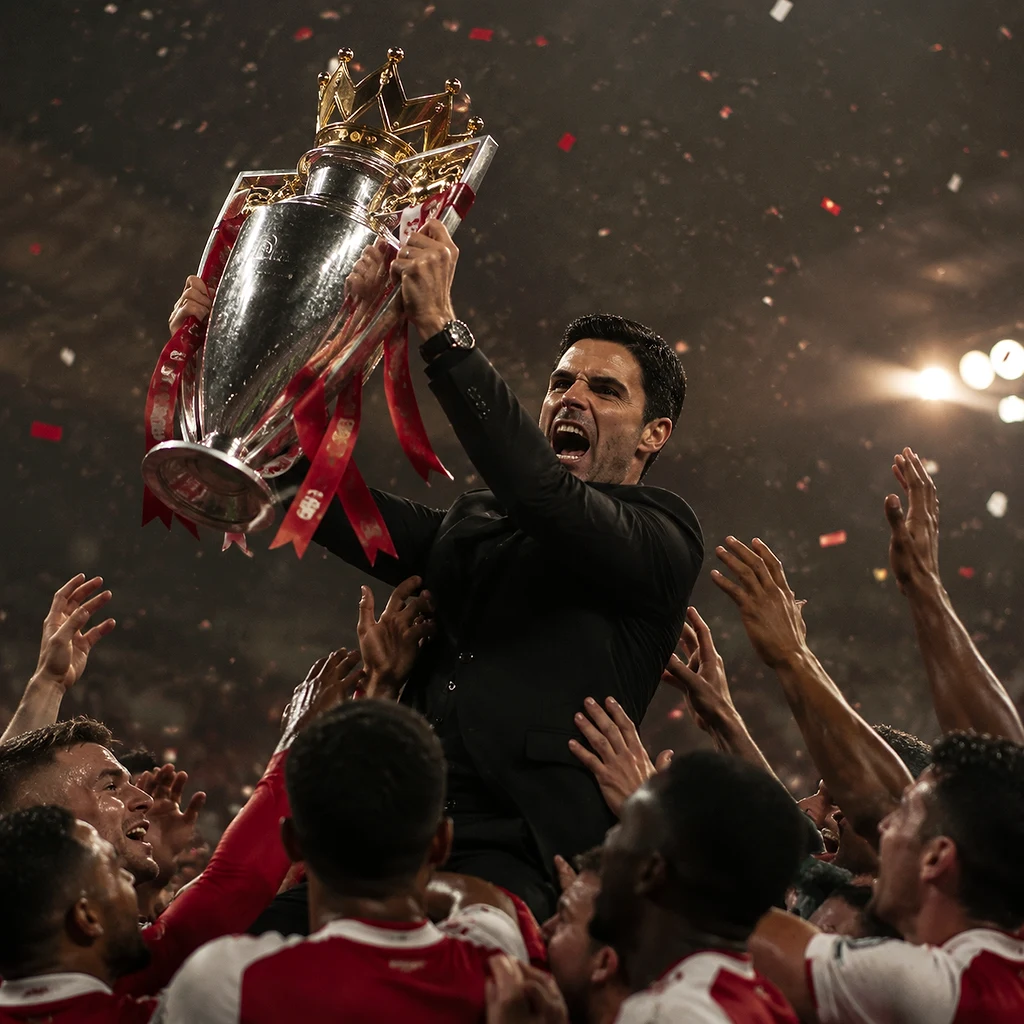
阿森纳的 14 次英超冠军:阿尔特塔和一个 22 年的等待
Arsenal Wins Premier League After 22 Years
About this story
Arsenal Wins Premier League After 22 Years. HSK 5-6 Chinese listening practice.
This is an HSK 5-6 Chinese listening episode that runs about 7 minutes. The full Mandarin script is shown with tap-for-pinyin and a line-by-line English translation, so you can listen and read at once — comprehensible input in the sense of Stephen Krashen's i+1 theory. It teaches 12 key vocabulary words such as 经济、接受、历史 and walks through 4 grammar patterns, each explained in English with examples. The same news story is retold at 4 difficulty levels — use the level selector above to find the version that is challenging but still understandable for you.
Read at your level
原文Read the complete story in Chinese. Reveal pinyin and English only when you need them.
English transcript reference
May 19, 2026,
Bournemouth, England.
That match —
Manchester City should have won it, really.
One point away
and they kept their chance to defend the title.
Their opponents
were Bournemouth, sitting mid-to-lower table.
On paper,
Guardiola's City should have controlled this match.
But football,
its most beguiling feature
is that it doesn't go by "on paper."
Bournemouth scored first.
Then City equalized.
1–1.
Ninety minutes later,
all of England's attention turned to the same thing:
Arsenal are the 2025–26 Premier League champions.
This is their first time in 22 years.
It's also their 14th English top-flight title
in their 140-year history.
What kind of time is 22 years?
22 years ago was 2003–04.
That year,
Arsenal were Wenger's "Invincibles" —
38 matches, the whole season, unbeaten.
The only time it's ever happened in the Premier League.
And it was from that peak
that Arsenal's decline began — slow but steady.
Wenger was still there,
but the team kept losing to Man Utd, Chelsea, and later Man City.
The new Emirates Stadium left the club deep in debt,
and the club had to pinch every penny.
Top players left one by one.
Title chances missed one by one.
In 2018, Wenger left.
He had been at Arsenal for 22 years.
The two managers who followed him didn't work.
Until December 2019,
the club brought in 37-year-old Mikel Arteta.
Arteta is Spanish,
and a former Arsenal captain.
He had just finished a stint as Guardiola's assistant at Man City.
When he took over,
Arsenal were 10th.
Not even able to play in European competition.
The dressing room was in chaos.
The fans had no hope.
Arteta did several things.
The first
was clearing house.
He sold Aubameyang, Mkhitaryan, Özil.
He pushed out older players whose effort didn't show.
"Culture" was a word
he used in every press conference.
The second
was buying young players.
He brought in Havertz from Chelsea.
He brought in Rice from Brighton.
He brought in Vieira from Portugal.
Most importantly,
he promoted Saka, Martinelli, and Smith Rowe from the academy into the first team.
He signed the Norwegian Ødegaard,
and made him captain.
The third,
and the hardest,
was winning.
In 2022–23,
Arsenal almost took the title.
They led for a long time.
In the end, Man City overtook them,
and they finished second.
The fans were crushed.
"Again."
In 2023–24,
Arsenal were second again.
Man City took it again.
"Just short.
Just short again."
In those two years,
people started asking:
maybe Arteta isn't enough?
Maybe Arsenal should just settle for this?
But this year
was different.
This year,
the Saliba–Gabriel center-back pairing
was the most solid in Europe.
Rice was one of England's best midfielders.
Saka was a candidate for Footballer of the Year.
Ødegaard captained like a veteran.
More importantly,
the mentality changed.
In the critical matches,
they didn't lose anymore.
In two games against Man City,
Arsenal won both.
In two games against Liverpool,
Arsenal didn't lose either.
Against Man United, Chelsea, and Spurs,
they grabbed all the key points.
On May 18,
Arsenal won 1–0 at Burnley away.
After that evening,
the title was within their grasp.
Just needed Man City's match.
The afternoon of May 19,
Man City appeared at Bournemouth.
Every Arsenal fan's TV was on.
Pubs were packed.
On social media millions watched in sync.
Bournemouth scored.
Arsenal fans screamed.
City equalized.
Hearts sank again.
Then they waited.
Waited.
Waited for the whistle ending the 90 minutes to blow.
1–1.
Arsenal are champions.
Around the Emirates Stadium in London,
it filled with people immediately.
Some cried.
Some shouted.
Some long-time fans
brought their grandchildren to walk around once.
The headlines in Britain's main papers:
The Guardian: "The wait is over."
The Times: "Arteta's Arsenal, finally."
The Independent simply printed a photo of Wenger lifting the 2004 trophy.
In his post-match interview Arteta,
calmly, said:
"This isn't something I did alone.
"It's the club, the players, the fans,
"every person over these 22 years who didn't leave —
"we all did it together.
He named one person:
Wenger.
He said:
"Wenger taught us what this club means.
"I think he's happy today too.
And the other side?
What about Man City, the team that lost the title?
Guardiola was honest.
He said:
"Arsenal deserved this year.
"We didn't play well enough.
"We need to start again.
Guardiola's Man City
won six Premier League titles in the past nine years.
But this year
is a turning point for English football.
One dynasty ends.
Another may have just begun.
Arsenal's story
isn't over.
On May 30,
they go to the Puskás Aréna in Budapest, Hungary,
for the second Champions League final in their history.
Their opponent is Paris Saint-Germain.
Both teams
have played beautifully this year.
If Arsenal can win,
they will be European champions.
That's something the club has never done in its history.
If they lose,
the Premier League title is already enough.
But honestly,
beyond the win and the loss,
there's something more worth saying.
22 years,
for a football club,
is a generation of fans.
Children who came to watch Wenger's side in 2003
are now parents.
The young guy selling hot dogs at the stadium back then
has now retired.
Some fans are already gone,
and their children keep watching.
These people,
for 22 years,
every Sunday,
turned on the TV.
Knowing the odds were they'd be disappointed,
they still watched.
One of football's meanings
is that it gives you a long, long story,
and gives you and the people around you
something to wait for together.
The 22-year wait is over.
But across those 22 years,
all the time spent together on sofas, in pubs, in stadium stands,
that, really, is the title itself.
The trophy is just the certificate that comes after.
Okay.
That's all for today.
See you in the next story.
Listen again
Try it without the transcript and notice what sounds clearer.
What vocabulary does this episode teach?
词汇Economy. The 22-year wait wasn't just a sporting drought — it was framed by club finances after the Emirates Stadium debt. The 经济 reality shaped the title gap.
To accept. Guardiola accepting that Arsenal deserved this year is what makes his interview notable — he had rarely needed to do it.
History. The episode treats this as a 历史 turning point — a dynasty ending, another perhaps beginning.
Trust. The unwritten word behind Arteta's rebuild — the players, the fans, and the board all had to 信任 him through two seasons of finishing second.
Standard. The episode argues Arteta's project was about restoring a 标准 — a culture of how the club operates, not just buying better players.
To complete. A 22-year project is finally 完成 — though the Champions League final remains.
To defend a championship. Man City's chance to 卫冕 (defend) the title ended at Bournemouth — the word that dominated UK football headlines for weeks.
To overtake from behind, surge past. In the previous 'so close' seasons, Man City 反超 Arsenal late. This year that didn't happen — Arsenal held.
Dynasty. The Man City era of six titles in seven years was a 王朝 in English football. The episode argues that 王朝 just ended.
The final (of a tournament). The Champions League 决赛 against PSG, May 30 in Budapest — still ahead.
A sports fan. The episode's emotional thesis: the title belongs to the 球迷, not just the players — to the people who showed up for 22 years.
Trophy. The episode's closing reframe: the 奖杯 is just a certificate; the real championship is the 22 years of waiting together.
* beyond level超纲词
What grammar patterns appear in this episode?
语法X 是该 + V 的
Marks an expected outcome that didn't happen. 曼城是该赢的 — Man City was supposed to win. The construction carries the 'on paper' assumption that the story then upends.
曼城是该赢的。
他是该来的。
按理说,X
按理说 = by reason / on paper. Sets up an expectation. The episode pivots on football breaking that expectation. Useful any time you want to flag 'the obvious answer would be...'
按理说,这场比赛瓜迪奥拉的曼城应该掌控。
按理说,他应该赢。
从 A 开始 / 从 A 起
从...开始 marks a starting point in time or sequence. 从那个高峰开始,阿森纳的下坡缓慢但持续 — from that peak, Arsenal's decline began. Compact way to anchor an arc.
从那个高峰开始,阿森纳的下坡缓慢但持续。
从这场比赛开始,阿森纳变了。
不只是 X,而是 Y
Lifts the meaning. The closing thesis: the trophy is 不只是 a sporting result — it's a generational shared experience. 而是 makes the upgrade explicit.
但是它告诉我们的,不只是体育。
奖杯不只是一个奖杯,而是 22 年的故事。
Proper nouns
专有名词Free account
Keep learning from this story
Create a free account to keep saved words and your preferred level together.
- Keep words with their story context
- Remember your preferred level
- Build your vocabulary over time