
A Chinese podcast · Same story, 4 levels
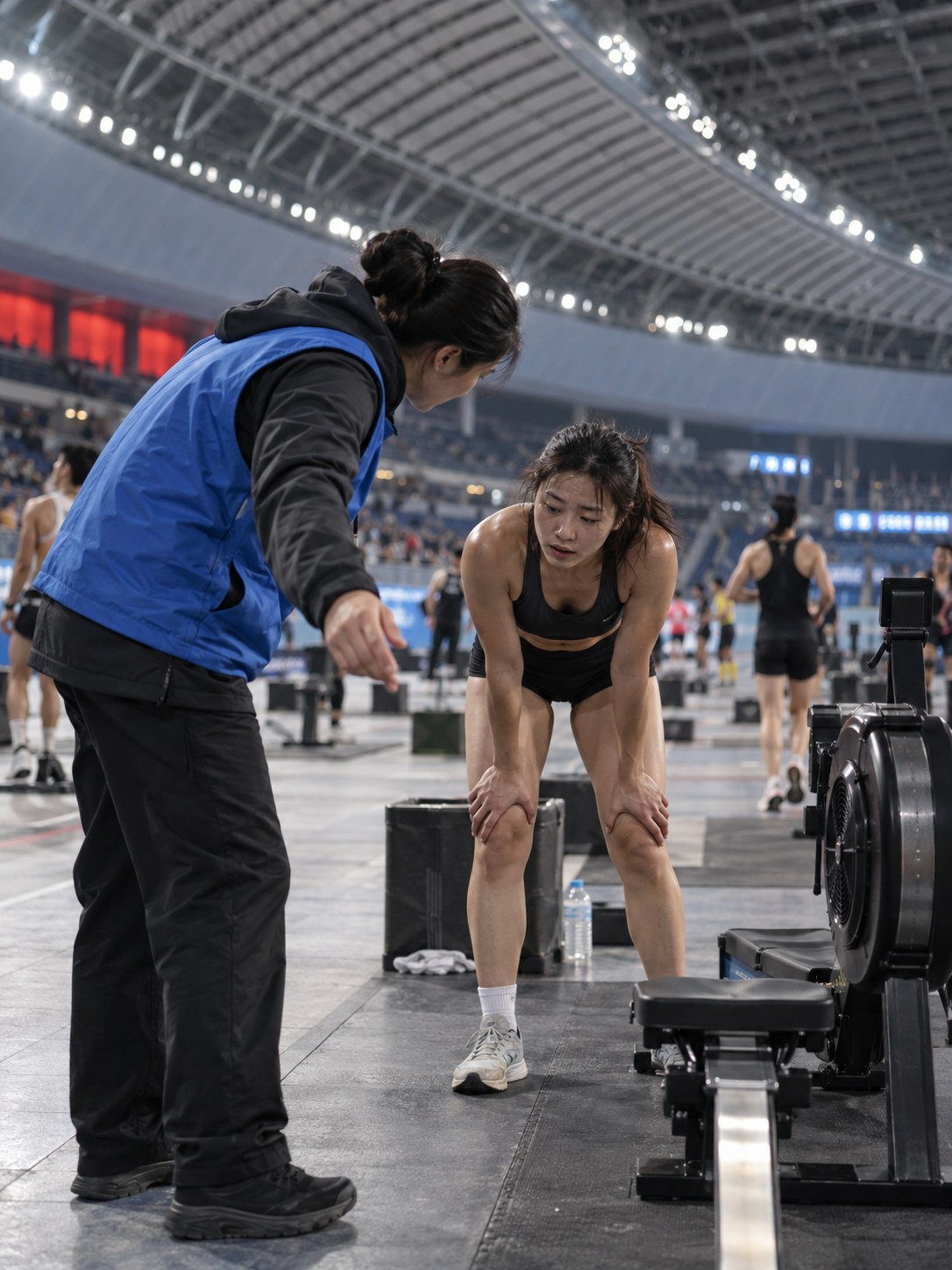
北京 HYROX 失禁事故后修改比赛规则
HYROX Changes Rules After Beijing Bowel Accident
About this story
A hygiene incident at the Beijing HYROX race leads to new safety rules for staff and participants. HSK 1 Chinese listening practice.
This is an HSK 1 Chinese listening episode that runs about 2 minutes. The full Mandarin script is shown with tap-for-pinyin and a line-by-line English translation, so you can listen and read at once — comprehensible input in the sense of Stephen Krashen's i+1 theory. It teaches 16 key vocabulary words such as 比赛、名字、跑 and walks through 5 grammar patterns, each explained in English with examples. The same news story is retold at 4 difficulty levels — use the level selector above to find the version that is challenging but still understandable for you.
Read at your level
原文Read the complete story in Chinese. Reveal pinyin and English only when you need them.
English transcript reference
Today, we talk about a competition in Beijing.
The name of the competition is HYROX.
There are many athletes in the competition.
Athletes must run, and they must also do exercises.
When one athlete does an exercise, the athletes behind must also do it.
What one athlete sees, the athletes behind will also see.
On September 12th, one athlete ran very fast.
But, she had a big problem.
Feces were on her clothes.
Feces were also on the competition equipment.
This was not what she wanted.
She needed help.
But, she did not stop.
She continued running, and continued doing exercises.
There were still many athletes behind.
They also had to run, and had to do exercises.
They saw the feces.
They thought: Is it clean here?
They thought: Is it safe here?
The staff also saw it.
But, the staff did not ask her to stop.
The staff did not come to help her immediately.
The staff also did not help the athletes behind immediately.
Only after the competition ended did they come to clean.
Many people said: This is too late.
HYROX later said: Sorry, this is our mistake.
HYROX wrote a new rule.
The rule says that when there is feces, staff can ask athletes to stop.
Staff can ask doctors to come.
Staff can also tell the athletes behind not to come.
Staff must help this athlete.
Staff must also help the athletes behind.
This rule is not to laugh at her.
She needs help, and the athletes behind need safety.
The competition is about who runs fast.
The competition must also keep everyone safe.
When you are staff, what will you do first?
Listen again
Try it without the transcript and notice what sounds clearer.
What vocabulary does this episode teach?
词汇HSK 1. A common noun for sports or game contests. Example: 一个比赛 (a competition).
HSK 1. Used to ask or state someone's or something's name. Example: 比赛的名字 (the name of the competition).
HSK 1. A basic verb for running. Example: 跑得很快 (run very fast).
HSK 1. Indicates the result of looking. Example: 看见了大便 (saw the feces).
HSK 1. Can mean a question to answer or a trouble to solve. Example: 一个大问题 (a big problem).
HSK 1. General term for clothing. Example: 在她的衣服上 (on her clothes).
HSK 2. Can be used as a verb or a noun. Example: 她需要帮助 (she needs help).
HSK 2. Adjective describing cleanliness. Example: 这里干净吗 (Is it clean here?).
HSK 3. Can be an adjective or a noun. Example: 这里安全吗 (Is it safe here?).
HSK 3. Verb indicating an action persists. Example: 继续跑 (continue running).
HSK 3. Adverb indicating very short time. Example: 没有马上来帮助 (did not come to help immediately).
HSK 4. Noun for established guidelines. Example: 一个新规则 (a new rule).
Beyond HSK 1. Specific term for participants in a competition. Example: 很多选手 (many athletes).
Beyond HSK 1. Medical or formal term for excrement. Example: 大便在她的衣服上 (feces were on her clothes).
Beyond HSK 1. Compound noun for people working at an event or organization. Example: 工作人员也看见了 (the staff also saw it).
Beyond HSK 1. Professional title for a medical practitioner. Example: 请医生来 (ask a doctor to come).
* beyond level超纲词
What grammar patterns appear in this episode?
语法Subject + 要 + Verb
Indicates necessity or obligation, meaning 'must' or 'need to'.
选手要跑,也要做运动。
后面的选手也要做。
Place + 有 + Object
Existential sentence structure indicating that something exists in a specific location.
比赛里有很多选手。
大便在她的衣服上。
Verb + 得 + Adjective
Complement of degree structure used to describe how an action is performed.
一个选手跑得很快。
不是……而是…… (Implied contrast)
Used to correct a misconception or state what something is not, often followed by the reality. In this script, '这不是她想的' implies 'This was not what she intended/wanted'.
这不是她想的。
这个规则不是为了笑她。
才 + Verb
Indicates that an action happened later than expected or only after a certain condition was met.
这个比赛结束了,他们才来洗。
Proper nouns
专有名词Sources
来源Free account
Keep learning from this story
Create a free account to keep saved words and your preferred level together.
- Keep words with their story context
- Remember your preferred level
- Build your vocabulary over time