
A Chinese podcast · Same story, 4 levels
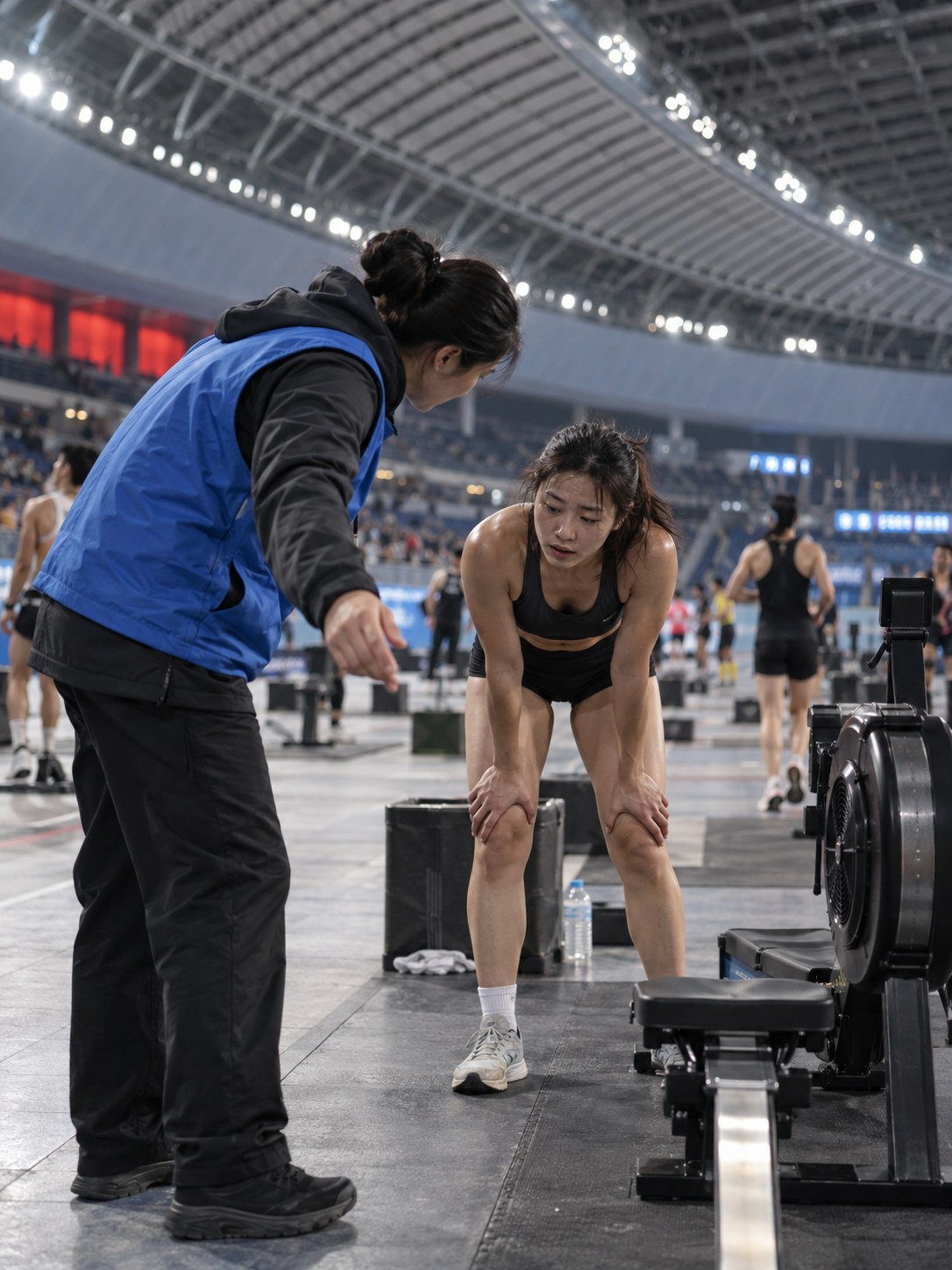
北京 HYROX 失禁事故后修改比赛规则
HYROX Changes Rules After Beijing Bowel Accident
About this story
HYROX updates rules after a hygiene incident in Beijing where staff failed to protect athletes, leading to a public apology. HSK 2 Chinese listening practice.
This is an HSK 2 Chinese listening episode that runs about 2 minutes. The full Mandarin script is shown with tap-for-pinyin and a line-by-line English translation, so you can listen and read at once — comprehensible input in the sense of Stephen Krashen's i+1 theory. It teaches 20 key vocabulary words such as 比赛、问题、运动 and walks through 5 grammar patterns, each explained in English with examples. The same news story is retold at 4 difficulty levels — use the level selector above to find the version that is challenging but still understandable for you.
Read at your level
原文Read the complete story in Chinese. Reveal pinyin and English only when you need them.
English transcript reference
Today we discuss an issue from a competition in Beijing.
The competition is called HYROX.
Athletes must run and also perform different exercises.
Many exercises require using the competition's equipment.
Once one athlete finishes, the next athlete uses it immediately.
Therefore, the venue and equipment must be clean.
On September 12, an athlete participated in the Beijing competition.
During the race, she suddenly had a physical problem.
Feces got on her clothes and also on the venue floor.
This was not something she wanted to happen, nor should it be used to mock her.
However, she did not stop.
She continued running and continued using the competition equipment.
There were many other athletes behind her.
They had to pass through the same venue and use the same equipment.
They did not know if the venue was clean.
They also did not know if the equipment was safe.
At this moment, what should the staff have done?
The staff could have first asked a doctor to help this athlete.
The staff could also have closed off the problematic area of the venue.
The equipment needed to be washed clean before subsequent athletes could use it.
However, on the day of the Beijing competition, the staff did not act immediately.
They did not help this athlete right away.
They also did not protect the following athletes right away.
Only after the competition ended did the staff begin cleaning up.
Many people felt that this was already too late.
The person in charge of HYROX later apologized publicly.
He said they did not do well at the time, and this was their responsibility.
HYROX also wrote new competition rules.
In the future, if such hygiene issues occur again, officials can make athletes withdraw from the competition.
Staff must first inspect the venue and equipment.
Only when the venue is clean and the equipment is safe can the following athletes continue.
The new rules are not meant to embarrass athletes who have physical problems.
They allow athletes to get help faster and keep the people behind them safer.
A competition looks at who is fastest, but must also care for everyone's health.
If you were an athlete coming up next, what would you want the staff to tell you first?
Listen again
Try it without the transcript and notice what sounds clearer.
What vocabulary does this episode teach?
词汇HSK 2. A common noun for sports or game contests. Example: 参加北京的比赛 (participate in the Beijing competition).
HSK 2. Used for both questions to ask and issues to solve. Example: 比赛里的问题 (a problem in the competition).
HSK 2. Can refer to physical activity or specific sports. Example: 做不同的运动 (do different exercises).
HSK 2. Adjective describing cleanliness. Example: 场地和器材都要干净 (the venue and equipment must be clean).
HSK 2. Verb or noun. Example: 请医生帮助这位选手 (ask a doctor to help this athlete).
HSK 2. Adjective or noun. Example: 器材是不是安全 (whether the equipment is safe).
HSK 2. Adverb indicating very short time delay. Example: 后面的选手马上也会用 (the next athlete will use it immediately).
HSK 2. Verb indicating resuming an action. Example: 她继续跑 (she continued running).
HSK 3. Often used as 负责人 (person in charge). Example: 这是他们的责任 (this is their responsibility).
HSK 3. Noun for established guidelines. Example: 新的比赛规则 (new competition rules).
HSK 3. Verb for examining something. Example: 工作人员要先检查场地 (staff must first inspect the venue).
HSK 3. Verb implying attention to needs. Example: 照顾每个人的健康 (care for everyone's health).
HSK 4. Verb for leaving a group or activity. Example: 让选手退出比赛 (make athletes withdraw from the competition).
Beyond HSK 4. Describes a state of embarrassment or discomfort. Example: 让...选手难堪 (make the athlete embarrassed).
Beyond HSK 4. Specific term for sports or technical equipment. Example: 比赛里的器材 (equipment in the competition).
Beyond HSK 4. The place where an event or sport happens. Example: 关掉有问题的场地 (close off the problematic venue area).
Beyond HSK 4. Medical or formal term for excrement. Example: 大便到了她的衣服上 (feces got on her clothes).
Beyond HSK 4. Adjective or adverb. Example: 公开道歉 (publicly apologize).
Beyond HSK 4. Verb for saying sorry. Example: 负责人后来公开道歉 (the person in charge later apologized publicly).
Beyond HSK 4. Noun relating to health and cleanliness standards. Example: 这样的卫生问题 (such hygiene issues).
* beyond level超纲词
What grammar patterns appear in this episode?
语法要...也要...
Used to list multiple requirements or actions that are both necessary. Translates to 'must... and also must...' or 'need to... and also need to...'.
选手要跑步,也要做不同的运动。
一场比赛要看谁最快,也要照顾每个人的健康。
先...再/才...
Indicates the sequence of actions. 'First do A, then/do B only after A is done'. '才' emphasizes that B happens only after the condition A is met.
工作人员可以先请医生帮助这位选手。
器材要洗干净,后面的选手才能使用。
工作人员要先检查场地和器材。
Used to correct a misconception. 'It is not A, but rather B'. In the script, it clarifies the purpose of the new rules.
新规则不是为了让身体出问题的选手难堪。
让 + Person + Verb
Causative structure meaning 'to let/make someone do something' or 'to cause someone to be in a certain state'.
负责人可以让选手退出比赛。
它让选手更快得到帮助。
也不应该拿来笑她。
Subject + 没有 + Time Word + Verb
Negative past tense indicating an action did not happen at a specific time or immediately.
工作人员没有马上行动。
他们没有马上帮助这位选手。
Proper Nouns
专有名词Sources
来源Free account
Keep learning from this story
Create a free account to keep saved words and your preferred level together.
- Keep words with their story context
- Remember your preferred level
- Build your vocabulary over time