
A Chinese podcast · Same story, 4 levels
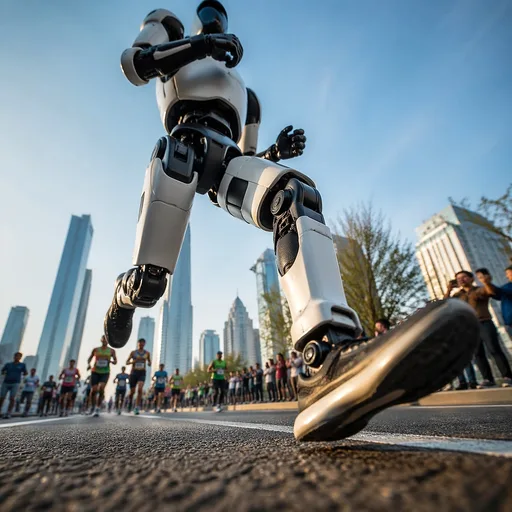
机器人跑赢了人类:北京半马拉松的疯狂一天
Beijing Robot Beats Humans in Half Marathon
About this story
A robot called Lightning from Honor finished the Beijing half marathon in 50 minutes — faster than many human runners. HSK 2 Chinese listening practice.
This is an HSK 2 Chinese listening episode that runs about 6 minutes. The full Mandarin script is shown with tap-for-pinyin and a line-by-line English translation, so you can listen and read at once — comprehensible input in the sense of Stephen Krashen's i+1 theory. It teaches 12 key vocabulary words such as 机器人、有意思、公司 and walks through 3 grammar patterns, each explained in English with examples. The same news story is retold at 4 difficulty levels — use the level selector above to find the version that is challenging but still understandable for you.
Read at your level
原文Read the complete story in Chinese. Reveal pinyin and English only when you need them.
English transcript reference
Speaking of what robots can do, something happened yesterday in Beijing that shocked the whole world.
A robot ran a half marathon.
And beat the human world record.
A half marathon is twenty-one kilometers.
The human world record is 57 minutes and 20 seconds.
Created by an African runner named Kiplimo.
Yesterday in Beijing.
A robot called "Lightning."
Finished in 50 minutes and 26 seconds.
About seven minutes faster than the human record.
Seven minutes in a running race is a huge gap.
Who made this robot?
A Chinese company called Honor.
You might have heard of Honor.
They make phones.
But now they also make robots.
What does this robot look like?
It's red.
One meter sixty-nine tall.
About the same height as an average Chinese person.
Its legs are ninety to ninety-five centimeters long.
Specifically designed to mimic elite human runners.
It also uses a phone technology.
Called liquid cooling.
Using liquid to help the robot cool down.
So it won't overheat while running.
This race was held in Yizhuang, Beijing.
Yizhuang is an industrial park in southern Beijing.
Many high-tech companies are based there.
Over a hundred teams participated.
More than three hundred robots.
Plus twelve thousand human runners.
They ran separately.
Humans on one track.
Robots on another.
So they won't collide.
Honor didn't just win first place.
They swept the top three spots.
And all three robots used autonomous navigation.
Autonomous navigation means the robot finds its own way and runs by itself.
Nobody is controlling it with a remote.
About forty percent of the robots ran autonomously.
The remaining sixty percent were remote controlled.
This race was first held last year.
How many teams were there last year?
Twenty-three.
This year?
One hundred and twelve.
Five times more.
Last year the fastest robot took how long?
Two hours and forty minutes.
This year?
Fifty minutes.
From two and a half hours to fifty minutes.
In one year.
This rate of progress is crazy.
But not all robots ran well.
There were some very funny moments.
One robot fell face-first just sixty meters after starting.
Face down onto the ground.
Then the technicians ran over.
Used packing tape to stick its upper body back together.
Then it kept running.
Finished the whole race held together with tape.
The spirit is very touching.
Another robot.
Crossed the finish line.
Succeeded.
But then it didn't know how to stop.
Went straight into the bushes on the side.
Fell in.
Just like a drunk person.
There was also a very small robot.
Called "Xiao Pai."
Only about sixty centimeters tall.
Like a little baby.
When it ran it was holding a baby bottle.
Bouncing forward step by step.
Very cute.
The fastest human runner was Zhao Haijie.
He ran one hour seven minutes and forty-seven seconds.
He said something to describe how it felt when the robot passed him.
He said: "It just went whoosh right past me."
Whoosh.
Like the wind.
One spectator named Liu Yanli.
She is a middle-aged woman.
She said something very interesting.
She said: "For those of us in middle age."
"This gives us a great sense of security for the future."
She might mean.
If robots can do many things in the future.
Life will become much more convenient.
China now has over a hundred and fifty robot-making companies.
The government has a plan for 2026 to 2030.
Including brain chips, quantum computing, and robot-powered factories.
The age of robots might really be coming.
But for now.
Let's first laugh at the robot that finished the race held together with tape.
And the robot that ran into the bushes.
And the little robot carrying a baby bottle bouncing along.
This is robots in 2026.
Some are faster than people.
Some are funnier than people.
But all are improving.
And improving very very fast.
What will next year be like?
Nobody knows.
But I bet next year's robots will be even faster.
Fall down less.
Maybe next year they won't need tape anymore.
Listen again
Try it without the transcript and notice what sounds clearer.
What vocabulary does this episode teach?
词汇A machine that looks and moves like a human.
HSK 1-2. interesting.
HSK 1-2. company.
HSK 1-2. side / beside.
HSK 1-2. meaning / interest.
HSK 1-2. mobile phone.
A 21-kilometer running race.
The best performance ever achieved globally.
When a robot finds its own path without human control.
Using liquid to cool down electronics or machines.
Controlling something from a distance.
Adhesive tape used to stick things together.
* beyond level超纲词
What grammar patterns appear in this episode?
语法Proper nouns
专有名词Sources
来源Free account
Keep learning from this story
Create a free account to keep saved words and your preferred level together.
- Keep words with their story context
- Remember your preferred level
- Build your vocabulary over time