
A Chinese podcast · Same story, 4 levels
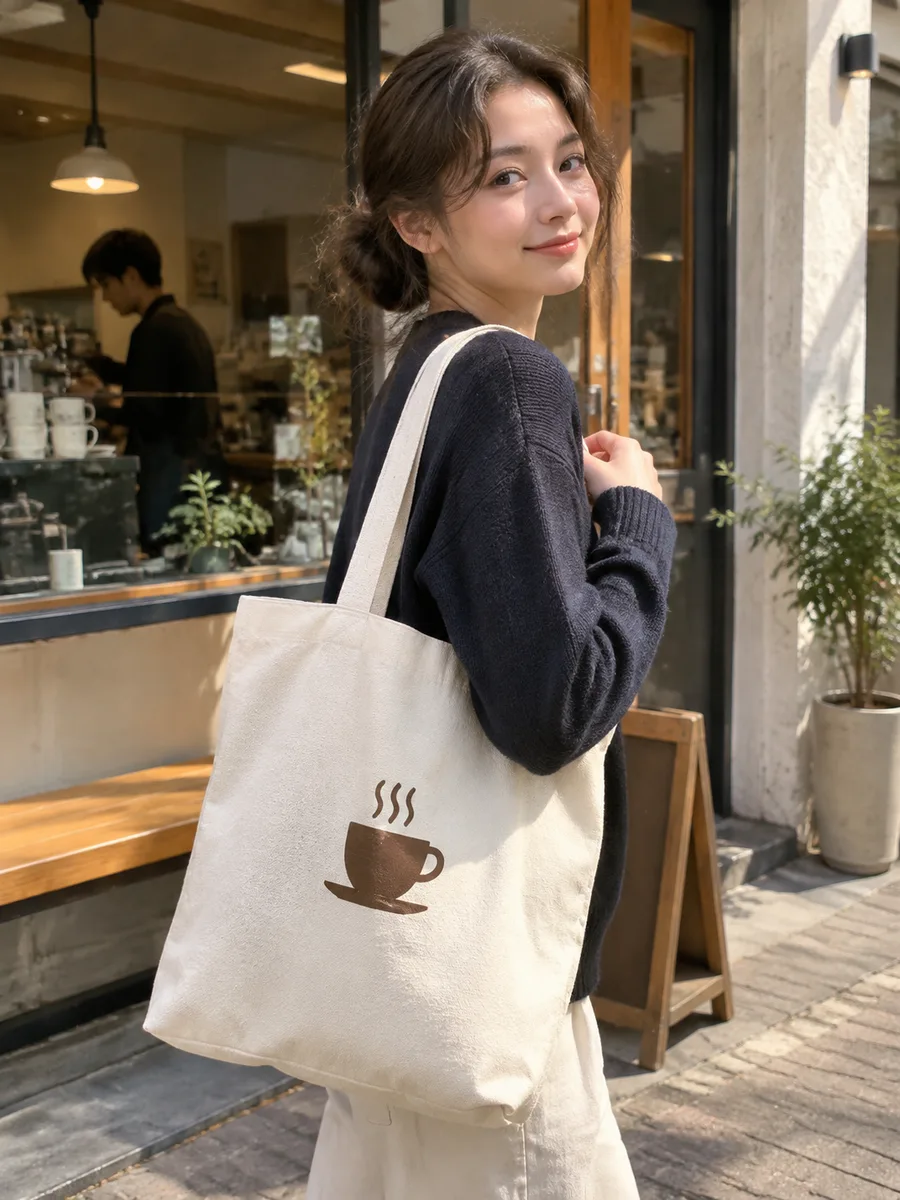
咖啡店为什么开始卖包?
Coffee Shops Turn Tote Bags Into Branding
About this story
HSK 1-3 Chinese listening. Small shops sell branded canvas bags, turning inexpensive merchandise into advertising and signs of belonging.
This is an HSK 3-4 Chinese listening episode that runs about 4 minutes. The full Mandarin script is shown with tap-for-pinyin and a line-by-line English translation, so you can listen and read at once — comprehensible input in the sense of Stephen Krashen's i+1 theory. It teaches 12 key vocabulary words such as 买、小、商店 and walks through 4 grammar patterns, each explained in English with examples. The same news story is retold at 4 difficulty levels — use the level selector above to find the version that is challenging but still understandable for you.
Read at your level
原文Read the complete story in Chinese. Reveal pinyin and English only when you need them.
English transcript reference
A small bag costing less than three dollars — someone actually listed it online for fifty thousand dollars.
In the United States, there is a supermarket called Trader Joe's.
On September 30th, this store sold a special Halloween-edition cloth bag.
One bag cost two dollars and ninety-nine cents. It was very small — about the size of a tablet computer.
Because so many people were buying them, some stores had to set a rule: each person could buy only a few at most.
Online, this bag that cost less than three dollars was listed by some people at twenty dollars, and some even listed it at fifty thousand dollars.
Fifty thousand dollars is just the asking price — it doesn't mean someone will actually buy it.
But this shows that in people's minds, this kind of bag is no longer just a bag.
To make a cloth bag, if you make a huge number of them, the cost of one might be less than one dollar.
But when a person carries this bag out the door, walks down the street, takes the subway, goes to the supermarket, many people will see this bag.
The store's name is printed on the bag, so the people who see it will learn about this store.
It's like a walking advertisement — and this advertisement doesn't cost much money.
For example, there is a very famous bookstore called Daunt Books, and there is also a bookstore in Paris called Shakespeare and Company.
The cloth bags they sell are popular among many people who love reading.
The third reason is that the buyers have their own ideas too.
For many shoppers, a store's bag can also express their own tastes.
Especially after the pandemic, many people are more willing to support small shops near their homes.
Buying a bag is telling others: I'm a customer of this store, and I like it here.
There is another reason, and it has to do with young people.
There is a teacher at New York University named Jared Watson. He studies the psychology of people when they shop.
He says today's young people, especially the generation that grew up online, want even more to express themselves through clothes and accessories.
They want even more to use the things they've used and the places they've been to tell others: who I am, and what I like.
In the past, people might show themselves off with very expensive watches or brand-name clothes.
Now, many people feel that wearing a brand-name item everyone has makes you nothing special.
They would rather carry a bag that only certain people know about — like a bag from a small bookstore, or a bag from a small coffee shop.
There is a person who does brand consulting, named Connor Archbold. He says that in the past people used price tags to show their status, but now what matters more is taste and a sense of belonging.
In other words, which small circle you belong to, what you understand, what you like — these have become more important.
There is another very interesting point: although this kind of bag is meant to make a person look special, it can also help people find friends.
Now in Western countries, about half of all people don't join any group, don't go to church, and don't join sports clubs.
Many people feel lonely.
At times like this, if you carry a bag that few people know about and run into another person carrying the same bag, you might glance at each other, smile, and even chat a bit.
It's like two little fish in a big pond finding each other.
So this kind of bag is a signal, telling others: we're together.
Finally, there is another new trend: individuals can now make their own "merch."
For example, there is a website called Etsy, where people can make their own designed cups, matches, and T-shirts.
Some people, when they get married or celebrate a birthday, will make a batch of items printed with their own names or designs and give them to the guests who come.
This year, a very famous magazine called Architectural Digest wrote an article asking: should your home also have its own merch?
Because people today value experiences and memories more and more, things that help people remember a place or a gathering have become more and more valuable.
Think about it: if your favorite coffee shop started selling bags, which one would you buy?
Listen again
Try it without the transcript and notice what sounds clearer.
What vocabulary does this episode teach?
词汇HSK 1. Core verb; appears throughout as 买的人 (buyers) and 买东西 (to shop).
HSK 1. Used for 小袋子 (small bag), 小店 (small shop), 小圈子 (small circle).
HSK 1. Note 店 alone also appears in 书店 (bookstore) and 咖啡店 (coffee shop).
HSK 1. In the script: 喜欢读书的人 (people who like reading), 我喜欢这里 (I like it here).
HSK 2. Works as adjective (特别版, special edition) and adverb (特别是…, especially…).
HSK 2. Used for opinions: 很多人觉得… (many people feel that…).
HSK 3. Appears twice: 有一家超市 and 去超市.
Beyond HSK 3. 标 (to mark) + 价 (price). The script stresses 五万美元只是标价 — an asking price, not a sale.
Beyond HSK 3. 布 (cloth) + 袋 (bag). 袋子 is the everyday word for 'bag' used elsewhere in the script.
Beyond HSK 3. Business term: 一个的成本可能还不到一美元 (the cost of one may be under a dollar).
Beyond HSK 3. 归属 (belonging) + 感 (feeling); pairs with 品味 (taste) in the script.
Beyond HSK 3. Literally 'periphery'; in modern usage it means tie-in merch, e.g. 做自己的周边 (make your own merch).
* beyond level超纲词
What grammar patterns appear in this episode?
语法因为……只好…… (because…, have no choice but to…)
Expresses that a situation forces an unavoidable action. 只好 means 'can only / have no choice but to'.
因为买的人太多,有的店只好规定,每个人最多只能买几个。
如果……就…… (if…, then…)
A conditional structure: the 就 clause gives the result that follows from the 如果 condition.
做一个布袋子,如果做很多很多,一个的成本可能还不到一美元。
这时候,如果你背着一个很少有人知道的袋子出门,遇到另一个也背着同样袋子的人,你们可能就会互相看一眼,笑一笑,甚至聊上几句。
越来越 + Adj/V (more and more)
Shows a gradual ongoing change. It can modify adjectives (越来越看重) or verbs of mental attitude.
因为现在的人越来越看重经历和回忆,所以这种能让人记住一个地方、一次聚会的东西,就变得越来越有价值。
虽然……但(是)…… (although…, but…)
Concessive structure: the 虽然 clause concedes a point, and 但/但是 introduces the contrast.
还有一个很有意思的点:这种袋子虽然是为了让人显得特别,但它也能让人找到朋友。
Proper nouns
专有名词Sources
来源Free account
Keep learning from this story
Create a free account to keep saved words and your preferred level together.
- Keep words with their story context
- Remember your preferred level
- Build your vocabulary over time