
A Chinese podcast · Same story, 4 levels
敦煌:一个洞被拆成一张世界地图
Dunhuang: 492 Caves, 50,000 Manuscripts, 130 Pounds
About this story
Why a desert town produced 492 painted caves, and how 50,000 manuscripts left in ten years. HSK 3 Chinese listening practice.
This is an HSK 3-4 Chinese listening episode that runs about 4 minutes. The full Mandarin script is shown with tap-for-pinyin and a line-by-line English translation, so you can listen and read at once — comprehensible input in the sense of Stephen Krashen's i+1 theory. It teaches 8 key vocabulary words such as 藏经洞、写本、道士 and walks through 3 grammar patterns, each explained in English with examples. The same news story is retold at 4 difficulty levels — use the level selector above to find the version that is challenging but still understandable for you.
Read at your level
原文Read the complete story in Chinese. Reveal pinyin and English only when you need them.
English transcript reference
As the plane approached Dunhuang, there was nothing outside the window but desert.
The first question is a natural one: in a place this dry, why is there a city, and so much art?
The answer starts with water.
Dunhuang sits on the road from the Central Plains to Central Asia, one of the few places along it where you can drink.
With water, caravans can rest; if they can rest, the road stays usable.
If the road stays usable, money and people keep passing through.
The Mogao Caves were cut into the cliff beside that road.
The first cave was opened in 366; generation after generation kept cutting, for more than a thousand years.
Today there are 492 caves with murals, spread across five levels of the cliff.
The murals come to roughly 45,000 square metres, plus more than 2,000 painted sculptures.
In 1987, the Mogao Caves became a World Heritage Site.
Walking into a cave, the first thing you notice is often not the Buddha but the details.
What instruments the musicians play, what carts the caravans use, what people wear, how farmers work the fields.
These images preserve the daily life of Dunhuang from over a thousand years ago.
The people who paid for the caves meant to earn merit, and incidentally left behind a history of ordinary life.
But Dunhuang's most famous story happened in a very small cave.
It's called the Library Cave, cave number 17.
In 1900, the Daoist caretaker Wang Yuanlu was clearing sand when he found a room behind a wall.
When it was opened, more than 50,000 items were stacked neatly inside.
The dates run from the fourth century all the way to the eleventh.
There were sutras, account books, letters, poems, and medical prescriptions.
About a thousand years ago, someone put them in and then bricked up the wall.
Why it was sealed is still unsettled.
What happened next is the real turn in this story.
In 1907, the Englishman Aurel Stein reached Dunhuang.
He bought 29 cases from Wang Yuanlu: about 7,000 complete manuscripts and 6,000 fragments.
He paid 130 pounds in total.
130 pounds, for more than 13,000 items.
The next year the Frenchman Paul Pelliot arrived and spent three weeks selecting in the cave.
He read Chinese, so what he took was mostly the most valuable material.
In 1910, about a fifth of the remaining Chinese manuscripts were shipped to Beijing.
Within ten years, the contents of the Library Cave had scattered across the world.
To study this material today, you have to go to London, Paris, Beijing and many other places.
The contents of one cave were broken up into a map of the world.
It's hard to draw a simple conclusion about this.
Without these men, some of it might already have been lost.
But the way they took it did rest on the other side not knowing.
Both statements hold at once.
Later a compromise appeared, called the International Dunhuang Project.
Collecting institutions in each country photograph their Dunhuang manuscripts in high resolution and put them on one website.
The objects are still spread across countries; the images can be reassembled in one place.
That doesn't settle who owns them, but it does settle the research problem.
The same thinking is applied to the caves themselves.
Murals suffer from damp, from light, and from crowds.
So visits are now capped: you see the digital images first, then the actual caves, with limits on how long you stay.
Moving part of the viewing onto a screen is a way to have the real thing looked at less often.
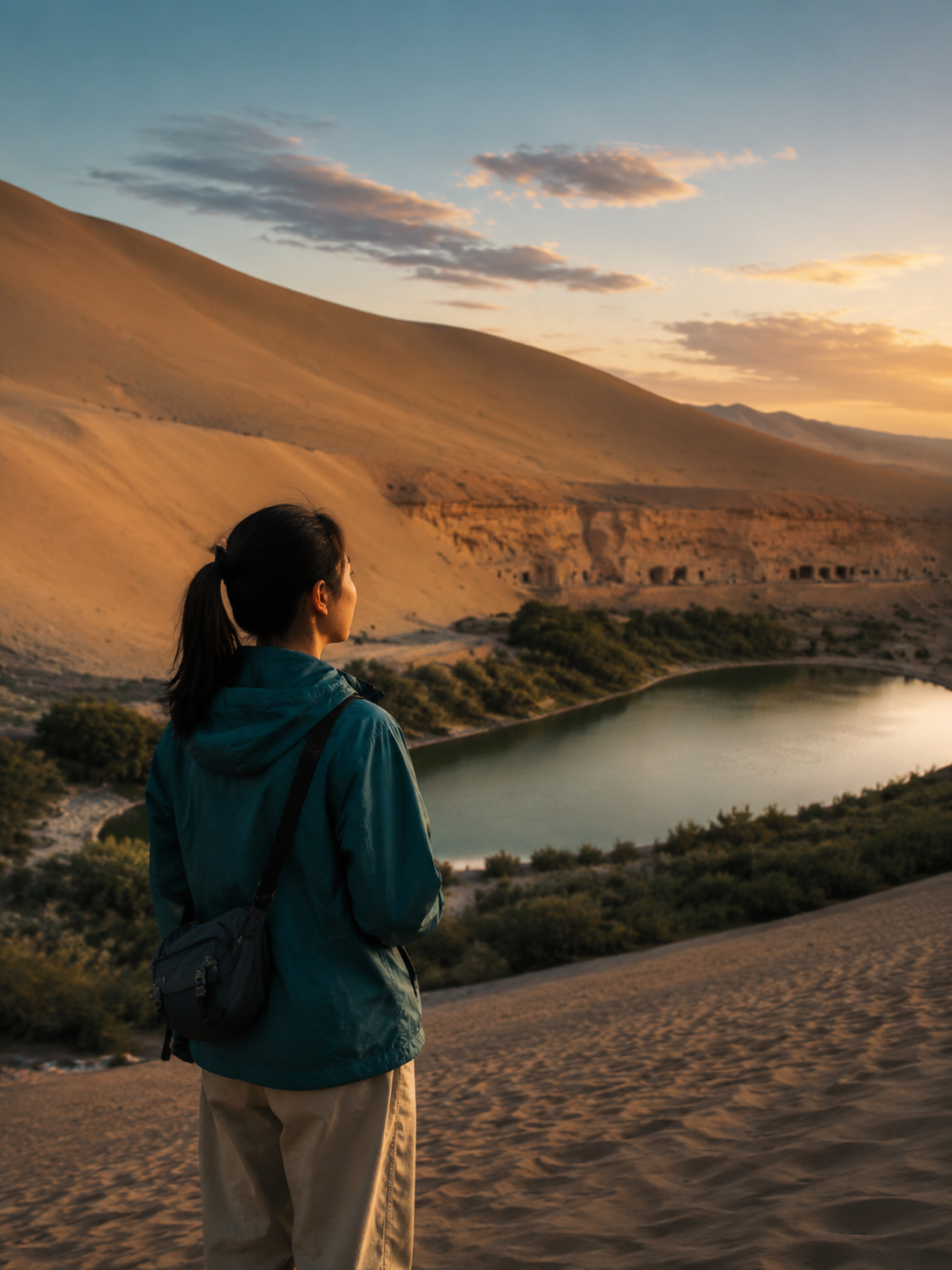
At dusk I went back to the edge of the desert.
Sixteen hundred years of caves, 45,000 square metres of murals, 50,000 items, 130 pounds.
Put those numbers side by side and you have the whole problem of Dunhuang.
If something will decay where it stands but survives once taken away, which would you choose?
Listen again
Try it without the transcript and notice what sounds clearer.
What vocabulary does this episode teach?
词汇HSK 3. The famous one happened in a very small cave.
HSK 3. Within ten years the contents were spread across it.
HSK 2. Four of them contain the whole problem.
Cave 17. Why it was sealed is still unsettled.
About 7,000 complete ones left in 1907.
Wang Yuanlu, caretaker of the caves.
They could rest at Dunhuang, so the route held.
130 of them for 13,000 items.
* beyond level超纲词
What grammar patterns appear in this episode?
语法其中 …
Introduces a breakdown of a total just stated.
他从王圆箓手里买走二十九箱,其中大约七千件完整的写本,六千件残片。
把 + object + verb + 进去
Says something was put into a place.
大约一千年前,有人把它们放进去,然后砌上了墙。
如果 …,反而 …
Sets up an expectation, then states the opposite outcome.
如果一件东西留在原地会坏,被拿走反而能保住,你会怎么选?
Proper nouns
专有名词Sources
来源Free account
Keep learning from this story
Create a free account to keep saved words and your preferred level together.
- Keep words with their story context
- Remember your preferred level
- Build your vocabulary over time