
A Chinese podcast · Same story, 4 levels
敦煌:一份意外完整的档案
Dunhuang: 492 Caves, 50,000 Manuscripts, 130 Pounds
About this story
Geography, 1,600 years of cave-cutting, the 1907 sale for 130 pounds, and the digital compromise that followed. HSK 5-6 Chinese listening practice.
This is an HSK 5-6 Chinese listening episode that runs about 5 minutes. The full Mandarin script is shown with tap-for-pinyin and a line-by-line English translation, so you can listen and read at once — comprehensible input in the sense of Stephen Krashen's i+1 theory. It teaches 8 key vocabulary words such as 绿洲、开凿、文书 and walks through 3 grammar patterns, each explained in English with examples. The same news story is retold at 4 difficulty levels — use the level selector above to find the version that is challenging but still understandable for you.
Read at your level
原文Read the complete story in Chinese. Reveal pinyin and English only when you need them.
English transcript reference
Dunhuang is easiest to tell as a story about feelings: the treasures were tricked out of us by foreigners.
That version isn't wrong, but it makes you miss the more interesting part.
Start with geography.
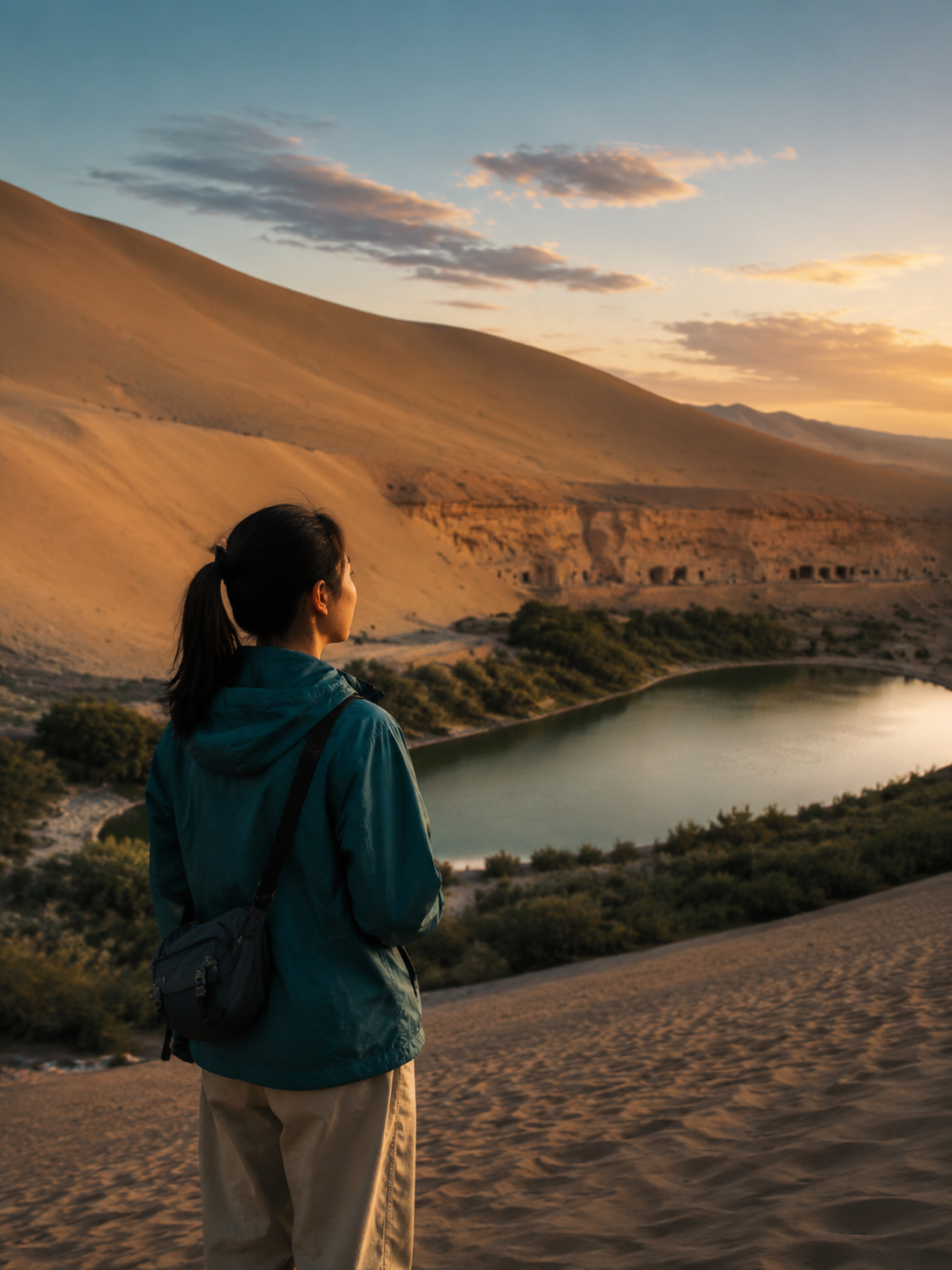
Dunhuang lies at the far western end of the Hexi Corridor, the last oasis with real water before you enter Central Asia from the Central Plains.
There are very few places to stop in that desert, and Dunhuang happens to be one.
With water, caravans can rest; if they can rest, the route holds; if the route holds, people, goods and ideas pass through year after year.
The Mogao Caves were cut into the cliff beside that route.
The first cave was opened in 366, and generation after generation kept adding to it for more than a thousand years.
Today 492 caves survive with murals, distributed across five levels of the cliff.
The murals total roughly 45,000 square metres, with more than 2,000 painted sculptures besides.
In 1987, the Mogao Caves were inscribed on the World Heritage List.
Once you're actually inside a cave, what usually catches you first is the incidental detail.
What instruments the band is playing, what carts the caravan drives, what the figures are wearing, how farmers work the land, how a wedding proceeds.
The donors who funded the caves meant to accumulate merit, and incidentally preserved a thousand years of ordinary life for everyone after them.
That is Dunhuang's first layer of value: it is an accidentally complete archive.
And the most famous thing about Dunhuang happened in a cave less than three metres across.
It is called the Library Cave, number 17.
In 1900, the Daoist caretaker Wang Yuanlu was clearing drifted sand when he noticed that the space behind one wall was hollow.
When it was opened, more than 50,000 manuscripts were stacked neatly inside.
The dates run from the fourth century to the eleventh, and the contents include sutras, account books, contracts, letters, poems and medical prescriptions.
About a thousand years ago, someone sealed them in and bricked up the wall.
Why the cave was sealed is still unsettled; scholars have proposed a refuge theory, a discard theory, and several others.
What happened next is the real turn in this story.
In 1907, the British explorer Aurel Stein reached Dunhuang.
He acquired 29 cases of manuscripts and paintings from Wang Yuanlu: roughly 7,000 complete manuscripts and 6,000 fragments.
The entire sum he paid for them was 130 pounds.
130 pounds, for more than 13,000 items.
The next year the French sinologist Paul Pelliot arrived and spent three weeks selecting inside the cave.
He read Chinese, so what he picked out was largely the material of highest documentary value.
In 1910, about a fifth of the remaining Chinese manuscripts were shipped to Beijing.
Within ten years, the contents of the Library Cave had dispersed into public and private collections around the world.
To study this material systematically today, you have to make the circuit of London, Paris, St Petersburg, Tokyo and Beijing.
The contents of one cave were broken up into a map of the world.
This is hard to judge in a single sentence.
Without these men stepping in, some of those manuscripts might not have survived to today.
But the way they obtained them did rest on the other side not knowing what they were worth.
Both judgements hold at once, and neither cancels the other.
More useful than the argument is the compromise that came later: the International Dunhuang Project.
Participating institutions scan their Dunhuang manuscripts item by item in high resolution and put them all on one platform.
The physical objects remain scattered across countries; the digital images can be reassembled in a single interface.
It doesn't settle ownership, but it settles the researcher's problem, and researchers are why these manuscripts matter at all.
The same logic is applied to the caves themselves.
Murals are extremely sensitive to humidity, light and carbon dioxide, and heavy visitor traffic visibly accelerates flaking and fading.
So visits now run on booked, capped entry: you see the images at the digital centre first, then enter the real caves, with strict limits on how long you stay.
Shifting part of the viewing onto a screen is exactly a way to have the real thing looked at less often.
This is the same idea as the International Dunhuang Project: use infinitely copyable images to absorb the demand on an object that actually wears out.
At dusk I went back to the edge of the desert.
Sixteen hundred years of caves, 45,000 square metres of murals, 50,000 manuscripts, 130 pounds.
Set those four numbers side by side and you have the whole problem of Dunhuang.
If an object will be destroyed where it stands but survives by being taken away, where do you think it belongs?
Listen again
Try it without the transcript and notice what sounds clearer.
What vocabulary does this episode teach?
词汇HSK 4. 492 caves survive with their murals.
HSK 4. The seller did not know what the papers were worth.
HSK 4. Digitisation solves research, not ownership.
The last one with real water before Central Asia.
Began in 366 and continued for over a thousand years.
More than 50,000 of them, 4th to 11th century.
About 6,000 of them went in the 1907 sale.
What the donors accidentally created while buying merit.
* beyond level超纲词
What grammar patterns appear in this episode?
语法自 A 延续到 B
Formal way to state a span running from one point to another.
年代自四世纪延续到十一世纪,内容包括佛经、账本、契约、书信、诗歌和药方。
并不 + verb
Emphatic negation, denying an expected implication.
两种判断同时成立,并不互相取消。
正是为了 …
States the real purpose behind an action that looks odd.
把一部分观看转移到屏幕上,正是为了让实物少被看几次。
Proper nouns
专有名词Sources
来源Free account
Keep learning from this story
Create a free account to keep saved words and your preferred level together.
- Keep words with their story context
- Remember your preferred level
- Build your vocabulary over time