
A Chinese podcast · Same story, 4 levels
敦煌:一百三十英镑
Dunhuang: 492 Caves, 50,000 Manuscripts, 130 Pounds
About this story
492 caves, 45,000 square metres of murals, and the 1900 discovery that sent 50,000 manuscripts around the world. HSK 2 Chinese listening practice.
This is an HSK 2 Chinese listening episode that runs about 4 minutes. The full Mandarin script is shown with tap-for-pinyin and a line-by-line English translation, so you can listen and read at once — comprehensible input in the sense of Stephen Krashen's i+1 theory. It teaches 8 key vocabulary words such as 敦煌、莫高窟、藏经洞 and walks through 3 grammar patterns, each explained in English with examples. The same news story is retold at 4 difficulty levels — use the level selector above to find the version that is challenging but still understandable for you.
Read at your level
原文Read the complete story in Chinese. Reveal pinyin and English only when you need them.
English transcript reference
Dunhuang is in the desert.
There's no water in the desert, but Dunhuang has water.
Where there's water, people can settle.
Long ago, people travelling the Silk Road rested at Dunhuang.
Today I'm going to see the Mogao Caves.
The Mogao Caves are on a cliff face.
There are many caves on the cliff, five levels in all.
My friend said: the first cave was cut in 366.
I said: 366?
She said: yes, more than 1,600 years ago.
She said: people after that cut them one by one, for over a thousand years.
I said: how many caves are there now?
She said: caves with paintings, 492 of them.
She said: the paintings inside cover 45,000 square metres.
She said: and there are more than 2,000 painted figures.
She said: in 1987, the Mogao Caves became a World Heritage Site.
I went into one cave.
The cave isn't big, but all four walls are paintings.
There are people in the paintings, horses, and flowers too.
These paintings have been here more than a thousand years.
In the afternoon, she took me to see a very small cave.
She said: this cave is called the Library Cave.
She said: in 1900, a Daoist priest found a door here.
She said: behind the door is a small room.
She said: there were more than 50,000 items in the room.
She said: books, paintings, and writing by people from long ago.
She said: the dates run from the year 400 to the year 1000.
I said: why were there so many?
She said: a thousand years ago, someone put them in and shut the door.
She said: why it was shut, nobody knows to this day.
I said: where are these things now?
She said: not here.
She said: in 1907, an Englishman came.
She said: he bought 29 cases from the priest.
She said: about 7,000 complete books, and 6,000 smaller pieces.
I said: how much did he pay?
She said: 130 pounds.
I said: 130 pounds, for 13,000 items?
She said: yes, 130 pounds.
She said: the next year, a Frenchman came too.
She said: he looked through the cave for three weeks and took a lot as well.
She said: within ten years, the things from the Library Cave were in many countries.
I said: so how do you see them now?
She said: there's a new way now.
She said: whichever country a piece is in, it gets photographed there.
She said: the photos all go online.
She said: that way you can see them all in one place.
I said: the things are still in many countries.
She said: yes, but the photos are together.
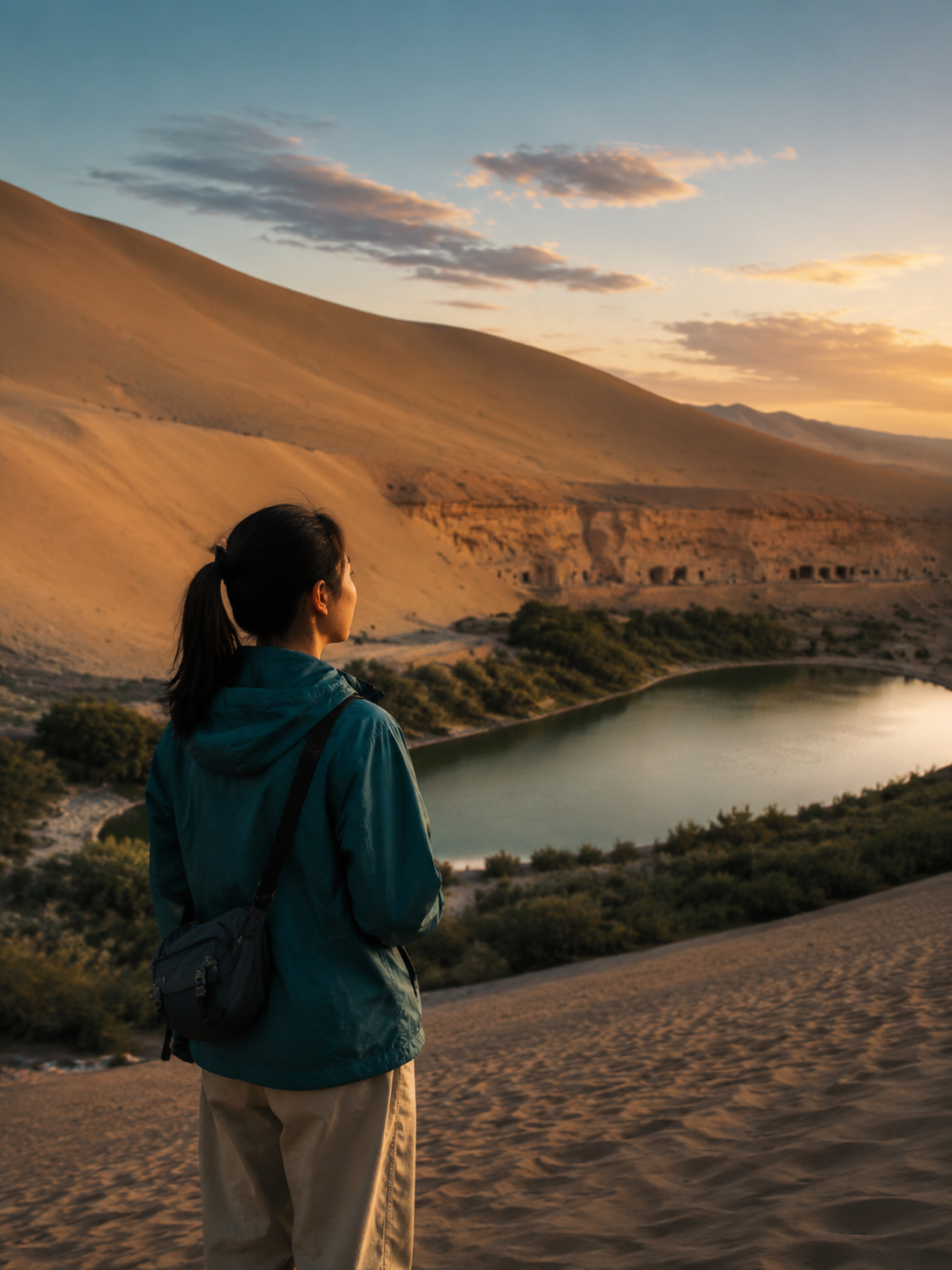
In the evening, I sat at the edge of the desert.
Sixteen hundred years, 492 caves, 45,000 square metres of painting.
More than 50,000 items, 130 pounds.
Tell me: for something very old, what matters most, that someone protects it, or that it stays where it was?
Listen again
Try it without the transcript and notice what sounds clearer.
What vocabulary does this episode teach?
词汇HSK 2. The objects stayed apart; the photos were brought together.
HSK 1. More than 50,000 items in one small room.
HSK 1. The question is which place they belong in.
The stop on the Silk Road that had water.
Five levels of caves cut into one cliff face.
Sealed about 1,000 years ago; opened in 1900.
Wang Yuanlu, who was clearing sand when he found the door.
130 of them, for 29 cases.
* beyond level超纲词
What grammar patterns appear in this episode?
语法把 + object + verb
Says what was done to a specific object.
她说:一千年以前,有人把东西放进去,就把门关上了。
从 A 到 B
Marks a span, in time or in space.
她说:时间从四百年到一千年。
A 还是 B?
Offers two options and asks the listener to choose.
你说,一个很老的东西,最重要的是有人保护它,还是在原来的地方?
Proper nouns
专有名词Sources
来源Free account
Keep learning from this story
Create a free account to keep saved words and your preferred level together.
- Keep words with their story context
- Remember your preferred level
- Build your vocabulary over time