
A Chinese podcast · Same story, 4 levels
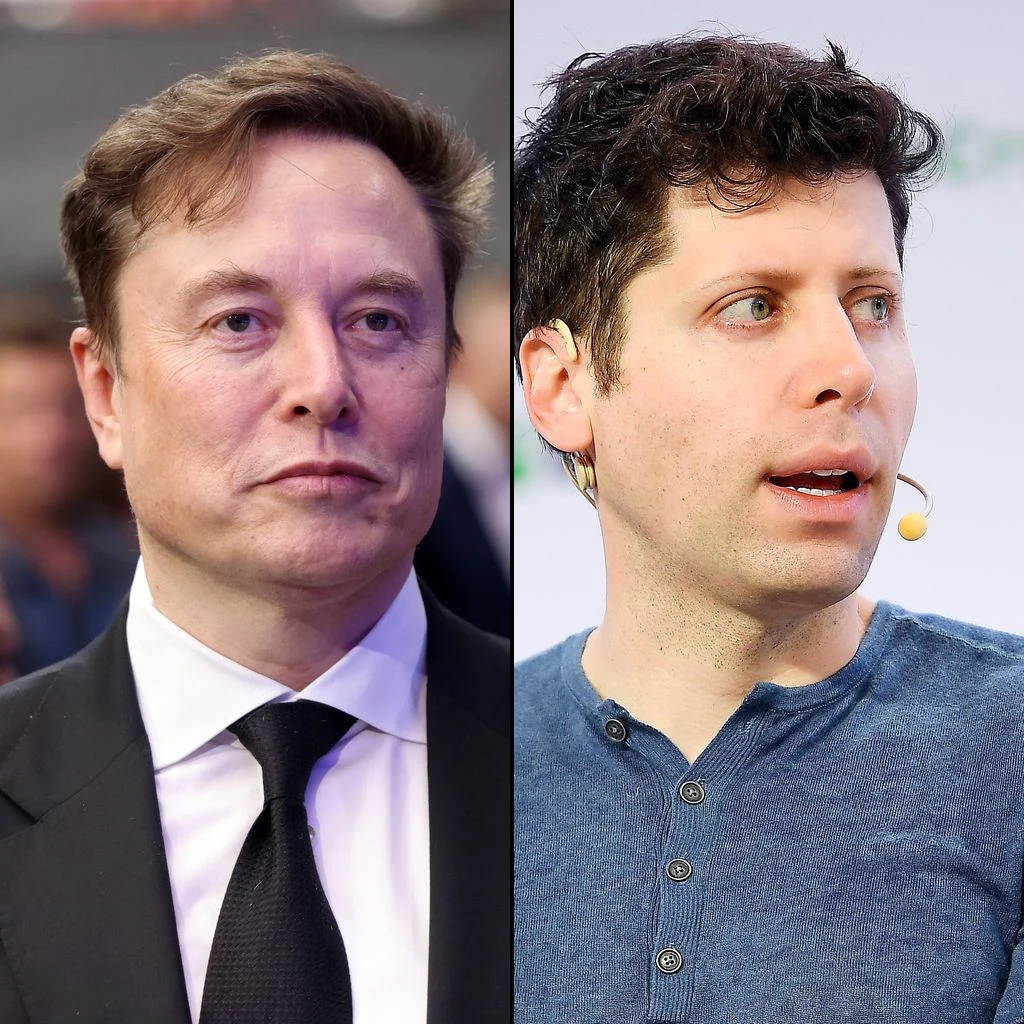
马斯克 vs 奥特曼:从合伙人到对手
Musk vs Altman: From Partners to Enemies
About this story
Musk vs Altman: From Partners to Enemies. HSK 3 Chinese listening practice.
This is an HSK 3-4 Chinese listening episode that runs about 4 minutes. The full Mandarin script is shown with tap-for-pinyin and a line-by-line English translation, so you can listen and read at once — comprehensible input in the sense of Stephen Krashen's i+1 theory. It teaches 12 key vocabulary words such as 决定、影响、输 and walks through 4 grammar patterns, each explained in English with examples. The same news story is retold at 4 difficulty levels — use the level selector above to find the version that is challenging but still understandable for you.
Read at your level
原文Read the complete story in Chinese. Reveal pinyin and English only when you need them.
English transcript reference
On May 18, an AI news story came out of the US.
Not a new model,
not a new product.
A court decision.
Musk lost.
Who is Musk?
You know him.
The richest man in the world.
Tesla, SpaceX, X, xAI —
they're all his.
Who was he suing?
He was suing Sam Altman,
and Altman's company,
OpenAI.
OpenAI is the company that makes ChatGPT.
The number-one AI company in the world.
These two people,
actually have a long history.
In 2015,
Musk and Altman,
along with a few friends,
together founded OpenAI.
At that time,
they said:
when we make AI,
it's not for making money.
It's to make AI safe.
It's also to let everyone use it.
So OpenAI, at the start,
was a non-profit company.
We say "non-profit."
But after a few years,
their thinking changed.
Altman thought:
making AI is too expensive.
We don't have money.
We have to let the company earn money,
so we can keep going.
Musk thought:
we can't do that.
We said at the start,
this is for everyone.
Later,
Musk left OpenAI in 2018.
He started his own AI company,
called xAI.
OpenAI kept going.
They made ChatGPT,
made GPT-4,
made GPT-5.
They went from a small non-profit,
to a very large company.
Now OpenAI is worth hundreds of billions of dollars.
Musk watched,
and the more he thought, the unhappier he got.
He thought:
"This should have been mine.
"Altman tricked everyone.
Last year,
Musk went to court.
He sued Altman,
and OpenAI.
He said:
"You violated the agreement we had at the start.
"You shouldn't earn money like this.
This is the biggest AI lawsuit in recent years in the US.
The court had 12 ordinary people,
listen to this case.
They are called a "jury."
A jury isn't judges,
they are ordinary people.
Altman and Musk both went to court.
Both spoke.
Both were asked many questions.
Altman said:
Musk left in 2018.
After he left,
OpenAI had almost no money.
He stopped caring.
We grew it ourselves, slowly.
Now he comes saying we're wrong,
he himself wasn't even there back then.
The 12 jurors,
listened for several days.
On May 18,
they deliberated for less than two hours.
Then they said:
"Musk,
"you came too late.
"You knew about these things back in 2018.
"You should have sued earlier.
"Now the time has passed.
"We can't listen to you.
That is to say,
the court didn't say "Altman is right,"
nor "Musk is wrong."
What the court said was:
"You came too late.
Musk is unhappy.
He said:
"This is only a timing issue.
"I'll go to a higher court.
Altman is happy.
He said:
"We can focus on making AI now.
This story,
isn't over.
Musk will go to a higher court.
That could take a year,
two years.
Maybe even longer.
But this round of winning and losing
actually matters.
It tells us:
even if you are the richest person in the world,
you can't just sue whenever you want.
The law has a clock,
once the time has passed,
you can't sue anymore.
It also tells us:
this AI industry
has too much money.
Between people,
it's very easy to become enemies.
These two,
ten years ago,
were friends building OpenAI together.
Now,
they are opponents in court.
In the future,
this kind of story,
we'll probably see more of.
Okay.
That's all for today.
Talk tomorrow.
Listen again
Try it without the transcript and notice what sounds clearer.
What vocabulary does this episode teach?
词汇Decision; to decide. The episode pivots on several 决定: Musk to leave, OpenAI to add a for-profit arm, the jury to dismiss. Each one redirected the story.
Influence, impact. Musk's role in early OpenAI had huge 影响; his absence after 2018 also had huge 影响. The word covers both.
To lose (a case, a contest). The verdict headline. Paired in the episode with 赢 (to win).
To win. Sam 赢了 this round. Musk says he'll fight again.
To accept. Used here for the unwritten background: even if you don't 接受 a verdict, life moves on. (Musk doesn't 接受 — he'll appeal.)
Ordinary. A jury isn't judges — it's 12 普通人, ordinary people. That detail matters: the law lets ordinary people decide.
A court. The arena. The episode tracks Musk going to 法院 once, losing, and announcing he'll go to a higher 法院.
A jury. American legal feature; less common in China. The 12 ordinary people who heard the case and decided in under two hours.
Non-profit. OpenAI started as a 非营利 company — that founding label is the entire basis of Musk's lawsuit.
To violate (an agreement, a rule). Musk's claim: OpenAI 违反了 the original deal. Crucial legal verb.
Enemy. The closing thesis: in AI, money turns 朋友 into 敌人 fast.
Industry, sector. The 'AI 行业' framing — this isn't just two people fighting, it's a window into a whole industry.
* beyond level超纲词
What grammar patterns appear in this episode?
语法也就是说 + clause
也就是说 introduces a restatement / clarification of what was just said. The episode uses it to translate the legal verdict into plain English (or plain Chinese, here): 也就是说,马斯克输了. Essential for explainer-style speech.
也就是说,马斯克输了。
也就是说,法院说他来晚了。
就算 X,也 Y
就算...也... = even if. The closing lesson uses it: 就算你是世界上最有钱的人,你也不可以想告就告 — even if you're the world's richest person, you can't sue whenever you want. Marks a hard limit that doesn't bend.
就算你是世界上最有钱的人,你也不可以想告就告。
就算他不喜欢,也要听法院的。
过了 X,就不能 Y
Time-deadline structure. The whole verdict hinges on this: 过了时间,就不能告了 — once the time is up, you can't sue. Useful for any rules-with-a-clock.
过了时间,就不能告了。
过了今天,就不可以了。
X 让 Y + V
让 puts another subject inside your verb. 法院让 12 个人来听 — the court has 12 people listen. Foundational causative.
法院让 12 个人来听这个案子。
他让公司赚钱。
Proper nouns
专有名词Free account
Keep learning from this story
Create a free account to keep saved words and your preferred level together.
- Keep words with their story context
- Remember your preferred level
- Build your vocabulary over time