
A Chinese podcast · Same story, 4 levels
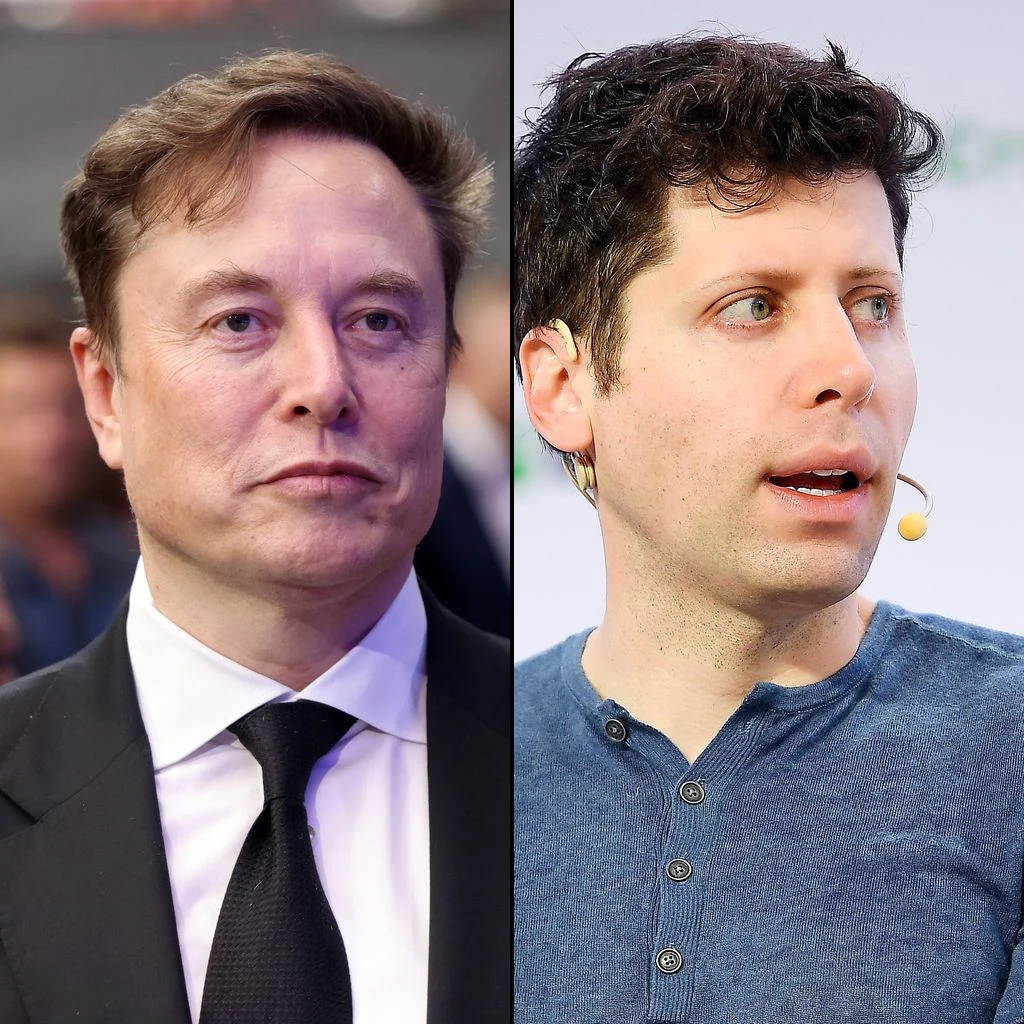
马斯克 v. 奥特曼——硅谷最大 AI 恩怨案
Musk v. Altman — Silicon Valley's Biggest AI Feud
About this story
Musk v. Altman — Silicon Valley's Biggest AI Feud. HSK 5-6 Chinese listening practice.
This is an HSK 5-6 Chinese listening episode that runs about 7 minutes. The full Mandarin script is shown with tap-for-pinyin and a line-by-line English translation, so you can listen and read at once — comprehensible input in the sense of Stephen Krashen's i+1 theory. It teaches 12 key vocabulary words such as 政府、信任、公平 and walks through 4 grammar patterns, each explained in English with examples. The same news story is retold at 4 difficulty levels — use the level selector above to find the version that is challenging but still understandable for you.
Read at your level
原文Read the complete story in Chinese. Reveal pinyin and English only when you need them.
English transcript reference
May 18, 2026, Oakland, California.
A 12-person jury,
after several days of meetings
and hearing the biggest lawsuit in the AI industry,
took less than two hours
to reach a conclusion.
Musk lost.
Specifically:
they decided that
Musk's case against OpenAI and Sam Altman
exceeded the time the law allows.
That is to say:
it wasn't that Musk's reasoning was wrong,
he came too late.
This is one of the most-watched tech lawsuits of recent years in the US.
Let's go through it properly today.
The story begins back in 2015.
That year,
a group of people held a meeting in San Francisco.
Among them was Musk,
Sam Altman,
and several AI researchers.
They were all worried about the same thing:
in the future AI could become extremely powerful.
If only big companies like Google and Facebook,
made AI behind closed doors,
then AI might end up controlled by a handful of companies.
That would be dangerous,
for all of humanity.
So they decided:
we'll start our own AI company.
But this company,
must not be like Google,
chasing profit.
It must be a non-profit.
Research results
will be public.
Code
will be open.
That was OpenAI.
At the start,
Musk put in a lot of money.
He pledged a hundred million dollars.
For the first few years,
he was seen as the face of OpenAI.
But by 2018,
the two of them began to clash.
The first reason
was money.
Making AI was far more expensive than imagined.
The non-profit model couldn't raise enough.
Altman and others began to think:
could we add a for-profit arm?
Still available to everyone,
but with returns allowed for investors.
Musk disagreed.
Musk's logic was:
we said at the start it would be a non-profit.
You're changing it now,
which means breaking the deal.
The second reason
was sharper.
Musk wanted to be CEO of OpenAI himself.
He wanted to take it over.
But the others didn't agree.
In the end,
in February 2018,
Musk left OpenAI's board.
He also stopped his donations.
OpenAI at that point
was actually in danger.
Without Musk's money,
the company almost didn't survive.
But Altman and the team held on.
They built a for-profit subsidiary,
got Microsoft to invest ten billion dollars,
then made ChatGPT.
Then made GPT-4.
Then the valuation went from 20 billion,
to 500 billion dollars.
And Musk?
Musk, on the outside,
watched OpenAI grow step by step.
Watched Altman become the most powerful person in AI.
Watched OpenAI become more and more like an ordinary tech company.
The more he thought, the less he could let it go.
In 2024,
Musk sued OpenAI and Altman in California federal court.
His core claims were two:
First,
OpenAI violated the "charitable trust" —
meaning,
you originally built this in the name of charity,
the money, the talent, the attention,
were all based on that promise.
Now you've become a for-profit company,
which means you tricked all the donors and supporters from back then.
Second,
Altman and other leadership
unfairly enriched themselves.
They took what should have belonged to "all humanity."
These claims
sound powerful.
But the legal world
doesn't only look at "right or wrong,"
it also looks at "time."
The jury heard the case for several days.
Altman took the stand
and delivered crucial testimony.
He basically said:
"Musk left in 2018.
"When he left,
"we almost died.
"We saved it ourselves.
"Now he comes saying we're wrong?
"He's the one who ran away.
On May 18,
the 12 jurors,
in less than two hours, reached a conclusion:
the timing of Musk's lawsuit
exceeded the "statute of limitations."
What is the "statute of limitations"?
It means for anything,
if you want to sue someone,
there is a time limit.
Once the time is up,
you can't sue.
The jury decided:
Musk actually already knew about OpenAI's change of direction in 2018.
At that time he didn't sue.
Later he kept complaining publicly,
but didn't go to court.
He waited until 2024 to formally sue,
which was already past the legal time limit.
The court therefore ruled against him.
But did not discuss:
"whether OpenAI actually violated the agreement.
That's why Musk is angry.
He said:
"This is just a timing issue.
"This is a technicality.
"If a mere technicality can block a case this big,
"then all charitable promises in the future are meaningless.
He announced he will appeal.
All the way to the federal appellate court.
And Altman?
He was calm.
He said:
"OpenAI can finally focus on doing what we're meant to do.
This ruling
actually tells us three things.
First,
about the nature of AI.
OpenAI going from a small non-profit
to today's 500-billion-dollar giant,
that process
is one of an ideal being remade by reality.
Back then they said "for everyone,"
today's AI
requires a monthly fee,
is controlled by a few countries,
and is becoming infrastructure, like water or electricity.
The ideal isn't dead.
But it has been redefined by money.
Second,
about Silicon Valley friendship.
Musk and Altman,
in 2015, were co-founders.
In 2018, estranged colleagues.
In 2024, opponents.
In 2026, two people facing off in court.
"Friends" in Silicon Valley
have never been quite the same
as "friends" for ordinary people.
Between them sit billions and hundreds of billions of dollars,
and very different visions of the future.
Third,
about the law.
Even if you are the richest person in the world,
the law will not stop for you.
The "statute of limitations" sounds like a small thing,
but it's exactly why Musk lost this time.
Musk will appeal.
The story isn't over.
But this round,
Altman won.
We watch this AI industry
the way you watch a slowly unfolding television drama.
New characters will appear,
new lawsuits will appear.
But ChatGPT is still there.
xAI is still there.
The story of AI
still has a long way to go.
Okay.
That's all for today.
See you in the next story.
Listen again
Try it without the transcript and notice what sounds clearer.
What vocabulary does this episode teach?
词汇Government. Used in the closing argument about AI being 'controlled by a few 政府'. Important in any modern AI discussion.
Trust. The unwritten word beneath the lawsuit: donors gave because they 信任 the non-profit framing. Musk's claim is that that 信任 was betrayed.
Fair, fairness. Musk's signature complaint: '这不公平' — and the deeper question of whether the 'statute of limitations' is itself a fair tool here.
Decision. Several pivot points in the story are 决定: to leave, to restructure, to sue, to dismiss. Each one bent the arc.
To accept. Musk refused to 接受 OpenAI's drift, then refused to 接受 the verdict — the refusal is consistent.
Serious, severe. Used implicitly: this is one of the most 严重 tech lawsuits of recent years, given the size of the parties and the stakes.
Non-profit. The founding label of OpenAI in 2015 and the entire basis of Musk's claim. The fight is about how much of that founding identity still binds the company today.
Legal term: the time window within which a lawsuit must be filed. Once it lapses, the case is barred regardless of merit. This is exactly what doomed Musk's claim — not its substance, its timing.
To appeal (a verdict to a higher court). Musk's announced next move: 上诉 to the federal appellate court. The case isn't over until the appeals are exhausted.
Jury — 12 ordinary citizens who decide questions of fact in a US trial. Their less-than-two-hour deliberation here signals confidence in the timing-bar reading.
To violate. Musk's claim: OpenAI 违反了 the founding agreement / 'charitable trust'. The court never ruled on whether this was true — only that he sued too late.
(Company) valuation. The episode tracks OpenAI's 估值 climbing from $20B to $500B as the engine of Musk's grievance: he watched the wealth he helped seed compound into someone else's empire.
* beyond level超纲词
What grammar patterns appear in this episode?
语法不是 A,而是 B
Sharp contrastive structure. The verdict logic: 不是马斯克的理由不对,是他来得太晚了 — it isn't that Musk was wrong on the merits; it's that he was late. 而是 makes the replacement explicit; 是 alone is the conversational variant used here.
不是马斯克的理由不对,是他来得太晚了。
不是为了赚钱,是为了让 AI 安全。
就算 A,也 B
Concessive structure. The closing principle: 就算你是世界上最有钱的人,法律也不会因为你而停下来 — even if you're the richest person in the world, the law doesn't stop for you. Marks a hard rule that refuses to bend to status.
就算你是世界上最有钱的人,法律也不会因为你而停下来。
就算他上诉,也要等很久。
越 V₁ 越 V₂
Proportional structure. 'Musk 越想越不甘心' — the more he thought, the less he could let it go. One of the most compact ways to render an escalating emotional state.
他越想越不甘心。
越想越生气。
从 A 到 B
Tracks change across a span. The episode stacks them: 2015 是合伙人,2018 是不和的同事,2024 是对手,2026 是法院上的两个人 — a whole arc compressed into time stamps. 从…到 is the formal generalized form.
从一个小的非营利公司,变成了一个非常大的公司。
从 2015 年到 2026 年,他们从朋友变成了对手。
Proper nouns
专有名词Free account
Keep learning from this story
Create a free account to keep saved words and your preferred level together.
- Keep words with their story context
- Remember your preferred level
- Build your vocabulary over time