
A Chinese podcast · Same story, 4 levels
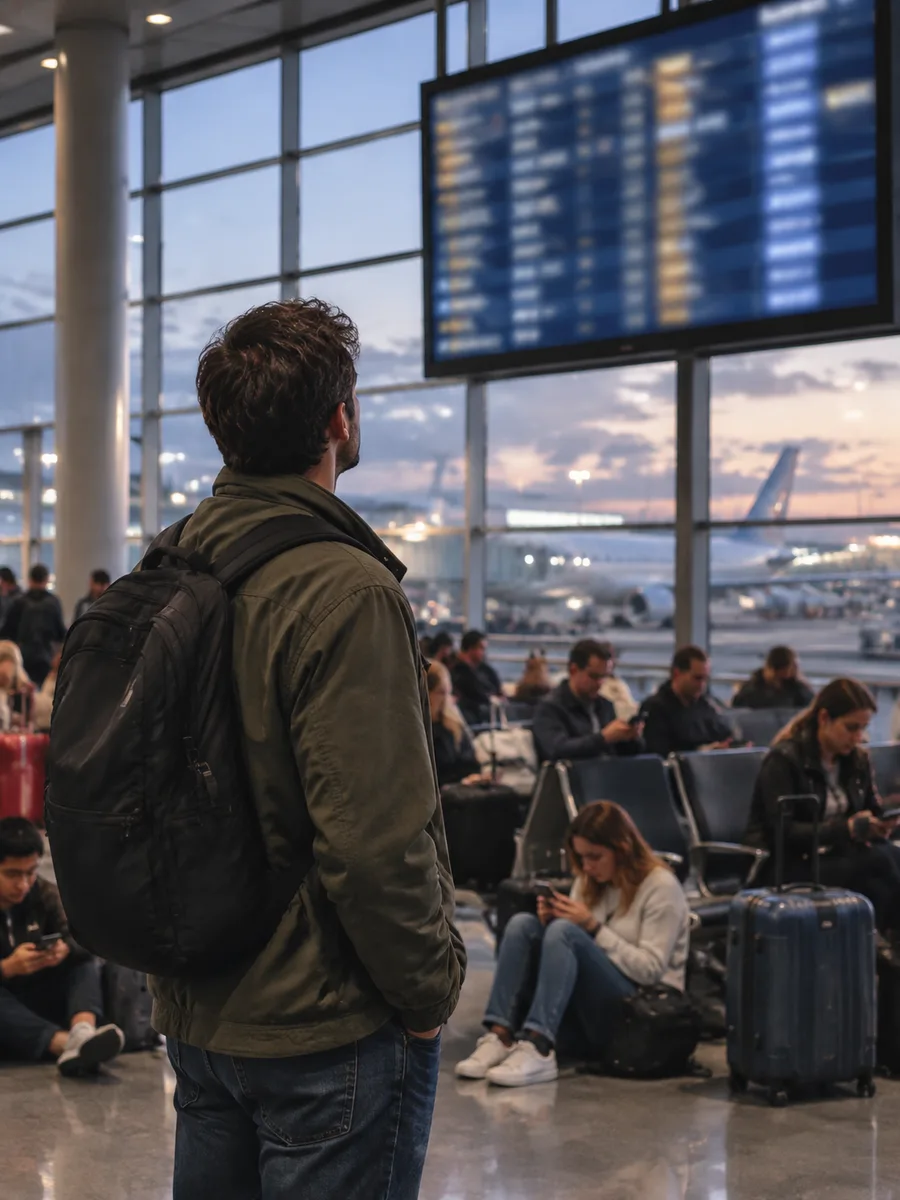
美国所有机场停飞四个多小时
Every US Airport Stopped Departures for Hours
About this story
On 13 November 2026 the FAA halted departures at every US airport for more than four hours after its communications equipment failed. HSK 5+ Chinese listening practice.
This is an HSK 5+ Chinese listening episode that runs about 3 minutes. The full Mandarin script is shown with tap-for-pinyin and a line-by-line English translation, so you can listen and read at once — comprehensible input in the sense of Stephen Krashen's i+1 theory. It teaches 12 key vocabulary words such as 安全、原因、调查 and walks through 5 grammar patterns, each explained in English with examples. The same news story is retold at 4 difficulty levels — use the level selector above to find the version that is challenging but still understandable for you.
Read at your level
原文Read the complete story in Chinese. Reveal pinyin and English only when you need them.
English transcript reference
"I don't know any more than you do."
On the afternoon of 13 November, a controller in the tower at Newark airport gave this answer over the radio to pilots waiting to take off.
That afternoon the US Federal Aviation Administration gave every airport in the country the same order: not one plane on the ground may take off.
The reason was a single sentence: "extraordinary circumstances and for reasons of safety".
A nationwide stop is extremely rare in the United States; this is the third in twenty-five years.
The first was 9/11 in 2001; the second was in January 2023, when the system that issues notices to pilots went down.
This one lasted more than four hours, and its cause was surprisingly small.
According to the Transportation Secretary, at 3:36 in the afternoon the agency found that radar and communications data at control centres around the country were becoming unstable.
Controllers now and then could not see where planes were, and could not reach pilots straight away.
At that time there were more than 3,500 planes over the United States.
The agency had not completely lost radar and communications, but it was unwilling to take the risk, so it made all the planes still on the ground wait.
Planes in the air kept flying, some were diverted to other airports, and medical flights carrying transplant organs were not stopped.
What stopped was a whole country's daily routine: more than ten thousand flights were affected and at least several hundred thousand travellers were stuck in terminals.
Airports had to find places everywhere to park planes, and some airlines simply cancelled almost all their remaining flights that day.
With a disruption this big, many people's first thought was a cyberattack.
The Homeland Security Secretary said there was no evidence of anyone breaking in and that it looked like a problem with the equipment itself, though the investigation continues.
Others pointed the finger at artificial intelligence, that is, the new systems the agency had begun using only in recent weeks.
The Transportation Secretary denied it; he said those systems are not connected at all to the equipment that failed.
The cause he gave sounds almost too simple to believe.
The agency's communications network is run by a contractor called L3Harris, which is replacing the ageing copper wire with optical fibre section by section; the work is more than seventy percent done.
On the day of the failure it was doing routine maintenance at a remote site.
A router there was suddenly flooded with a huge amount of data and then, like the first domino falling, dragged down routers all over the country one by one.
In other words, this stop happened in the very process of upgrading the system.
Whether it was an operating error, a faulty installation or a defect in the router itself, the Secretary said, still has to be investigated.
At about 8:15 in the evening the order was lifted, but the trouble was not over.
Planes were parked at airports where they should not have been, crews had reached their limit on working hours, and delays and cancellations dragged on into the weekend.
The Transportation Secretary's conclusion was blunt: this system will break again.
He asked Congress for fifty billion dollars in emergency funding to replace the air traffic control system completely, while Congress approved twelve and a half billion last year.
He also promised that flights would be back to normal before the Thanksgiving travel peak.
One router at a remote site stopped a whole country's planes for more than four hours; that is the state of America's air traffic control system today.
Listen again
Try it without the transcript and notice what sounds clearer.
What vocabulary does this episode teach?
词汇HSK 2. Used in 出于安全考虑, for reasons of safety.
HSK 2. Used in 他给出的原因.
HSK 3. Used in 调查还在继续.
HSK 4. Used in 这套系统还会再坏. Measure word 套.
HSK 3. Used in 他同时保证.
HSK 2. Used in 航班会恢复正常.
The person who directs aircraft from a tower or control centre.
A loanword from English radar.
A device that passes data along inside a network. Measure word 台.
Replaces 铜线, copper wire, in modern networks.
A company hired to do work for an organisation.
像推倒第一张骨牌一样 means like knocking over the first domino.
* beyond level超纲词
What grammar patterns appear in this episode?
语法并没有 + Verb
并 strengthens a negation, often to correct what one might assume.
航空局并没有完全失去雷达和通信,但它不愿意冒险,于是让还在地面的飞机统统等着。
像 …… 一样
Like; in the same way as.
那里的一台路由器,突然被大量数据淹没,接着,像推倒第一张骨牌一样,把全国各地的路由器一台一台拖下水。
换句话说
In other words.
换句话说,这次停飞,正是在给系统升级的过程中发生的。
到底是 A,还是 B
Asks which of several possibilities is really the case.
到底是操作失误、安装出错,还是路由器本身有毛病,部长说,还要再查。
A,而 B
而 sets a second fact against the first.
他要求国会紧急拨款五百亿美元,把空管系统彻底换新,而国会去年批的是一百二十五亿。
Proper nouns
专有名词Sources
来源- FAA lifts ground stop after more than four hours, but flight cancellations will stretch into the weekend
- Ground stop lifted hours after stranding thousands of flights across the U.S.
- Legacy tech issue led to FAA's nationwide ground stop
- FAA Lifts 4-Hour Nationwide Ground Stop; Disruptions to Last Into Weekend
Free account
Keep learning from this story
Create a free account to keep saved words and your preferred level together.
- Keep words with their story context
- Remember your preferred level
- Build your vocabulary over time