
A Chinese podcast · Same story, 4 levels
从两个半小时到五十分钟:北京机器人半马拉松和中国的机器人野心
Beijing Robot Beats Humans in Half Marathon
About this story
Honor's robot Lightning runs Beijing's Yizhuang half marathon in 50 minutes, signaling China's humanoid robotics ambition. HSK 5-6 Chinese listening practice.
This is an HSK 5-6 Chinese listening episode that runs about 7 minutes. The full Mandarin script is shown with tap-for-pinyin and a line-by-line English translation, so you can listen and read at once — comprehensible input in the sense of Stephen Krashen's i+1 theory. It teaches 12 key vocabulary words such as 机器人、百分之、经济 and walks through 3 grammar patterns, each explained in English with examples. The same news story is retold at 4 difficulty levels — use the level selector above to find the version that is challenging but still understandable for you.
Read at your level
原文Read the complete story in Chinese. Reveal pinyin and English only when you need them.
English transcript reference
When it comes to measuring the speed of technological progress, few things are more intuitive than "two and a half hours last year, fifty minutes this year."
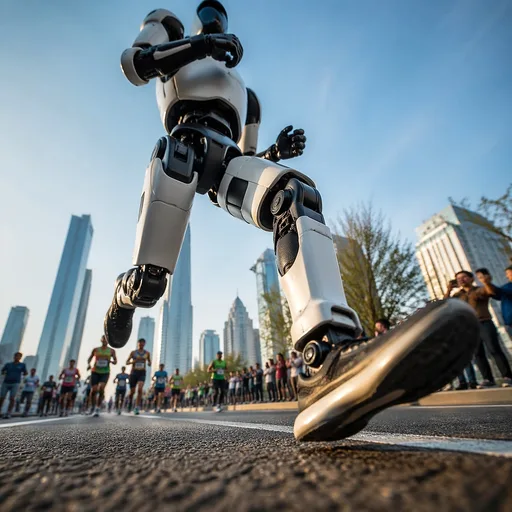
Yesterday in Beijing's Yizhuang, the second humanoid robot half marathon concluded.
A red humanoid robot called "Lightning" finished the 21-kilometer course in 50 minutes and 26 seconds.
This time beat the human half marathon world record by nearly seven minutes.
The human record is 57 minutes and 20 seconds, set by Ugandan runner Jacob Kiplimo in Lisbon.
A phone company's robot.
Runs faster than anyone on Earth.
The shock isn't that the robot won.
It's the speed at which it won.
Last year's inaugural race winner "Tiangong" finished in 2 hours 40 minutes and 42 seconds.
That pace was roughly equivalent to a not-very-athletic middle-aged person's jogging speed.
This year, Lightning ran 50 minutes and 26 seconds.
In one year, performance improved by more than three times.
In human sports history, shortening the half marathon from two and a half hours to under one hour took roughly decades.
Robots did it in twelve months.
This iteration speed is itself a signal.
Let's look at the full picture of this race.
The location was Yizhuang, Beijing Economic-Technological Development Area.
This zone is the core cluster of China's humanoid robotics industry.
Many leading robot companies are headquartered here.
This year 112 teams competed, including 5 international teams.
This was the first time international teams participated.
Compared to last year's 23 teams, growth was nearly five-fold.
Over 300 robots were on the course.
Plus 12,000 human runners.
Humans and robots ran on separate tracks to prevent collisions.
Each robot team's technicians followed in golf carts.
Carts carried stretchers and wheelchairs.
In case robots "got injured" — falls, parts coming loose, system crashes.
Lightning was developed by Honor.
Honor is a Chinese consumer electronics brand whose main product is smartphones.
But they spent a year developing this running-specific humanoid robot.
Lightning stands 169 centimeters tall.
Legs 90 to 95 centimeters long.
The design goal was to mimic elite human distance runners' body proportions and gait.
It uses liquid cooling technology accumulated from Honor's smartphone engineering.
Keeping the robot's core temperature stable during sustained high-intensity movement.
Honor didn't just win first.
They swept the top three spots.
All three robots used fully autonomous navigation.
Meaning they found their own path, avoided obstacles, determined their own pace.
Nobody operating a remote control in the background.
About 40% of all robots in the race were autonomous.
The remaining 60% still required human remote control.
But last year the proportion of autonomous was even lower.
This year's increase is itself a progress metric.
At least four robots ran under one hour.
Last year that number was zero.
The fastest human runner was Zhao Haijie.
He ran 1 hour 7 minutes and 47 seconds.
A reporter asked him what it felt like to run alongside robots.
He said a line that has been widely quoted.
"It just went whoosh right past me."
Like a gust of wind.
You're still adjusting your breathing.
It's already vanished from your field of vision.
But this race wasn't all serious technical competition.
It was also a walking comedy.
One robot face-planted about 60 meters after the start.
Smack, face down on the pavement.
Then technicians rushed over and taped its upper body together with packing tape.
It stood up and kept running.
Finished the full 21 kilometers held together with tape.
This image became the most widely shared content from the entire race.
Another robot successfully crossed the finish line.
Mission complete.
But then it suddenly veered off course and ran into roadside bushes.
Fell into a tree.
This suggests "finishing" and "stopping" may be two entirely different technical challenges for robots.
There was also a companion robot called "Xiao Pai" only about 60 centimeters tall.
It held a baby bottle and bounced along.
Like a toddler just learning to walk.
Every spectator along the road was laughing.
These scenes viewed alongside Lightning's record-breaking footage.
Create a very distinctive atmosphere.
Serious technological breakthroughs and absurd technological failures happening simultaneously.
This is precisely what an industry on the eve of explosion looks like.
Both things that amaze.
And things that make you laugh out loud.
Looking at the bigger picture, this race reflects a larger trend.
China now has over 150 humanoid robot companies.
The government has released a 2026-2030 tech development roadmap.
Including brain-computer interfaces, quantum computing, and robot-driven intelligent manufacturing.
The Chinese government is positioning humanoid robots as the next strategic industry.
The path is almost identical to how they drove the EV industry a decade ago.
First policies and subsidies.
Then attracting massive numbers of companies to enter.
Then using competition and scale effects to drive down costs.
Finally exporting products worldwide.
The path BYD walked.
Now the Honors of the world may walk it too.
A middle-aged woman named Liu Yanli who came to watch said a frequently quoted line.
She said: "For those of us in middle age, this gives us a great sense of security for the future."
She may be thinking: if robots can help with heavy physical labor in the future.
Moving, cleaning, caregiving, delivery.
Then she doesn't have to worry too much when she's old.
But the other side of the question is equally obvious.
If robots can run faster than people.
Carry more than people.
Never tire.
Don't need wages.
Then what about the people currently doing these jobs?
This question follows the same logic as the AI microdramas we discussed before.
Technological progress never stops to wait for people to get ready.
It just keeps running forward.
Just like Lightning.
Whoosh and it's gone.
You're still catching your breath.
It's already at the finish line.
Yesterday's race gave us two images.
One is a robot that ran a half marathon in fifty minutes.
The other is a robot that finished the entire course held together with tape.
One represents the frontier of technology.
The other represents the reality of technology.
The distance between the two isn't far.
Maybe it's just next year.
What will the third race look like?
Projecting at this iteration speed.
Maybe next year autonomous robots will run under forty minutes.
Maybe next year technicians won't need to follow in golf carts.
Maybe next year robots that fall can get up on their own.
No tape needed.
Maybe next year nobody will be laughing on the roadside.
Because robots will have left human silhouettes far behind.
Regardless.
April 19, 2026 is a day worth remembering.
A robot beat humans in a half marathon for the first time.
You'll remember that sound.
Whoosh.
Listen again
Try it without the transcript and notice what sounds clearer.
What vocabulary does this episode teach?
词汇A machine that looks and moves like a human.
HSK 1-4. percent.
HSK 1-4. economy.
HSK 1-4. government.
HSK 1-4. international.
HSK 1-4. policy.
A 21-kilometer running race.
The best performance ever achieved globally.
When a robot finds its own path without human control.
Using liquid to cool down electronics or machines.
Controlling something from a distance.
Adhesive tape used to stick things together.
* beyond level超纲词
What grammar patterns appear in this episode?
语法Proper nouns
专有名词Sources
来源Free account
Keep learning from this story
Create a free account to keep saved words and your preferred level together.
- Keep words with their story context
- Remember your preferred level
- Build your vocabulary over time