
A Chinese podcast · Same story, 4 levels
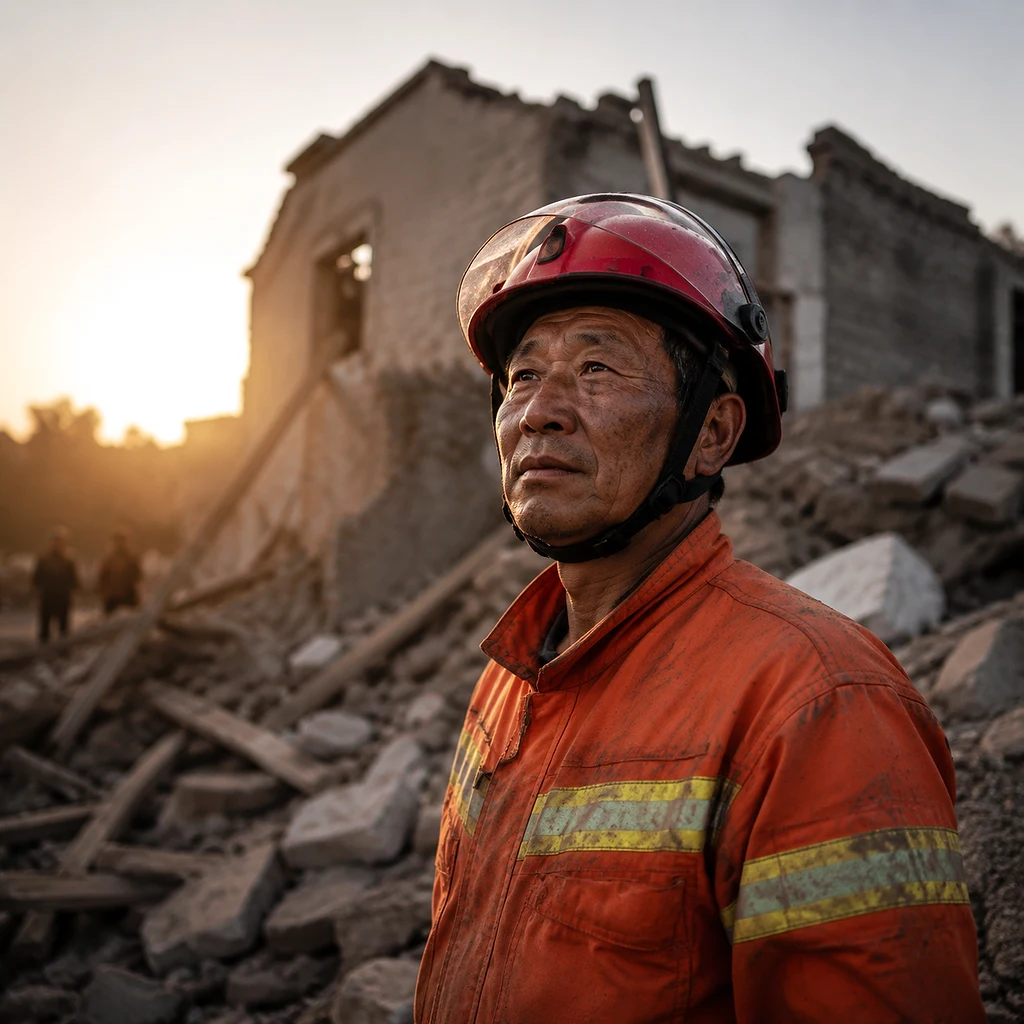
广西 5.2 级地震:一个"地震少"地方的提醒
The Guangxi 5.2: When a "Safe" Region Shakes
About this story
The Guangxi 5.2: When a "Safe" Region Shakes. HSK 5-6 Chinese listening practice.
This is an HSK 5-6 Chinese listening episode that runs about 7 minutes. The full Mandarin script is shown with tap-for-pinyin and a line-by-line English translation, so you can listen and read at once — comprehensible input in the sense of Stephen Krashen's i+1 theory. It teaches 12 key vocabulary words such as 标准、公平、稳定 and walks through 4 grammar patterns, each explained in English with examples. The same news story is retold at 4 difficulty levels — use the level selector above to find the version that is challenging but still understandable for you.
Read at your level
原文Read the complete story in Chinese. Reveal pinyin and English only when you need them.
English transcript reference
At 0:21 a.m. on May 18, 2026,
in Liunan District, Liuzhou City, Guangxi Zhuang Autonomous Region,
a magnitude 5.2 earthquake occurred.
Focal depth: 8 kilometers.
Epicenter at Taiyangcun Town, Liunan District,
about 16 kilometers from downtown Liuzhou.
This earthquake itself was not very high magnitude.
Magnitude 5.2,
among China's earthquakes in recent years,
doesn't count as severe.
But it drew national attention.
Why?
Because it happened in a place "that shouldn't have earthquakes."
China's earthquakes
are overwhelmingly concentrated in the west.
The edge of the Tibetan Plateau,
the western Sichuan Basin,
the Tianshan range in Xinjiang,
Yunnan.
These places
are at the front line where the Eurasian and Indian plates collide.
Plates compress, uplift, slip,
so earthquakes are frequent,
and some are extremely deadly.
The Wenchuan earthquake,
the Yushu earthquake,
the Ludian earthquake,
are all names everyone knows.
What about Guangxi?
Guangxi is in southern China,
within the interior of the South China block.
By traditional understanding,
the crust here is relatively stable,
earthquakes are few and small.
Over the past decades,
Guangxi has rarely had earthquakes above magnitude 5.
An inland city like Liuzhou
has almost never had one.
So this magnitude 5.2,
for Guangxi,
is a rare event.
Let's look closely at a few details of this earthquake.
First, it didn't happen in isolation.
On May 17,
that is, the day before the earthquake,
Liunan District had already had three small quakes:
7:46 a.m., magnitude 2.5;
5:07 p.m., magnitude 3.2;
10:54 p.m., magnitude 3.0.
These three small quakes,
in seismology, are called "foreshocks."
Not every major quake has foreshocks.
Sometimes
foreshocks get ignored.
People feel them,
but no one thinks a bigger one is coming.
This time the foreshock sequence in Liuzhou was clear.
In hindsight,
it was an obvious warning.
But beforehand,
no one knew whether a larger one would actually follow.
This is the hardest side of seismology —
prediction,
we still can't do it today.
Second, time and depth determined the damage.
0:21 a.m.,
the vast majority of people were in deep sleep.
A magnitude 5+ quake at this hour
means people had no reaction time.
Unlike during the day,
when you hear a sound and can run.
Being shaken awake in the middle of the night,
people need several seconds to register "this is an earthquake."
Those few seconds
are often the difference between life and death.
The focal depth was only 8 kilometers,
classifying this as a "shallow-focus earthquake."
The shallower the depth,
the more concentrated the energy reaching the surface.
The same magnitude 5.2,
if the focus had been 80 km down,
would have felt much weaker at the surface.
An 8-km shallow quake
pushes its destructive force straight up to the ground.
Combine the early hour with the shallow focus,
and that's why a 5.2
caused 13 buildings to collapse in Liuzhou.
Third, what kind of buildings collapsed?
Officials reported "roadside self-built houses."
This is the most common kind of dwelling in China's villages and small towns.
Built privately by an individual hiring workers,
not by a developer.
Some are decades old,
walls of bricks laid in mortar,
no steel reinforcement or concrete frame.
In Chinese they're called "brick-and-mortar" or, older still, "earth-and-brick" construction.
These houses
are comfortable in normal times,
with courtyards and sunlight.
But their earthquake resistance is poor.
The moment a strong quake hits,
the wall structure splits open in an instant,
then collapses.
In the Wenchuan earthquake,
this kind of self-built house was the first to fall.
The Yushu earthquake,
the Ludian earthquake,
the same.
China's newer high-rise apartments,
built to seismic standards,
generally don't fall in a magnitude 6 or 7.
So this time, all of Liuzhou's high-rises are fine.
Those affected
are the people living in old self-built houses.
There is a hidden unfairness in this.
People living in old self-built houses
tend to be lower-income families,
or elderly villagers.
They bear the bulk of an earthquake's cost.
Urban middle class in new high-rises
might only feel "a little shake."
This is the cruelty of earthquakes throughout history:
they aren't fair.
Fourth, what does Guangxi do now?
After this earthquake,
experts at the China Earthquake Administration said:
Guangxi's seismic belt
is more active than traditional understanding suggested.
The next few years will require continued monitoring.
What this means is:
the consensus that "Guangxi has few earthquakes"
may need revision.
Not that Guangxi will become Sichuan,
but rather,
"Guangxi doesn't need to worry about earthquakes at all" —
that idea
isn't necessarily right.
Going forward,
Guangxi's urban construction,
schools' emergency drills,
families' earthquake awareness,
all need to be reconsidered.
Fifth, what does this mean for the rest of China?
China has 1.4 billion people,
and many of them live in "low-earthquake" provinces.
Guangdong, Fujian, Jiangsu, Zhejiang, Hunan, Hubei.
People in these places
don't normally think about earthquakes at all.
But science tells us
the active vs. inactive phases of seismic belts
operate on decade and century timescales.
Places we think are "safe"
may just be ones where the last big quake was too long ago,
and we've lost the memory.
Historically,
Guangdong has had magnitude 7 quakes,
Fujian has had magnitude 6 quakes,
Hunan has had moderate quakes too.
We forgot.
This 5.2 in Guangxi
is not the apocalypse,
but it is a reminder.
A reminder to every person living in a "low-earthquake" place —
the city you live in
can shake too.
Finally, I want to say a few things.
Earthquakes are not moral events.
No one brings on an earthquake by doing something wrong.
An earthquake is the physical result of crustal movement.
What we can do
is not panic,
not fatalism,
but preparation.
Keep a simple emergency kit at home:
water,
a few days of food,
a flashlight,
some cash,
copies of important documents,
your regular medications.
Know that for the neighborhood you live in,
after an earthquake hits,
where the nearest open ground is.
Know where you and your family
will meet if you get separated.
These things
look excessive in normal times.
But the moment an earthquake comes,
you'll thank your past self for preparing.
The people of Liuzhou, Guangxi,
last night went through fear,
chaos,
and the long wait for sunrise.
Today,
what they need most is time,
money to rebuild,
the country's and society's care.
We watch the news,
and we think of them.
Okay.
That's all for today.
See you in the next story.
Listen again
Try it without the transcript and notice what sounds clearer.
What vocabulary does this episode teach?
词汇Standard, norm. The structural reason new high-rises survived: 按照抗震标准盖 — built to anti-seismic standards. The contrast with the old self-built houses (which followed no standards) is the heart of the damage story.
Fair, fairness. The episode's moral pivot: 这就是地震一直以来的残酷之处:它不公平 — earthquakes hit poorer households with old houses much harder than wealthier ones in modern high-rises.
Stable. The traditional view of Guangxi: '这里地壳比较稳定,地震少而且小' — the crust here is relatively stable, earthquakes are few and small. That assumption is what May 18 challenged.
Serious, severe. The narrator's opening calibration — 5.2 级在中国近年的地震里,不算严重的 — sets the tone: this is not a top-tier disaster, but it still matters.
To decide; to determine. The narrator's structural claim — '时间和深度决定了破坏' — time and depth determined the damage. Used for both human decisions and physical-cause-and-effect.
To prepare. The closing thesis: 我们能做的,是准备 — what we can do is prepare. Compact answer to a category of question (natural disaster, illness, anything you can't control) where the only useful response is upstream readiness.
A small earthquake that precedes a larger main shock. 前 (before) + 震 (quake). Not every major quake has 前震 — and in hindsight, the May 17 trio in Liunan clearly were.
The point inside the earth where an earthquake starts. The May 18 quake had 震源深度 only 8 km — extremely shallow, which is why surface damage was disproportionate to the magnitude.
A tectonic plate. The narrator places China's western seismic belts at the 欧亚板块和印度板块碰撞的前线 — the front line where the Eurasian and Indian plates collide. South China sits inside one plate's interior — historically calmer.
Deadly, fatal. 致 (to cause) + 命 (life). The narrator notes that some western Chinese earthquakes have been 非常致命 — extremely deadly, by way of contrast with the (less lethal) Guangxi event.
Rare, seldom seen. The May 18 Guangxi quake is described as 一次罕见的事件 (a rare event). 罕 (rare) + 见 (seen).
Fatalism — the philosophical view that what happens was always going to happen. The narrator rejects this: 我们能做的,不是恐慌,不是宿命论,而是准备 — what we can do is not panic, not fatalism, but preparation.
* beyond level超纲词
What grammar patterns appear in this episode?
语法不是 A, 也不是 B, 而是 C
Triple-negation-then-affirm rhetorical pattern. The closing thesis uses it: 我们能做的,不是恐慌,不是宿命论,而是准备 — 'what we can do is not panic, not fatalism, but preparation.' Common in essay-style Chinese for sharp argument.
我们能做的,不是恐慌,不是宿命论,而是准备。
X 越 Verb, Y 越 Verb
Coordinated comparative. 深度越浅,人在地面感觉越强 — 'the shallower the depth, the stronger people feel it on the surface.' One of Chinese's most compact ways to express a proportional relationship.
深度越浅,能量传到地面越集中。
不是 A 就 B (false-default rebuttal)
Rebuts a careless inference. The episode: 不是说'广西从来没有',就以为'广西永远不会有' — 'just because Guangxi has never had one doesn't mean it never will.' Use this whenever you want to break someone's assumption that the past predicts the future.
不是说"广西从来没有",就以为"广西永远不会有"。
意味着 + clause (analytical implication)
意味着 takes a fact and unpacks its implication. 这种时候发生 5 级以上的地震,意味着人没有反应时间 — 'a magnitude 5+ quake at this hour means people have no reaction time.' Essential for any analytical writing.
这种时候发生 5 级以上的地震,意味着人没有反应时间。
Proper nouns
专有名词Free account
Keep learning from this story
Create a free account to keep saved words and your preferred level together.
- Keep words with their story context
- Remember your preferred level
- Build your vocabulary over time