
A Chinese podcast · Same story, 4 levels
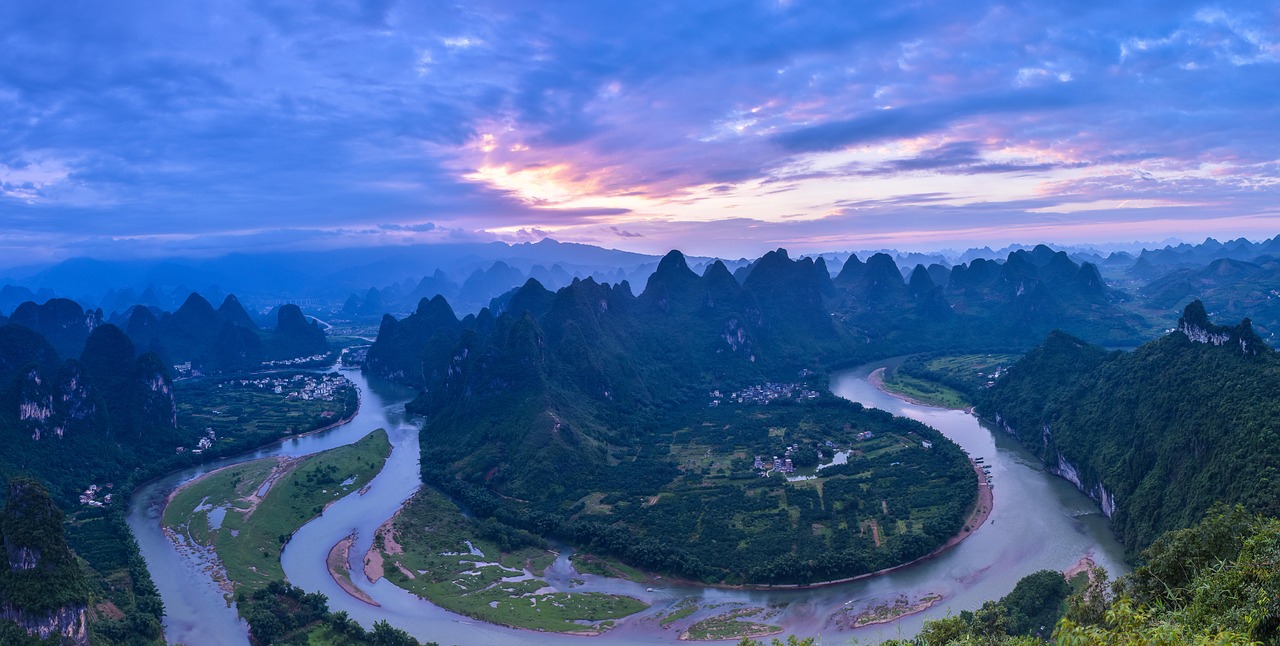
桂林:山是剩下来的
Guilin: What the Water Didn't Finish Eating
About this story
Karst geology, fenglin and fengcong, the 1201 poem behind China's most quoted line about scenery, and what happened to cormorant fishing. HSK 3 Chinese listening practice.
This is an HSK 3-4 Chinese listening episode that runs about 6 minutes. The full Mandarin script is shown with tap-for-pinyin and a line-by-line English translation, so you can listen and read at once — comprehensible input in the sense of Stephen Krashen's i+1 theory. It teaches 12 key vocabulary words such as 喀斯特、石灰岩、峰林 and walks through 3 grammar patterns, each explained in English with examples. The same news story is retold at 4 difficulty levels — use the level selector above to find the version that is challenging but still understandable for you.
Read at your level
原文Read the complete story in Chinese. Reveal pinyin and English only when you need them.
English transcript reference
Most people seeing Guilin for the first time feel the place doesn't look real.
The problem isn't Guilin — it's the paintings we've seen.
In Chinese landscape painting the hills are tall and thin, standing one by one at the water's edge, with blank space between them.
A lot of people assume the painter invented that.
Once you get to Guilin you find the painter was painting what was in front of him.
This kind of terrain has a name: karst.
The rock under Guilin is limestone, three thousand metres thick in places.
Three hundred million years ago, this was a shallow sea.
Marine organisms sank to the seabed when they died, layer on layer, and slowly became limestone.
Later the crust lifted, the sea withdrew, and the limestone was exposed.
Rainwater carries carbon dioxide, which dissolves limestone a little at a time.
For seventy million years, rain and groundwater kept dissolving it.
What dissolved became flat ground; what didn't dissolve stayed standing, and that's the peaks you see today.
So these hills didn't grow up — they are what was left over.
Guilin has two kinds of hills.
One is called fenglin, peak forest: each one completely separate, standing on flat ground.
One is called fengcong, peak cluster: joined into one mass at the base, splitting into several heads on top.
Once you know those two words, the way you look at the hills changes.
The next day I took the boat from Guilin to Yangshuo — eighty-three kilometres, four hours.
There was fog in the morning.
The guide on the boat said it looks most like the painting when there's fog.
Without fog, what you see is the shape of the rock.
With fog, what you see is distance: near ones dense, far ones faint, the furthest joined to the sky.
Chinese painting calls this liubai — leaving blank.
The painter leaves the blank on purpose; he knows the part you can't see will keep you thinking.
Once the boat was out, the hills came one after another on both banks.
The guide pointed out Elephant Trunk Hill, its foot reaching into the water, genuinely like an elephant drinking.
Further on is Nine Horses Fresco Hill, where nine horses are said to hide in the markings on the cliff.
I looked for a long time and found only three.
The guide laughed and said how many you see depends on where you stand, what the light is doing, and how badly you want to see them.
As we neared Yangshuo, he had us take out a twenty-yuan note.
The image on the back of the twenty is taken from this stretch of river; it's called Yellow Cloth Reflection.
Lots of people hold the banknote up against the real hills to photograph them aligned.
The gesture is a bit funny, but it shows something: once a place becomes an image, people come back carrying the image to look for it.
The most famous line about Guilin is that its landscape is the finest under heaven.
I always assumed it was a tourism slogan.
It was actually written in 1201, by a man called Wang Zhenggong, from Ningbo, who held office in Guilin at the time.
That year Guilin held the provincial exam, and eleven candidates passed.
Custom required a Deer-Cry Banquet to see the new graduates off.
Wang wrote two poems at the banquet, and the first line of the second one is that famous sentence.
The full couplet runs: Guilin's landscape is finest under heaven; jade-green and silk-blue, the meaning is there to be read.
In other words, a line Chinese people have been quoting for over eight hundred years was originally written for eleven young men who had just passed an exam.
The poem was carved on the south face of Solitary Beauty Peak.
Afterwards water seeped through the limestone and the calcium carbonate in it covered the whole tablet, layer by layer.
It wasn't until 1983, when staff from the Guihai Stele Forest Museum cleaned the face of it, that this Southern Song carving reappeared.
I like that detail a lot.
The most famous sentence ever written about Guilin was buried for over seven hundred years by Guilin's own rock.
In the afternoon I saw cormorant fishing.
An old man stood on a narrow bamboo raft with two black water birds on it.
The bird dives, and when it surfaces there's a fish in its beak.
The old man lifts the bird back with a bamboo pole, prises open its beak, takes the fish out, and feeds it a small one.
There's a ring around the bird's neck: small fish go down, big ones don't.
This method has been used in China for at least a thousand years; it's recorded in Song-dynasty books.
I asked the guide whether anyone still makes a living from it.
His answer was blunt: basically no one.
There are fewer fish in the river, and fishing is restricted to protect the water.
Most young people go to Guangdong for work.
The old man you see today really is a fisherman and the skill is real, but his main income now comes from tourists' photographs.
Calling it a performance isn't fair to him.
Calling it traditional life isn't accurate either.
It's more like a craft that has been kept: the use has changed, the craft is still there.
By the end of the day, what stayed with me wasn't the most famous peaks.
It was those numbers — three hundred million years, seventy million, eight hundred, one thousand — suddenly all stacked on the same river.
If a place was painted, photographed and printed on money before you ever arrived, how can you still see it for the first time?
Listen again
Try it without the transcript and notice what sounds clearer.
What vocabulary does this episode teach?
词汇HSK 2-3. Used for each named spot along the river.
HSK 1. Naming a hill is a way of teaching people how to look at it.
HSK 2. The reaction everyone has on first seeing Guilin.
HSK 3. How many horses you see 'has to do with' where you stand.
The landform: soluble limestone carved out by water.
Laid down under a shallow sea 300 million years ago.
Fully separated towers on a plain.
Joined at the base — thought to be the earlier stage.
What the fog does for you, and what the painter did on purpose.
Where the line about Guilin was actually written, in 1201.
Seeped out of the limestone and buried the poem for 700 years.
The guide's word for cormorant fishing as it survives today.
* beyond level超纲词
What grammar patterns appear in this episode?
语法被 + verb + 的 + noun
A passive relative clause: the part that was dissolved.
被溶掉的部分成了平地,没有溶掉的立在那里,就是今天的山峰。
把 A 叫 B
Introduces the name given to something.
中国画把这个叫留白。
一旦 …,就 …
Once the first happens, the second follows.
这个动作有点好笑,却说明了一件事:一个地方一旦变成图像,人就会带着图像回来找它。
Proper nouns
专有名词Free account
Keep learning from this story
Create a free account to keep saved words and your preferred level together.
- Keep words with their story context
- Remember your preferred level
- Build your vocabulary over time