
A Chinese podcast · Same story, 4 levels
桂林:被自己的石头埋了七百年
Guilin: What the Water Didn't Finish Eating
About this story
How karst dissolution built Guilin, why fengcong becomes fenglin, and how the 1201 stele of China's most famous scenic line stayed buried until 1983. HSK 5-6 Chinese listening practice.
This is an HSK 5-6 Chinese listening episode that runs about 6 minutes. The full Mandarin script is shown with tap-for-pinyin and a line-by-line English translation, so you can listen and read at once — comprehensible input in the sense of Stephen Krashen's i+1 theory. It teaches 12 key vocabulary words such as 溶蚀、孤峰、地壳 and walks through 3 grammar patterns, each explained in English with examples. The same news story is retold at 4 difficulty levels — use the level selector above to find the version that is challenging but still understandable for you.
Read at your level
原文Read the complete story in Chinese. Reveal pinyin and English only when you need them.
English transcript reference
The problem with Guilin is that it's almost impossible to see it for the first time.
Before you arrive, this landscape has entered your eyes countless times through ink paintings, tourism posters and the twenty-yuan note.
So when you finally stand on the riverbank, the first reaction is a kind of confirmation: so it really does look like this.
Surprise turns up much later.
That sense of confirmation is worth interrogating, and the way in is geology.
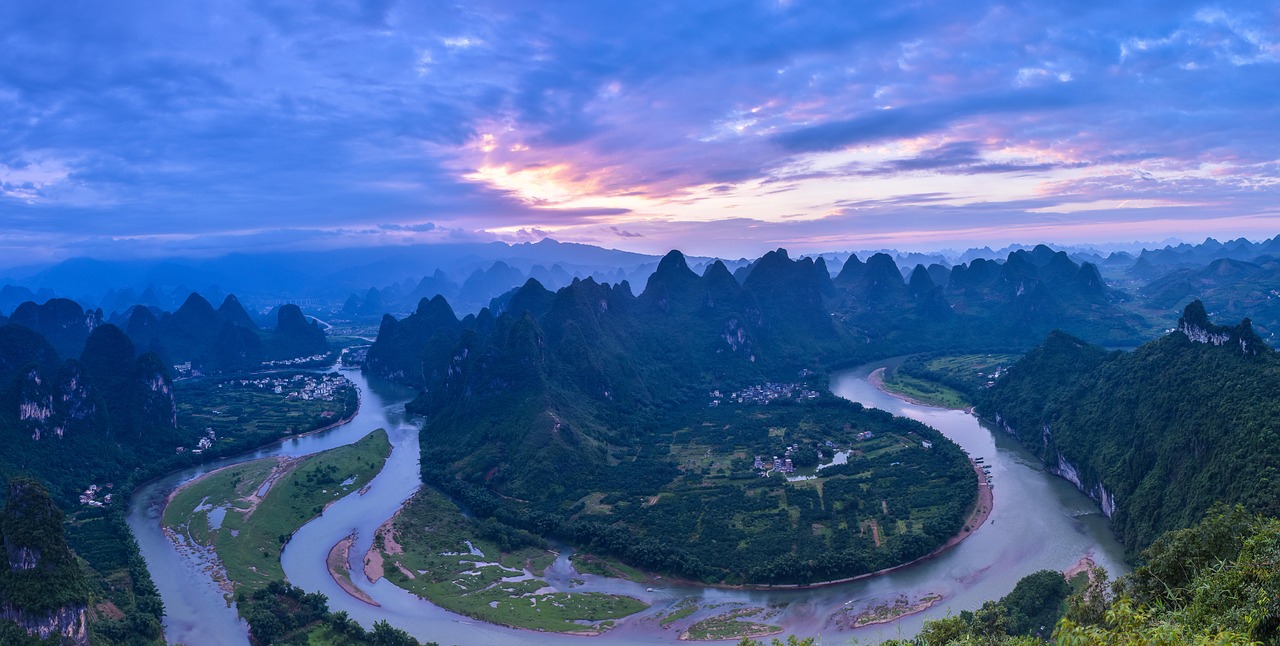
Guilin's landform is called karst; the rock beneath is limestone, reaching three thousand metres thick in places.
Three hundred million years ago this was a warm, shallow sea.
The calcareous skeletons of marine organisms sank to the seabed, accumulated layer upon layer, and compacted into thick beds of calcium carbonate.
Later the crust lifted, the sea withdrew, and those beds were exposed to air and rain.
Rainwater absorbs carbon dioxide and turns weakly acidic, which lets it slowly dissolve calcium carbonate.
Over roughly seventy million years since, rain and groundwater have seeped down the fractures in the rock, dissolving and hollowing it out.
What dissolved became plains and caves; what did not dissolve stayed where it was, and that is today's isolated peaks.
Understanding the scenery as what remains, rather than as what grew, is closer to the truth and more unsettling.
Guilin's hills come in two forms, and Chinese distinguishes them precisely.
Fengcong are joined at the base and split into several summits above; fenglin are fully independent towers standing directly on the plain.
Fengcong is generally taken to develop first; as dissolution continues and the bases are further eroded apart, it gradually becomes fenglin.
Which is to say, the two kinds of hill you see along the Li River may be two stages of the same process.
The next day I took the boat from Guilin to Yangshuo — about eighty-three kilometres, four hours on the water.
There was fog at dawn.
The guide said it looks most like the painting in fog.
Without fog, what you see is the outline of rock.
With fog, what you see is spatial depth: dense nearby, fainter further out, the furthest all but merged with the sky.
What Chinese painting calls liubai, leaving blank, is essentially handing the work of imagining to the viewer.
The blank hasn't been omitted; it's waiting for you to fill it.
The fog is doing the same job.
The peaks came almost without a break along the way.
The guide pointed out Elephant Trunk Hill, its foot reaching into the water, the shape genuinely like an elephant drinking.
Further on is Nine Horses Fresco Hill, where nine horses are said to hide in the texture of the cliff.
I stared for a long while and made out only three.
The guide said how many you see depends on where you stand, the light at that moment, and how badly you want to see them.
It sounds like a joke, but it explains what naming does.
A name is an instruction manual for looking: it decides where you begin, and quietly limits what you are able to see.
As we approached Yangshuo he had everyone take out a twenty-yuan note.
The image on the reverse is taken from this stretch of water, around the place called Yellow Cloth Reflection.
Many people hold the banknote up against the real peaks and photograph them aligned.
The gesture looks slightly absurd, yet it exposes something precise about contemporary travel: we are often just checking an image.
When the view exists before the experience, arriving becomes verification.
The most widely quoted line about Guilin says its landscape is the finest under heaven.
For a long time I assumed it was a modern tourism slogan.
It was written in 1201, by Wang Zhenggong, a native of Ningbo who held office in Guilin at the time.
That year Guilin held the provincial examination, and eleven candidates passed.
Custom required a Deer-Cry Banquet to send the new graduates off; the banquet fell on the sixteenth day of the ninth lunar month.
Wang composed two poems at the table, and the second opens with that famous sentence.
The full couplet runs: Guilin's landscape is finest under heaven; jade-green and silk-blue, the meaning is there to be read.
In other words, the sentence Chinese people have quoted for over eight hundred years, and now use to sell scenery, was first written to encourage eleven young men who had just earned a degree.
What happened to the poem afterwards is more interesting still.
It was carved into the cliff on the south face of Solitary Beauty Peak; water then seeped through the limestone, precipitating calcium carbonate that covered the entire tablet layer by layer.
Not until 1983, when staff of the Guihai Stele Forest Museum cleaned the surface, did this Southern Song carving reappear, signed Wang Zhenggong of Siming, first year of the Jiatai era.
The most famous sentence ever written about Guilin was buried for over seven hundred years by Guilin's own rock.
In the afternoon the cormorant fishing appeared.
An old man stood on a narrow bamboo raft, two black water birds perched at its stern.
The bird dives and surfaces holding a fish.
The old man lifts it back onto the raft with a bamboo pole, prises open the beak, removes the fish, then feeds it a smaller one.
A grass cord or metal ring around the bird's throat lets small fish go down while larger ones lodge in the gullet.
This partnership is documented in China for at least a thousand years; Song-dynasty texts already describe it.
I asked the guide whether anyone still lives by this skill today.
His answer was entirely unambiguous: essentially no one.
Fish stocks in the Li River have fallen, catching is tightly restricted to protect the water, and most young people leave to work elsewhere.
The old man you see today did come from a fishing family and his technique is genuine, but his income now comes from visitors' cameras.
To call it a performance isn't fair to that man.
To call it a continuation of traditional life is plainly inaccurate.
A better formulation: it is a craft that has been kept — its economic use has changed, the craft itself remains real.
Cultural heritage often sits in this in-between state; it has changed how it lives, and gone on existing.
By evening the hills receded into a row of dark silhouettes.
In a single day I had passed a three-hundred-million-year-old sea, seventy million years of dissolution, an eight-hundred-year-old line of verse and a thousand-year-old way of catching fish.
They belong to completely different scales of time, yet they are crowded onto the same eighty-three kilometres of river.
If a place was being described, photographed and printed on currency before you were born, what method could let you genuinely see it for the first time?
Listen again
Try it without the transcript and notice what sounds clearer.
What vocabulary does this episode teach?
词汇HSK 3. Why fishing on the Li River is now restricted.
HSK 4. When the view precedes experience, arriving becomes verification.
HSK 4. How many horses you make out depends on it.
HSK 4-ish. The other variable in what you can see.
Seventy million years of it produced the peaks.
What is left standing when everything around it dissolves.
Its uplift is what brought the seabed into the air.
How the 1201 poem was recorded on Solitary Beauty Peak.
Precipitated out of seeping water and sealed the inscription over.
Eleven candidates passed it in Guilin that year.
What arriving becomes when the image came first.
Cormorant fishing as technique rather than livelihood.
* beyond level超纲词
What grammar patterns appear in this episode?
语法取决于
States what an outcome depends on.
向导说,能看出几匹,取决于你站的位置、当时的光线,以及你有多想看到。
换句话说
Restates the previous point more plainly.
换句话说,中国人念了八百多年、用来推销风景的这句话,最初是写给十一个刚考上功名的年轻人的勉励。
当 …,就 …
Sets up a condition and its consequence.
当风景先于经验存在,抵达就变成了验证。
Proper nouns
专有名词Free account
Keep learning from this story
Create a free account to keep saved words and your preferred level together.
- Keep words with their story context
- Remember your preferred level
- Build your vocabulary over time