
A Chinese podcast · Same story, 4 levels
一家中企人形机器人两年降价七成,它们将先走进谁的家
Cheaper Humanoid Robots Could Enter Homes First
About this story
As AI improves humanoid robots and one Chinese firm's prices fall 72%, experts weigh the impact on homes, jobs, and wages. HSK 3 Chinese listening practice.
This is an HSK 3 Chinese listening episode that runs about 3 minutes. The full Mandarin script is shown with tap-for-pinyin and a line-by-line English translation, so you can listen and read at once — comprehensible input in the sense of Stephen Krashen's i+1 theory. It teaches 12 key vocabulary words such as 工厂、影响、反对 and walks through 4 grammar patterns, each explained in English with examples. The same news story is retold at 4 difficulty levels — use the level selector above to find the version that is challenging but still understandable for you.
Read at your level
原文Read the complete story in Chinese. Reveal pinyin and English only when you need them.
English transcript reference
Today's AI may help humans solve a math puzzle from 1859.
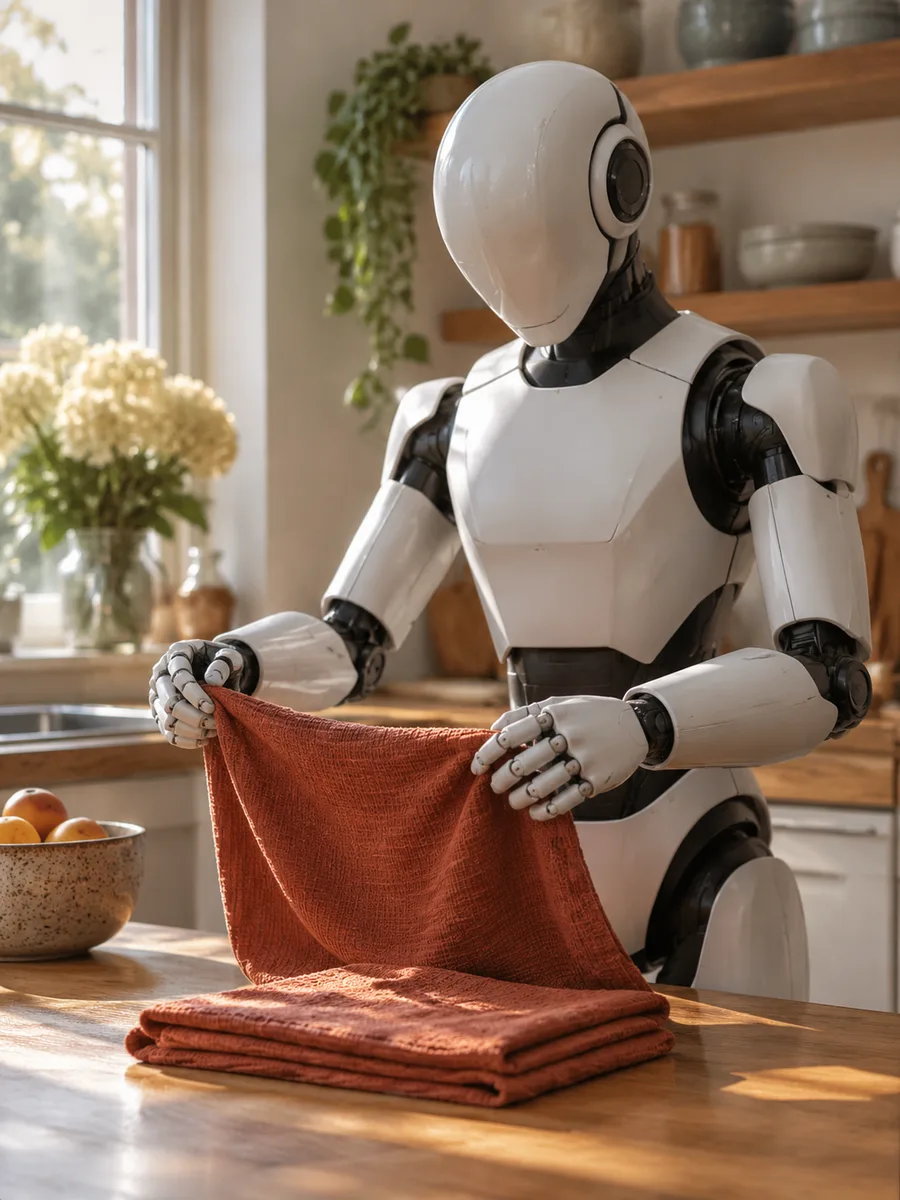
Yet real-world robots still struggle even to fold a bedsheet.
Humanoid robots are machines that move and work like humans.
In the past, factory machines stayed in one spot repeating a single motion.
Now engineers are applying large-model technology to robots.
By one measure, robots connected to AI double in capability every two months.
At the same time, robot hardware prices are also falling sharply.
One Chinese company's average robot price dropped 72 percent in two years.
AI serves as the robot's brain, so people can assign tasks simply by speaking.
The robot's body handles the hands-on work to finish all kinds of chores.
Experts predict this shift will start in ordinary people's homes first.
Over the next five to fifteen years, the first one million units could enter American homes.
They will first help wash dishes and do chores in laundry rooms and kitchens.
Housework carries low risk, and few people object to a robot washing dishes.
Just like early robot vacuums, tech enthusiasts will be the first to try them out.
Freeing people from heavy housework is a wonderful thing.
Many women in particular can save large amounts of time.
Over the decades that follow, robots will enter factories, hospitals, and construction sites.
Many people assumed AI would only affect office jobs.
Once robots mature, however, construction workers, electricians, and plumbers will also be affected.
If blue-collar jobs are no longer safe, governments may step in to regulate.
For instance, Bill Gates proposed reserving certain jobs for humans.
There will also be strong pushback in society, just like with self-driving cars.
Opposition will slow down the pace, though in the end it probably cannot stop it.
If robots take over factories, companies will no longer need to chase low wages.
In the future, land and energy prices will become even more important.
Countries may also become less welcoming toward foreign workers.
Service industries such as elder care could also be transformed by robots.
String quartets still take just as much human labor as in Mozart's day, because services are hard to make more productive.
In the future, goods will become as cheap as clothing.
Yet scarce land and natural resources may become even more expensive.
Perhaps humans will still need to manage, look after, and repair these robots.
Just as farmers did not all lose their jobs after tractors arrived.
When attending concerts, people may still prefer watching live human performers.
Yet if a small minority controls the machines, the wealth gap could grow wider.
Humanoid robots are arriving fast, and the whole world needs to get ready now.
Listen again
Try it without the transcript and notice what sounds clearer.
What vocabulary does this episode teach?
词汇HSK 3. Contrasts fixed factory arms with flexible future robots (如果机器人接管工厂).
HSK 3. Appears in AI 只会影响办公室里的工作 and 水管工人也受影响.
HSK 3. Used as both verb (很少有人反对) and noun (社会上也会有强烈反对).
HSK 3. Appears in 服务业 (service industries) and 服务难提高效率.
HSK 3. Contrasts legacy factory arms (只重复一个动作) with general-purpose robots.
HSK 3. Appears in 硬件价格 (hardware prices) and 土地和能源价格 (land and energy prices).
HSK 3. Used in 如果蓝领工作不安全 (if blue-collar jobs are no longer safe).
HSK 3. Appears in 土地和能源价格 (land and energy prices).
HSK 3. Used in 服务难提高效率 (services are hard to make more productive).
Cover keyword defined in the script as 像人一样活动、干活的机器.
Key first-wave use case in 洗衣房和厨房帮忙洗碗、做家务.
Refers to builders, electricians, and plumbers in 如果蓝领工作不安全.
* beyond level超纲词
What grammar patterns appear in this episode?
语法把 + Someone + 从……中 + Verb
Expresses freeing or moving someone out of a state.
把人从很重的家务中解放出来,是件大好事。
就像……一样
Draws a concrete parallel ('just like X').
社会上也会有强烈反对,就像自动驾驶汽车一样。
尤其是……
Singles out the most affected subgroup ('especially...').
尤其是很多女性,可以省下大量时间。
Proper nouns
专有名词Sources
来源Free account
Keep learning from this story
Create a free account to keep saved words and your preferred level together.
- Keep words with their story context
- Remember your preferred level
- Build your vocabulary over time