
A Chinese podcast · Same story, 4 levels
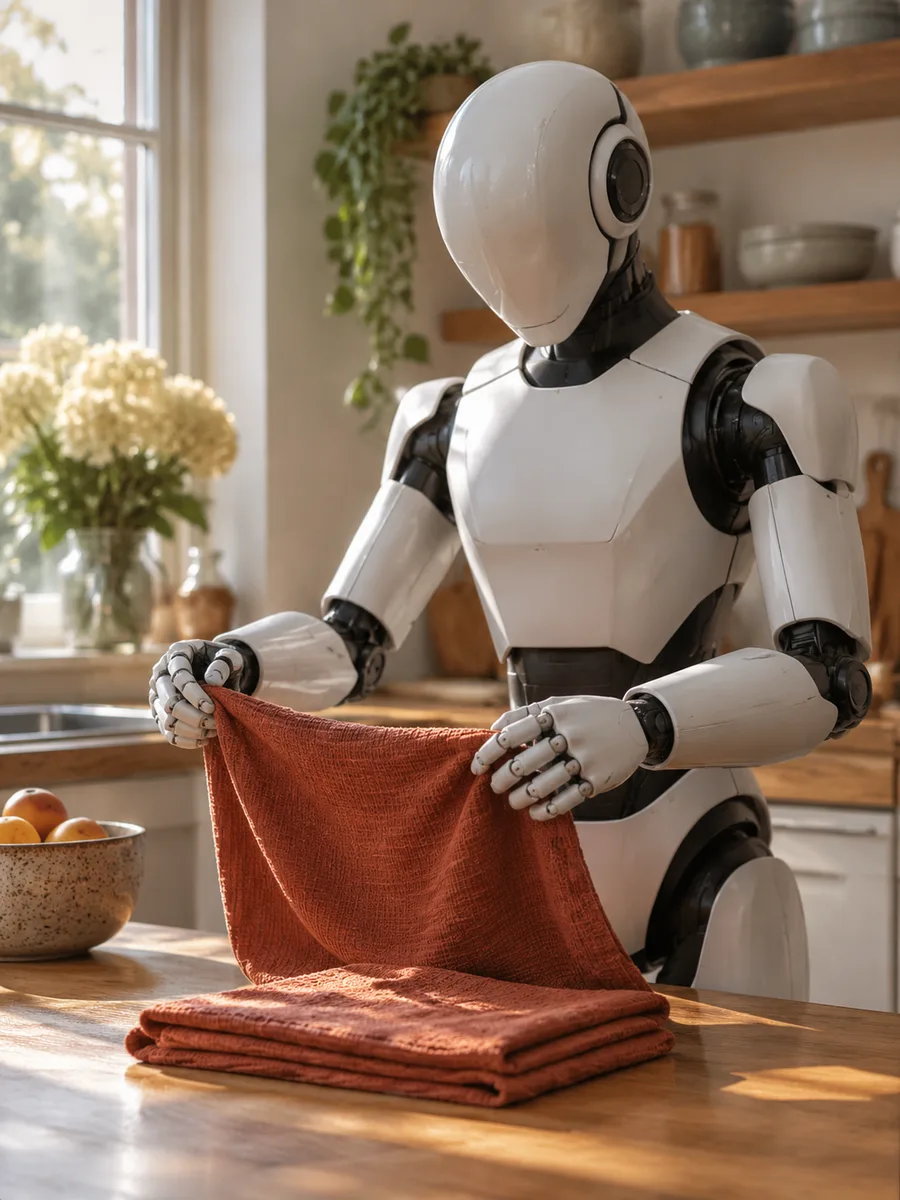
一家中企人形机器人两年降价七成,它们将先走进谁的家
Cheaper Humanoid Robots Could Enter Homes First
About this story
As AI improves humanoid robots and one Chinese firm's prices fall 72%, experts weigh the impact on homes, jobs, and wages. HSK 4 Chinese listening practice.
This is an HSK 4 Chinese listening episode that runs about 3 minutes. The full Mandarin script is shown with tap-for-pinyin and a line-by-line English translation, so you can listen and read at once — comprehensible input in the sense of Stephen Krashen's i+1 theory. It teaches 12 key vocabulary words such as 模型、复制、提供 and walks through 4 grammar patterns, each explained in English with examples. The same news story is retold at 4 difficulty levels — use the level selector above to find the version that is challenging but still understandable for you.
Read at your level
原文Read the complete story in Chinese. Reveal pinyin and English only when you need them.
English transcript reference
Large language models may already have helped humans prove the Riemann hypothesis, unsolved since 1859.
Yet their physical-world cousins, humanoid robots, still struggle even to fold a bedsheet neatly.
Replicating the flexibility of the human body has always been far harder than replicating brainpower.
In the past, factory machines stayed bolted in place, repeating the exact same motion.
But that picture will soon change as engineers apply large-model techniques to robots.
Scaling laws propelled AI to the frontier of mathematics within four years, and robots are beginning to reap the same dividend.
By one measure, robots wired to AI models double in capability every two months.
At the same time, hardware prices are plunging: one Chinese firm's average humanoid robot price fell 72 percent in two years.
AI supplies the brain so people can simply speak to assign tasks, while the body supplies the muscle.
This robotics revolution will likely start in homes rather than in factories.
Forecasters estimate that within five to fifteen years, the first one million units will enter American households.
Chores in laundry rooms and kitchens are low-risk and do not require dangerous physical force.
While automation often faces pushback in workplaces, almost no one protests not having to load the dishwasher themselves.
Tech enthusiasts will be the early adopters, just as with robot vacuums and robotic lawn mowers.
Freeing humans—and especially women—from heavy housework is a major boon in itself.
The real economic shock will arrive over the following years and decades, as robots enter factories, hospitals, and construction sites.
This shatters a lazy assumption that only white-collar jobs will be replaced by AI.
White-collar workers planning to retrain as builders, electricians, or plumbers may find that escape route closed.
Once blue-collar trades are no longer a safe harbor, Bill Gates's proposal to 'reserve jobs for humans' will grow more appealing.
Political resistance will also slow the pace, much as officials, drivers, and lawyers have slowed self-driving cars.
Once robots take over production, factories will stop chasing low wages, making land and energy prices more decisive.
If picking fruit and laying bricks no longer require human labor, countries may grow cooler toward foreign workers.
Economist William Baumol noted that a string quartet takes the same human labor today as in Mozart's time.
The same holds for elder care, yet robots could break the centuries-old rule that many services resist productivity gains.
Goods and services could become as cheap as T-shirts, while scarce land and resources may become far more valuable.
Humans may still manage and maintain robots—just as tractors did not eliminate all farmers—and people may still prefer live human orchestras.
Otherwise the economy could swing toward extreme inequality, leaving everyone else competing with machines for energy and land.
AI's leap over the past few years caught the world off guard, and today people are still unprepared for humanoid robots.
Listen again
Try it without the transcript and notice what sounds clearer.
What vocabulary does this episode teach?
词汇HSK 4. Refers to AI foundation models in 大语言模型 (large language models) and 大模型技术.
HSK 4. Contrasts physical dexterity with cognitive tasks in 复制人体的灵活性.
HSK 4. Used in AI 提供大脑……躯体则提供力气.
HSK 4. Refers to mass adoption of home appliances in 普及扫地机器人和割草机.
HSK 4. Used for AI job displacement in 只有白领工作会被 AI 替代.
HSK 4. Appears in 管理维护机器人 (manage and maintain robots).
HSK 4. Introduces the downside scenario in 否则经济就会走向高度不平等.
HSK 4. Appears in 土地和能源价格更关键 (land and energy prices become more decisive).
Cover keyword for bipedal, human-shaped general-purpose robots.
Idiomatic numerical expression in 能力每两个月翻一番 (capability doubles every two months).
Figurative term in 蓝领不再是避风港 (blue-collar jobs are no longer a safe haven).
Four-character idiom describing how AI's rapid leap surprised the world.
* beyond level超纲词
What grammar patterns appear in this episode?
语法先从……开始,而不是从……开始
Contrasts where a shift starts against a common expectation ('starting from A rather than B').
这场机器人革命很可能先从家庭开始,而不是从工厂开始。
一旦……,……不再……
Describes a threshold that permanently changes incentives ('once X happens, Y no longer...').
一旦机器人接管生产,工厂不再追逐低工资,土地和能源价格更关键。
若……,……可能……
Concise conditional ('if X, then Y may...').
若采摘水果和砌砖不再需要人力,各国对外来劳工可能更冷淡。
否则……
Introduces the alternative consequence if the preceding condition fails.
否则经济就会走向高度不平等,其余人被迫与机器争夺能源和土地。
Proper nouns
专有名词Sources
来源Free account
Keep learning from this story
Create a free account to keep saved words and your preferred level together.
- Keep words with their story context
- Remember your preferred level
- Build your vocabulary over time