
A Chinese podcast · Same story, 4 levels
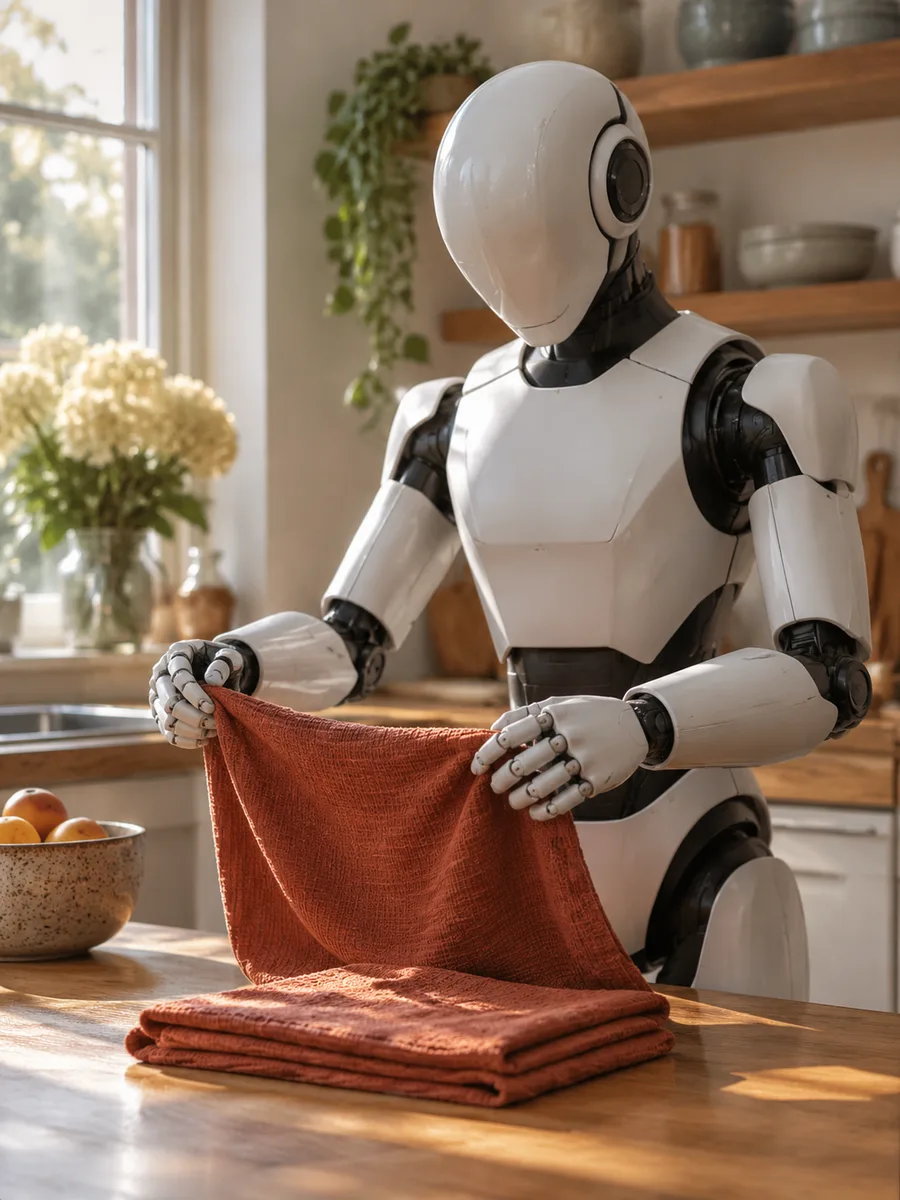
一家中企人形机器人两年降价七成,它们将先走进谁的家
Cheaper Humanoid Robots Could Enter Homes First
About this story
As AI improves humanoid robots and one Chinese firm's prices fall 72%, experts weigh the impact on homes, jobs, and wages. HSK 5+ Chinese listening practice.
This is an HSK 5+ Chinese listening episode that runs about 4 minutes. The full Mandarin script is shown with tap-for-pinyin and a line-by-line English translation, so you can listen and read at once — comprehensible input in the sense of Stephen Krashen's i+1 theory. It teaches 12 key vocabulary words such as 机器人、通用、正如 and walks through 4 grammar patterns, each explained in English with examples. The same news story is retold at 4 difficulty levels — use the level selector above to find the version that is challenging but still understandable for you.
Read at your level
原文Read the complete story in Chinese. Reveal pinyin and English only when you need them.
English transcript reference
Large language models may already have assisted in proving the Riemann hypothesis, open since 1859, yet robots in the physical world still cannot fold a bedsheet properly.
Replicating the all-purpose dexterity of the human body is far trickier than replicating cognitive output; machines on past factory floors were usually bolted to one station repeating a single motion.
Yet that picture is about to be rewritten as engineers transfer the core methods of large language models to general-purpose robots.
Scaling laws vaulted AI from barely counting to the frontier of mathematics in four short years, and robotics is now beginning to capture that same dividend.
By one metric, models hooked into robots double their real-world capability every two months, and advanced AI may also feed back into robot R&D.
Meanwhile hardware costs are plunging: one Chinese company's average price for a humanoid robot fell 72 percent in two years.
Discussing AI's economic impact without general-purpose robots is incomplete: AI provides the brain, and the humanoid body supplies the brawn.
This transformation will likely begin in the home, with forecasts projecting the first million units entering American laundry rooms and kitchens within five to fifteen years.
Housework has high error tolerance and does not require life-threatening strength; almost no one will protest no longer loading plates into a dishwasher.
Much like the path blazed by robot vacuums and automatic mowers, early-adopting tech enthusiasts will pave the way for household humanoids.
Liberating humans—especially women—from drudgery is welcome, yet the truly profound shock will erupt over the decades that follow.
Robots will then push into factories, hospitals, and construction sites, shattering the lazy premise that only white-collar brainwork faces replacement.
Office workers banking on pivoting into carpentry, electrical work, or plumbing may find no exit left.
Once blue-collar work is no longer safe, policy interventions carving out human-only jobs—as Bill Gates has floated—will become far more tempting.
Broader political backlash will also slow adoption, just as self-driving cars have stumbled against pushback from officials, drivers, and lawyers.
Yet humanoid robots span too many sectors: hostility will be fiercer, but ultimately will likely fail to halt their spread.
Global manufacturing geography will reorganize in turn: once robots run the shop floor, human wages cease to be decisive, giving way to land and energy prices.
Voters may object less when robots replace foreign labor, and if fruit-picking and bricklaying no longer need hands, countries may grow cooler toward migrant workers.
Many service roles insulated from productivity growth for centuries also face restructuring: economist William Baumol noted that a string quartet still requires the same human labor as ever.
Elder care and similar services rely on human labor just like orchestras in Mozart's era, yet general-purpose robots could finally shatter this long-standing bottleneck.
Relative prices and wages will undergo a dramatic reshuffle: vast swathes of goods and services will surge in supply and plunge in price like T-shirts and agriculture.
Scarce land and natural resources will not get cheaper; measured against goods and services their value may soar, and land rent could take a huge share of economic output.
Humans may still handle managing, directing, supervising, and maintaining robots, much as tractors never eliminated all farmers.
Moreover, human preference for 'relational goods' such as live symphony orchestras may let people trade their labor for machine-produced abundance.
Should that benign vision fail to materialize, society could slide toward stark inequality, with robots serving only their owners while everyone else competes with machines for energy and land.
AI's leap over the past few years caught the world flat-footed; with workable humanoid robots right around the corner, now is the time to prepare.
Listen again
Try it without the transcript and notice what sounds clearer.
What vocabulary does this episode teach?
词汇HSK 4. Central subject across the entire piece (通用机器人, 人形机器人).
HSK 5. Contrasts versatile 通用机器人 with fixed single-task factory machines.
HSK 5. Formal analogy connector used three times (正如扫地机器人……, 正如拖拉机并未淘汰全部农民).
HSK 5. Appears in 科技极客将率先为家用人形机器人铺平道路.
HSK 3. Appears in 谈论 AI 经济影响 (discussing the economic impact of AI).
HSK 3. Used in 服务岗位 (service roles) and 商品与服务 (goods and services).
HSK 4. Appears in 高级 AI 也可能反哺研发 (advanced AI may also feed back into R&D).
HSK 5. Describes transferring LLM techniques to robotics (将核心方法迁移到通用机器人身上).
HSK 5. Listed among future human roles in 管理、调度、监督和维护机器人.
HSK 5. Describes Baumol's service-sector productivity limit (打破这一长期瓶颈).
HSK 5. Modifies land and natural resources (稀缺的土地和自然资源).
Formal idiom describing the 1859 Riemann hypothesis.
* beyond level超纲词
What grammar patterns appear in this episode?
语法固然……,但……
Formal concessive frame ('admittedly X, yet Y').
将人类尤其是女性从繁重家务中解放固然可喜,但真正深远的冲击将在随后几十年爆发。
正如……
Introduces an authoritative historical or industry analogy ('just as...').
人类仍可能负责管理、调度、监督和维护机器人,正如拖拉机并未淘汰全部农民。
倘若……,便……
Elevated conditional ('should X happen, then Y').
倘若这一图景落空,社会便会滑向极度失衡,机器人只服务所有者,其余人与机器争夺能源和土地。
取而代之
Compact predicate meaning 'to take its place instead'.
全球生产版图将随之重组,当机器人接管车间后,人类工资不再举足轻重,土地与能源价格将取而代之。
Proper nouns
专有名词Sources
来源Free account
Keep learning from this story
Create a free account to keep saved words and your preferred level together.
- Keep words with their story context
- Remember your preferred level
- Build your vocabulary over time