
A Chinese podcast · Same story, 4 levels
查尔斯三世:不抱怨的国王
King Charles III at Four Years: Cancer, Family Scandal and a 58% Approval Rating — How He Stopped Complaining
About this story
King Charles III's fourth year on the throne: cancer diagnosis, a brother arrested, four prime ministers, and a 58% YouGov approval rating. HSK 4 Chinese listening practice.
This is an HSK 4 Chinese listening episode that runs about 3 minutes. The full Mandarin script is shown with tap-for-pinyin and a line-by-line English translation, so you can listen and read at once — comprehensible input in the sense of Stephen Krashen's i+1 theory. It teaches 12 key vocabulary words such as 报纸、问题、答案 and walks through 8 grammar patterns, each explained in English with examples. The same news story is retold at 4 difficulty levels — use the level selector above to find the version that is challenging but still understandable for you.
Read at your level
原文Read the complete story in Chinese. Reveal pinyin and English only when you need them.
English transcript reference
When Charles became king, British newspapers were asking how much longer the monarchy could last.
Four years on, that question has an answer: he has done better than many expected.
What he was once most famous for was complaining that he did not know what he was supposed to do with his life.
Today that complaint is no longer heard; instead people ask: how is he actually doing?
He took over the throne after his mother's death, and it has now been four years.
His mother reigned for seventy years, far longer than his four.
These four years have not been easy: in 2024 he was diagnosed with cancer, and one of his brothers was arrested.
During these four years, Britain also went through four prime ministers.
At first many people doubted him, and journalists often forgot to change how they addressed him and call him king.
Now the polling firm YouGov gives him a favourability rating of fifty-eight percent.
That number is lower than his son William's seventy-four percent.
As for his other son Harry, it is only twenty-nine percent.
There are actually several reasons why his favourability has risen.
The first is the honeymoon period that everyone is willing to grant a new king.
The second is that he is willing to work; even after the cancer diagnosis he did not really stop.
After less than three months of treatment, he returned to the public eye.
There is another bonus point: in 2025, he took back the remaining royal titles of his brother Andrew.
This year Andrew was arrested over an accusation, and he denies having done anything wrong.
But the most important change is that he no longer complains.
When his mother was queen, her creed was "never complain, never explain".
People used to call him "the complaining prince"; now he has learned that lesson.
Luck helped too: the things he was mocked for early on now look ahead of their time.
For example, his habit of talking to plants, and Poundbury, the small town he built himself.
Now leaders from various countries all want to meet him.
His biographer says that meeting the king is an item on many leaders' life lists.
Charles himself thought about the role of king for many years.
Years ago he edited a Shakespeare anthology.
A line he marked in "Henry V" says that being king is a hard job.
There is one thing a king has that others do not, and that is ceremony.
He probably now understands that line deeply.
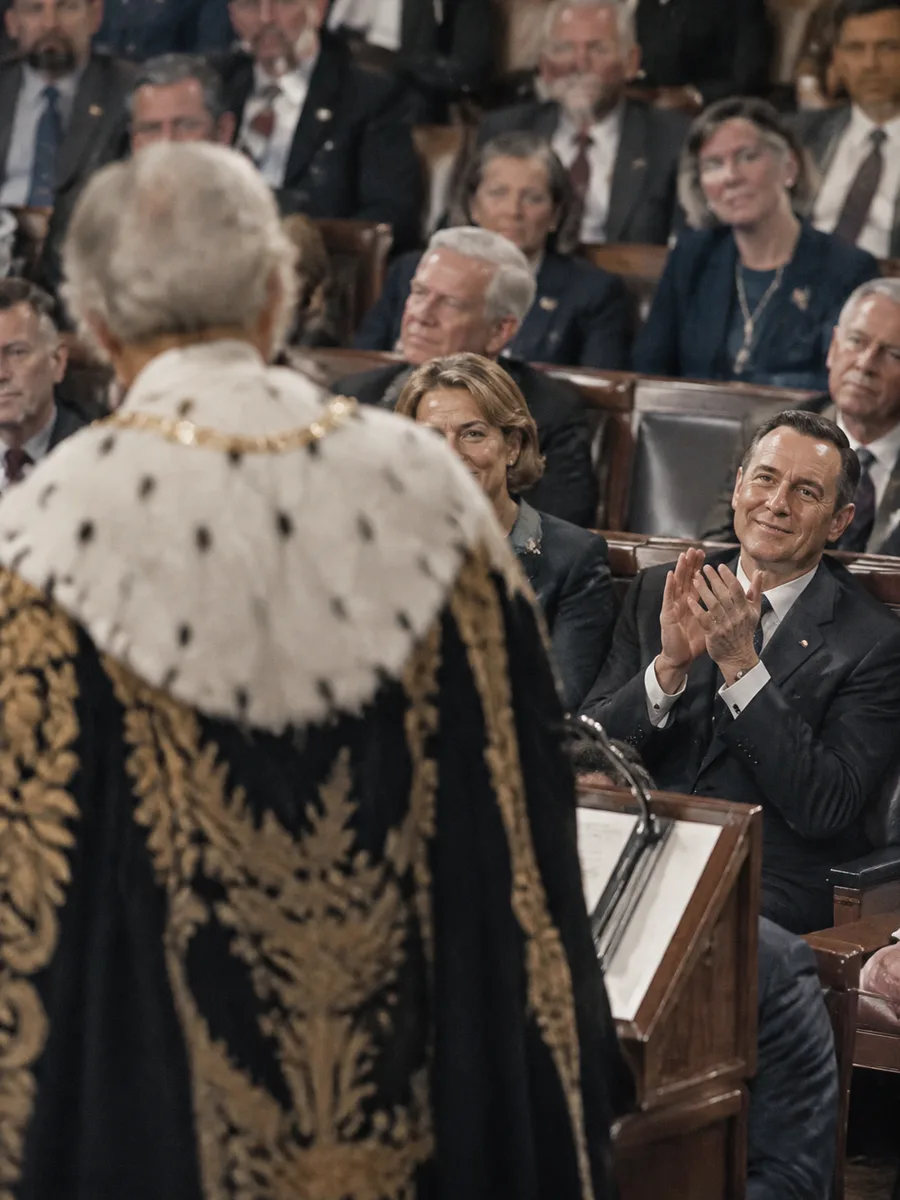
This year he spoke at the US Congress, and standing ovations came one after another.
Those are all pure ceremony, but ceremony is sometimes genuinely useful.
Next there is an even trickier topic.
In early November, he will speak at the Commonwealth Heads of Government Meeting in Antigua.
More than fifty heads of government will be present, and he is expected to talk about slavery.
This history is still sensitive in many Commonwealth countries, and it is hard to talk about.
Four years on, at least he no longer has to ask himself what he should be doing.
Listen again
Try it without the transcript and notice what sounds clearer.
What vocabulary does this episode teach?
词汇HSK 3. 报纸 is a newspaper; 记者 is a reporter, which also appears in the script.
HSK 3. 问题 can mean both a question and a problem; here 这个问题有了答案 means the question has an answer.
HSK 3. 答案 is the answer to a question; 有了答案 means there is an answer.
HSK 3. 去世 is a polite word for dying, used of his mother's death.
HSK 3. 并不轻松 means 'not at all easy'; 轻松 describes something without pressure.
HSK 3. 换了四位首相 means 'went through four prime ministers'.
HSK 3. 怀疑他的人很多 means 'many people doubted him'.
HSK 3. 这个数字 refers to the approval percentage mentioned before.
HSK 3. 国王 refers to a king; 女王 is a queen. Appears throughout as 当上国王 (become king).
HSK 3. 抱怨 means to complain; 爱抱怨的王子 is 'the complaining prince'.
HSK 3. 回到公众面前 means 'returned to the public eye'.
HSK 3. 被嘲笑的事 means 'the things he was mocked for'.
* beyond level超纲词
What grammar patterns appear in this episode?
语法是……的 (emphasis on a fact)
The 是……的 construction highlights a fact or circumstance, often with a time or manner element.
他从前最出名的,是抱怨自己不知道这辈子要干什么。
但最要紧的变化,是他不再抱怨了。
比 + Noun + Adjective (comparison)
比 introduces the standard of comparison; the adjective follows without 很.
他干得比很多人预想的好。
他母亲在位七十年,比他这四年长得多。
这个数字不如他儿子威廉的百分之七十四。
并不 / 不如 + Adjective (mild negation)
并不 softens a negation ('not at all'), while 不如 means 'not as good as'.
这个数字不如他儿子威廉的百分之七十四。
被 + Verb (passive)
被 marks the passive voice, often for unfortunate events.
一个弟弟被逮捕。
他早年被嘲笑的事,现在看反而很超前。
把 + Object + Verb + 了 (disposal construction)
把 moves the object before the verb to show what was done to it, often with a result.
如今他把这一课学会了。
一 + Measure + 接着一 + Measure (repetition)
This pattern expresses repeated, continuous occurrence.
起立鼓掌一次接着一次。
对 + Noun + Verb (attitude toward)
对 introduces the object of one's attitude or action.
查尔斯自己对国王这个角色想过很多年。
至少 + Clause (at least)
至少 introduces the minimum or a consoling point.
四年下来,他至少不用再问自己该做什么了。
Proper nouns
专有名词Sources
来源- Royal family favourability trackers, October 2026
- King to speak about slavery with 'unflinching honesty' at Commonwealth summit
- Who is Andrew Mountbatten-Windsor? Ex-prince tied to Epstein scandal
- King Charles to Return to Public Duties, Reassuring Anxious Royal Watchers
- As King Charles hosts Trump for state visit, here's what to look for
Free account
Keep learning from this story
Create a free account to keep saved words and your preferred level together.
- Keep words with their story context
- Remember your preferred level
- Build your vocabulary over time