
A Chinese podcast · Same story, 4 levels
查尔斯三世:不抱怨的国王
King Charles III at Four Years: Cancer, Family Scandal and a 58% Approval Rating — How He Stopped Complaining
About this story
King Charles III four years into his reign: cancer diagnosis, brother Andrew's arrest, four prime ministers, and a 58% YouGov approval rating behind William's 74%. HSK 5+ Chinese listening practice.
This is an HSK 5+ Chinese listening episode that runs about 3 minutes. The full Mandarin script is shown with tap-for-pinyin and a line-by-line English translation, so you can listen and read at once — comprehensible input in the sense of Stephen Krashen's i+1 theory. It teaches 12 key vocabulary words such as 抱怨、角色、去世 and walks through 5 grammar patterns, each explained in English with examples. The same news story is retold at 4 difficulty levels — use the level selector above to find the version that is challenging but still understandable for you.
Read at your level
原文Read the complete story in Chinese. Reveal pinyin and English only when you need them.
English transcript reference
The prince who once publicly complained that he did not know his role in life no longer complains.
After his mother died in 2022, he became Charles III — four years ago today.
Elizabeth II reigned for seventy years, seventeen times as long as he has.
In these four years he has been diagnosed with cancer, watched a brother arrested by police, and seen four British prime ministers come and go.
In the early days of his reign, few were optimistic about him, and newspapers ran endless pieces asking how much longer the monarchy could last.
Even the title "King" was often misused — people instinctively still called him the crown prince.
Four years later, the polling firm YouGov puts his favourability at fifty-eight percent.
That number is lower than Prince William's seventy-four percent, but far higher than Prince Harry's twenty-nine percent.
The reason for the rebound is no mystery: a new monarch always gets a honeymoon period, and his own diligence is genuinely rare.
In 2024 he was diagnosed with cancer and reappeared at public events in less than three months.
In 2025 he stripped his brother Andrew of his remaining royal titles.
In 2026 Andrew was arrested on suspicion of misconduct in public office; he denies the charges.
But what really did the work is probably that he stopped complaining.
The late queen left behind a creed of just two lines: never complain, never explain.
The man the tabloids once called "the complaining prince" has now made up that lesson.
Luck helped too — the quirks people mocked him for years ago now look like foresight.
Talking to plants and personally building the town of Poundbury were jokes back then, but now they are called far-sighted.
Poundbury, which he planned himself, is still being expanded today.
World leaders are now lining up to meet him.
Robert Hardman, who wrote his biography, says Charles has "left his critics speechless."
Hardman also says that for world leaders, a meeting with the king is "a bucket-list item."
He has actually spent most of his life pondering what a king really is.
In 1995 he edited a Shakespeare anthology, marking the soliloquy on kingship in Henry V.
That speech says kingship is a "hard condition," and that the only thing a king has more of than ordinary people is ceremony.
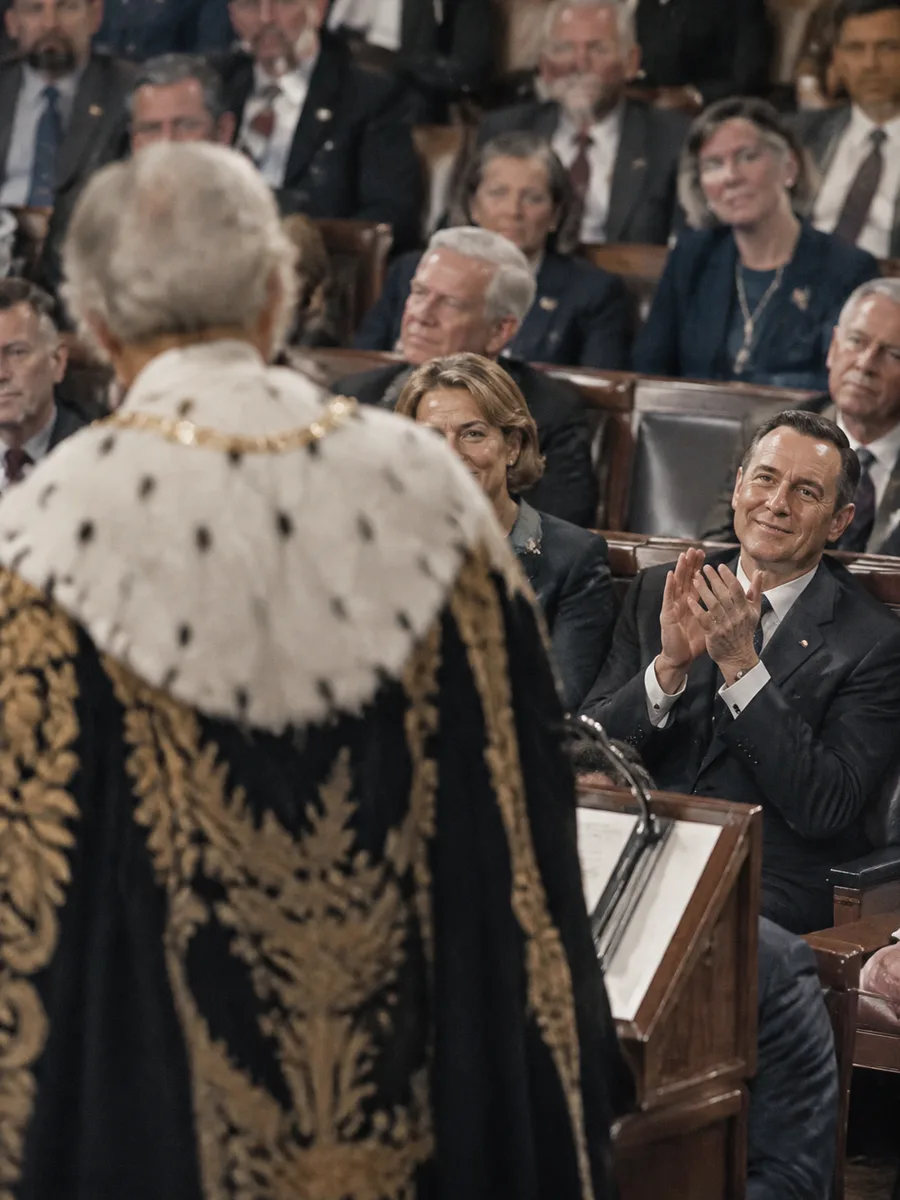
This year he gave a speech to the US Congress, and the standing ovations came one after another.
That is nothing but ceremony — but ceremony sometimes really works.
When Trump made his state visit to Britain, the one who received him was Charles.
Four years ago people were still debating whether he was up to the job; now that debate is basically over.
Next up is November 3rd, when he will address the opening of the Commonwealth Heads of Government Meeting in Antigua and Barbuda.
More than fifty heads of government will be there, and what he is expected to raise is the old debt of slavery.
Listen again
Try it without the transcript and notice what sounds clearer.
What vocabulary does this episode teach?
词汇HSK 5. 抱怨 + object/person: 抱怨自己不清楚人生角色. Also 抱怨天气.
HSK 5. 人生角色 'role in life'; also 扮演角色 'play a role'.
HSK 5. Polite word for dying, used of the queen here: 母亲去世后.
HSK 4. 讨论 + question clause: 讨论君主制还能撑多久.
HSK 4. 这个数字 'this figure'; used for statistics here.
HSK 4. 回升的原因 'the reason for the rebound'.
HSK 4. 公开活动 'public engagements'.
HSK 5. 否认有罪 'deny guilt'.
HSK 5-ish. 在位 + duration: 在位七十年.
HSK 5. 确诊癌症 'be diagnosed with cancer'; 确诊 + illness.
HSK 5. 被警方逮捕 'be arrested by police'.
HSK 5. 英国首相 'British prime minister'; measure word 位.
* beyond level超纲词
What grammar patterns appear in this episode?
语法不再 + Verb
Expresses that an action has stopped and will not resume — stronger and more final than 不 + verb.
那位曾经公开抱怨自己不清楚人生角色的王储,如今不再抱怨了。
但真正起作用的,恐怕还是他不再抱怨了。
A 低于 B,却远远高于 C
Comparison with 低于/高于 ('lower/higher than'), plus 却 for contrast and 远远 for 'by far'.
这个数字低于威廉王子的百分之七十四,却远远高于哈里王子的百分之二十九。
对……而言
Formal equivalent of 对……来说, 'as far as … is concerned / for …'.
对各国政要而言,与国王见一面是“人生清单上的一项”。
是……的 (focus construction)
Puts emphasis on the element after 是; often used to single out who did something.
特朗普对英国进行国事访问时,出面接待的正是他。
恐怕还是……
Softens a judgment: 'I'm afraid it's still/probably …'. 恐怕 signals a tentative conclusion.
但真正起作用的,恐怕还是他不再抱怨了。
Proper nouns
专有名词Sources
来源- Royal family favourability trackers, October 2026
- King to speak about slavery with 'unflinching honesty' at Commonwealth summit
- Who is Andrew Mountbatten-Windsor? Ex-prince tied to Epstein scandal
- King Charles to Return to Public Duties, Reassuring Anxious Royal Watchers
- As King Charles hosts Trump for state visit, here's what to look for
Free account
Keep learning from this story
Create a free account to keep saved words and your preferred level together.
- Keep words with their story context
- Remember your preferred level
- Build your vocabulary over time