
A Chinese podcast · Same story, 4 levels
英国国王来美国了
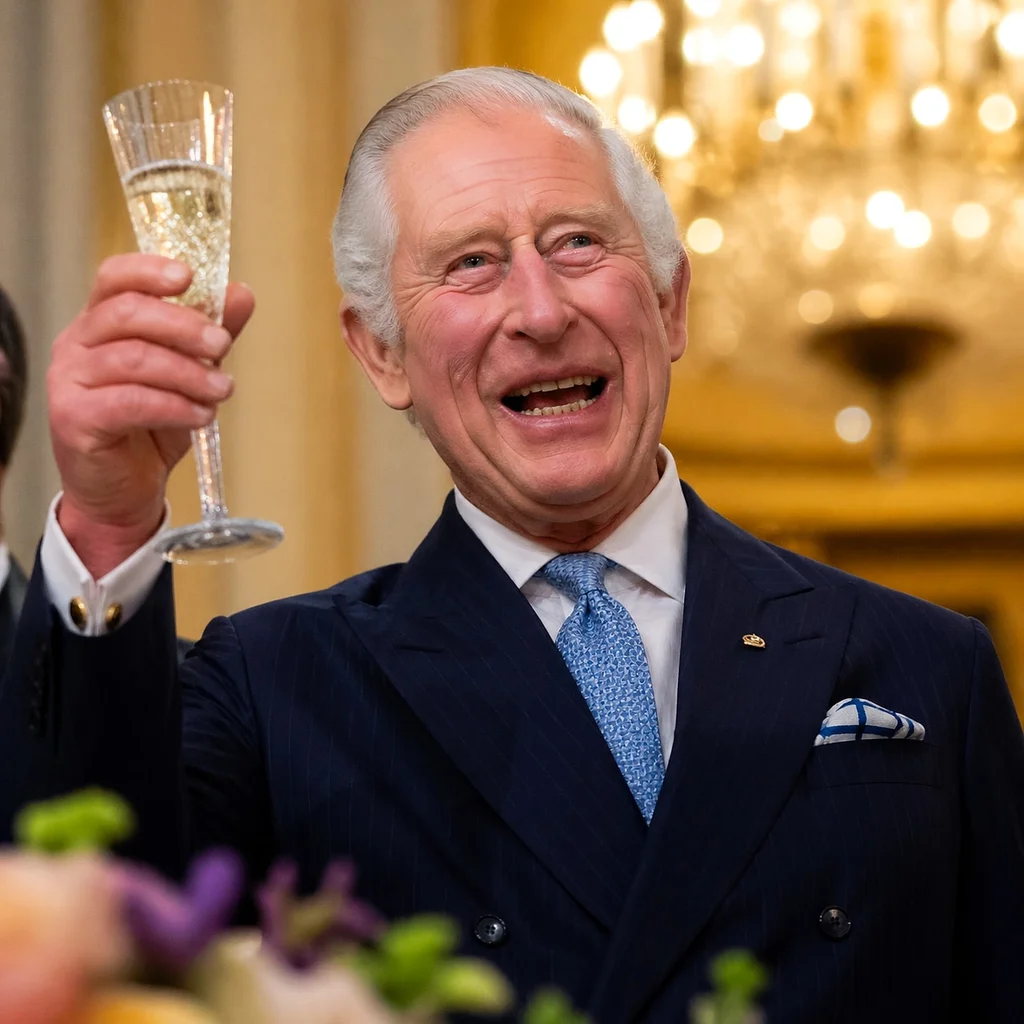
King Charles Jokes About 1814 White House Fire
About this story
A simple story about King Charles III visiting the US to meet Trump for America's 250th anniversary. HSK 1 Chinese listening practice.
This is an HSK 1 Chinese listening episode that runs about 14 minutes. The full Mandarin script is shown with tap-for-pinyin and a line-by-line English translation, so you can listen and read at once — comprehensible input in the sense of Stephen Krashen's i+1 theory. It teaches 18 key vocabulary words such as 国王、国家、美国 and walks through 6 grammar patterns, each explained in English with examples. The same news story is retold at 4 difficulty levels — use the level selector above to find the version that is challenging but still understandable for you.
Read at your level
原文Read the complete story in Chinese. Reveal pinyin and English only when you need them.
English transcript reference
Speaking of an interesting story — today we're talking about the King of England.
His name is Charles.
He is Charles III.
That is to say, there were two earlier kings also named Charles.
He's the third one.
Charles is the king of England.
England is a country.
England is not China.
England is not America either.
England is somewhere else.
England is not big.
But England has a king.
China has no king.
America has no king either.
Charles is over seventy years old this year.
He is no longer young.
He also has a wife.
His wife is named Camilla.
Camilla is the queen.
A "queen" is the king's wife.
Charles and Camilla came to America together.
They arrived on April 27th.
Today is April 30th.
They've been in America for three days now.
They will stay in America for four days.
Tomorrow they go home.
Why did they come to America?
Let me tell you.
Because this year is America's birthday.
You might ask: do countries have birthdays?
Yes, they do.
It's the day the country began.
America began two hundred and fifty years ago.
This year is exactly two hundred and fifty years.
So it's a big birthday.
The king of England came to wish America a happy birthday.
"To wish" means to say good things, hoping someone is well.
But there's something here.
Something interesting.
Listen to me slowly.
Two hundred and fifty years ago, America wasn't a country.
At that time, there was no country called America.
That place belonged to England.
England ruled it.
Whatever the English king said, the people there had to listen.
Later, the people there became unhappy.
They said: we are far from England.
England, don't rule us anymore.
We want to make our own new country.
England said: no.
You may not leave.
So they fought.
"Fighting" is a bad thing.
It's two people, or two countries, hurting each other.
England and America fought for many years.
In the end, America won.
England lost.
That year was America's first year.
So America is two hundred and fifty years old this year.
The king of England at that time was named George.
He was George III.
You see — George III, Charles III.
They were both kings.
They are family.
Not father and son.
They are family from very long ago.
The kings of England, starting from George III.
One after another, down to today's Charles III.
So you see:
Two hundred and fifty years ago, George III lost to America.
Two hundred and fifty years later, Charles III comes to America.
He comes and says: happy birthday!
Isn't that interesting?
And it doesn't end there.
Some years after losing the war,
England came to fight America again.
This time was even worse.
England got all the way to America's capital.
The capital is called Washington.
It's where the American president lives.
English soldiers reached Washington.
They did a big thing.
They burned down a big house.
This house is called the White House.
The White House is where the American president lives.
And where he works.
It's a big white house.
That's why it's called the White House.
The English soldiers burned the White House down.
They really did burn it.
This was over two hundred years ago.
The current White House is not the old one.
The old one is gone.
The current one was rebuilt later.
OK, knowing all this, let's come back to today.
Today is the year 2026.
Charles III came to America.
He came to the White House.
The very same place as the old White House.
The owner of the White House now is Trump.
Trump is the president of America.
Have you heard of Trump?
He's a famous person.
Trump invited Charles to dinner.
It was a big meal.
Many important people came.
While they ate, they also spoke.
Trump spoke first.
He said: England and America are good friends.
Then Charles spoke.
Charles did something especially interesting.
What was he going to say?
Listen to me.
Trump is now building something new at the White House.
He wants to build a big room next to the White House.
A big, big meeting room.
Everyone knows about this.
So Charles smiled and said:
I see you're building a new room.
I have something to apologize for.
I'm sorry that we English people, long ago, burned down your White House.
After he said this, he laughed.
The diners all laughed too.
Why did everyone laugh?
Think about it:
Charles is the English king.
The English king's family burned the White House two hundred years ago.
The current White House is new.
Trump is even building a new room.
So Charles said: sorry, we burned your house.
It sounds polite.
But it's also funny.
Trump heard this and laughed too.
He wasn't upset.
Charles also said one more thing.
He said something an English person had said.
That English person was named Wilde.
Wilde lived long ago and wrote many books.
Charles said: Wilde once said —
England and America are the same in everything.
Except they speak differently.
What does this mean?
England speaks English.
America also speaks English.
The two countries speak the same language.
But it sounds different.
So Wilde said: everything is the same, only the language is different.
Everyone laughed again.
Charles used a joke to do something big.
What big thing?
He turned a bad thing from the past into something everyone could laugh at together.
He did not say: "You weren't good to us before."
He did not say: "We weren't good to you before."
He smiled and said: I'm sorry.
Then everyone laughed.
The matter was over.
The day after the dinner, Charles went to a new place.
He went to the American Congress.
What is Congress?
Congress is the place where some important Americans meet.
They speak there, and make America's laws.
Laws are the rules everyone has to follow.
The English king going to American Congress is a very rare thing.
Charles's mother went there over thirty years ago.
His mother was also the English queen.
Her name was Elizabeth.
Mom got old, and died a few years ago.
So now Charles is the king.
Charles's visit was the second time in history.
The second time an English king has spoken in American Congress.
Charles spoke for twenty-five minutes in Congress.
What did he say?
He said several important things.
Let's go one by one.
The first thing, he said:
Right now, the world is hard.
There are many problems.
One country alone cannot solve them.
We have to do it together.
We have to help each other.
"Helping each other" means: you help me, I help you.
He told America: you can't do this alone.
You have to be with other countries.
The second thing, he said something important.
He said: a country needs rules.
People who do big things,
must follow the rules.
They cannot just do whatever they want.
There must be others watching.
"Watching" means: other people are also there.
If you do something bad, someone will tell you.
That way, you won't do bad things.
Think about it:
The English king, in the American Congress, saying this.
England is a country with a king.
But the English king cannot just do whatever he wants.
England has had this rule for a very long time.
So Charles told America: you should be like this too.
The third thing, Charles said:
Right now there is a country called Ukraine.
Ukraine is being attacked by a big country.
That big country is called Russia.
Russia is much bigger than Ukraine.
Ukraine alone cannot win.
So Ukraine needs other countries to help.
Charles said: America and England, must help Ukraine together.
We must keep helping.
We can't stop helping.
When Charles said this, all the people in Congress stood up.
They all clapped.
"Clapping" is making a sound with two hands.
It means: you are right, we'll listen to you.
What's interesting is: many Americans didn't want to help Ukraine.
They thought it cost too much money.
But once Charles spoke, they all stood up.
They all clapped.
They all said yes.
So this time, Charles did very well in America.
He used a very polite way to do several big things.
"Polite" means speaking very nicely, so no one gets upset.
He did not shout.
He did not argue with anyone.
He just smiled.
He just said a few words.
But the things he wanted to say, he said them all.
And the people listening all agreed with him.
This is how a smart person does things.
Finally, let's think about it.
What does this story tell us?
First:
Bad things from the past can pass.
England and America, two hundred and fifty years ago, were fighting.
England even burned America's White House.
But today, they have dinner together.
They laugh together.
They are good friends.
So if you have bad things with a friend, it's okay.
You can be friends again later.
Don't stay angry forever.
Second:
Speaking does not have to be loud.
A small joke can do big things.
Polite words can be more useful than angry words.
Charles wasn't loud.
He just smiled.
But everyone listened to him.
This is the smart way.
Today's story is finished.
Let's say it once more.
The English king Charles III, came to America.
He came to wish America a happy 250th birthday.
He went to the White House.
He had dinner with Trump.
He smiled and said: sorry, we burned your house.
Everyone laughed.
The next day, he went to American Congress.
He said some important things.
Everyone stood up and clapped.
He used a very polite way to do big things.
That's the most interesting story this week.
Okay, that's it for today.
Listen again
Try it without the transcript and notice what sounds clearer.
What vocabulary does this episode teach?
词汇国 (country) + 王 (king). 英国国王 = the king of England. Compare 王后 (queen, the king's wife) and 总统 (president).
HSK 2. 国 + 家 (home). 一个国家 = one country. Used throughout the episode for England, America, China.
HSK 1. 美 (beautiful) + 国. The Chinese name for the United States.
HSK 1. 中 (middle) + 国. Literally 'the middle kingdom.'
HSK 1. 英 (the first sound of English/heroic) + 国. Strictly speaking refers to the UK.
HSK 1. 好朋友 = good friend. The whole episode is about countries becoming 朋友 again after being enemies.
HSK 2. 笑了 = laughed. 大笑 = laugh out loud. The episode's central image is everyone 笑 at the joke.
HSK 1. The most basic verb of speech. 说话 = speak / talk. 他说 = he says.
HSK 1. 你想一想 = think about it. 我想 + verb = I want to V.
HSK 1. 做事 = do things, 做了 = did. Very general verb.
HSK 1. 对 + 不 + 起. Used for apologizing. The king's joke 'I'm sorry we burned your White House' uses this exact phrase.
HSK 2. 一件重要的事 = an important matter. 很重要 = very important.
HSK 4 but very common. 美国总统 = the American president. Both Trump and his predecessors are 总统.
HSK 3. 首 (head) + 都 (metropolis). 美国的首都是华盛顿 = the capital of America is Washington.
HSK 5+. 国 + 会 (meeting). The episode glosses it inline as 'where important people meet to make laws.'
HSK 3. The episode glosses it inline as 'speaking nicely so no one gets upset.' Also used in 不客气 (you're welcome).
拍 (clap/pat) + 手 (hand). Glossed inline as 'making sound with two hands' to show approval.
HSK 4. 祝你生日快乐 = happy birthday to you. The episode uses 祝 for the king wishing America a happy 250th birthday.
* beyond level超纲词
What grammar patterns appear in this episode?
语法X 就是 Y (definition)
The teacher's pattern. Used to define a new word inline using simpler words. Listen for it whenever a beyond-HSK-1 word appears.
王后就是国王的妻子。
国会就是美国一些重要的人开会的地方。
拍手就是用两只手做声音。
因为 ... + clause
'Because + reason.' At HSK 1 level often used alone (without 所以). The reason clause comes after 因为.
因为今年是美国的生日。
因为他是一个有名的人。
想 + Verb (want to V)
Modal of desire. 想 + verb phrase = 'want to V'. Subject + 想 + verb. Very common HSK 1 structure.
我们要自己做一个新的国家。
他们说:我们要自己做一个国家。
你和别人有过不好的事,没关系。
都 (all / both)
Adverb meaning 'all' or 'both.' Comes BEFORE the verb. The subject must already include 'all/multiple' for 都 to refer to.
国会的人都站了起来。
都拍手。
大家都笑了。
Verb + 起来 (start to V / arise)
Directional complement that adds 'start to' or 'arise' meaning. 站起来 = stand up. 笑起来 = burst into laughter.
国会的人都站了起来。
吃饭的人都笑起来了。
比 comparison
A 比 B + adjective. The basic comparison structure. 'A is more X than B.'
俄罗斯比乌克兰大很多。
客气的话,可能比生气的话更有用。
Proper nouns
专有名词Free account
Keep learning from this story
Create a free account to keep saved words and your preferred level together.
- Keep words with their story context
- Remember your preferred level
- Build your vocabulary over time