
A Chinese podcast · Same story, 4 levels
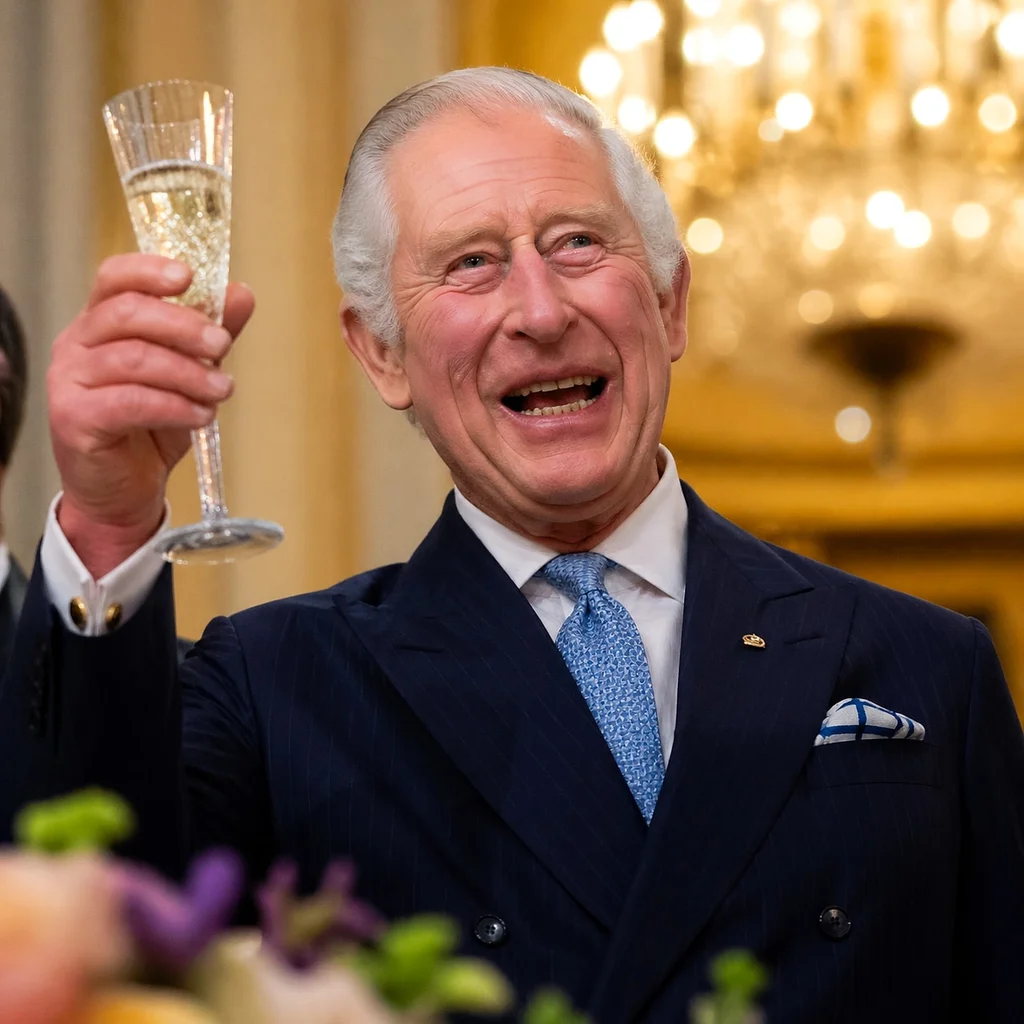
烧白宫的玩笑:查尔斯三世如何用一场国宴扭转英美关系
King Charles Jokes About 1814 White House Fire
About this story
Charles III's US state visit — a White House burning joke to Trump and a Magna Carta lecture to Congress on Ukraine. HSK 5-6 Chinese listening practice.
This is an HSK 5-6 Chinese listening episode that runs about 13 minutes. The full Mandarin script is shown with tap-for-pinyin and a line-by-line English translation, so you can listen and read at once — comprehensible input in the sense of Stephen Krashen's i+1 theory. It teaches 16 key vocabulary words such as 玩味、外交、微妙 and walks through 8 grammar patterns, each explained in English with examples. The same news story is retold at 4 difficulty levels — use the level selector above to find the version that is challenging but still understandable for you.
Read at your level
原文Read the complete story in Chinese. Reveal pinyin and English only when you need them.
English transcript reference
Speaking of the most fascinating international news story of the week — it's British king Charles III's visit to America.
I say "fascinating" because on the surface, this looks like an ordinary state visit.
But look closer, and there's so much packed inside.
Historical reversals, political maneuvering, the precise heat of diplomacy, and the composure of an old king.
Today we're going to take this performance apart in full.
Let me lay down the background first.
This year is the 250th anniversary of America's founding.
On July 4, 1776, the Declaration of Independence was issued — and from that day on, America formally became independent from the British Empire.
That is, 250 years ago, Americans were the subjects of the British king.
That war of independence lasted eight years, and in the end, America won.
The British king who lost the North American colonies was named George III.
And the British monarch who came to visit 250 years later is Charles III.
He is not a direct descendant of George III — the Windsor family has switched branches in between — but in terms of the British monarchy's lineage, he is the heir of George III's royal line.
So picture this scene:
George III, in his time, lost America.
Two and a half centuries later, Charles III comes to America to wish her a happy birthday.
And it doesn't end there.
Some thirty years after the Revolutionary War, Britain and America fought again — what's known as the War of 1812.
In 1814, British troops marched all the way into the American capital, Washington, and burned the White House to the ground.
Yes — that very White House.
The White House tourists see in Washington today is the one rebuilt afterwards.
The original was burned down by the British.
So you have to remember one fact:
In the entire family album of Anglo-American relations, there have been deeply unhappy chapters.
Wars lost, capitals burned, the most prestigious residence reduced to skeletal remains.
Of course the two countries later became iron-clad allies, but that past has always been there.
Now back to April 2026.
Charles and Queen Camilla's visit ran from April 27 to April 30 — four days in total.
Trump invited them personally, and the protocol was maxed out — South Lawn welcoming ceremony at the White House, state banquet, congressional address, and a stop in Virginia.
The political backdrop of this visit is actually very subtle.
In recent months, Trump's relations with Europe have been deteriorating.
With British prime minister Starmer, things are especially stuck.
A few weeks ago, Trump publicly mocked Starmer, saying: "This is no Winston Churchill."
He also threatened tariffs on British goods because of the UK's digital services tax on tech companies.
On top of that, the US and Israel are at war with Iran.
Trump wanted Britain to send troops to help, but Starmer refused.
Starmer publicly said: "This is not our war."
So Trump is full of resentment toward the British government.
But Charles is different.
Charles is the king, and according to British constitutional convention, the monarch must remain politically neutral.
He cannot criticize Trump, nor defend Starmer.
But precisely because of this "neutrality," he became the only Briton who could still get into the White House under these circumstances.
This is the magic of monarchy — when the prime ministers fall out, the king is still there.
On the evening of April 28, the White House state banquet.
Trump gave the opening speech, and as is customary, said all the kind things about the Anglo-American friendship.
Then it was Charles's turn.
He stood up, opened with a few words of polite thanks.
Then the tone shifted.
He said: "I notice you've been doing some construction work at the White House lately."
Let me insert one piece of context.
Trump has been making a major move on the East Wing of the White House: building a massive ballroom.
Reportedly several times the size of the existing State Dining Room.
This is somewhat controversial in America — environmental groups, historic preservation societies, and Congress all have objections.
At any rate, the White House right now is a construction site from morning to night.
Charles continued:
"And so, I must offer an apology for the following—"
"We British people once burned this house of yours down."
The whole room — burst into laughter.
Savor how brilliant this line is.
Layer one: it's a historical reference, hooked on the British burning of the White House in 1814.
Layer two: it ties that to Trump's current "construction project."
The implication being roughly: "Compared to our renovation back then, this one of yours is mild."
Layer three, and the highest level —
He used a flawless joke to transform the most awkward page of Anglo-American relations into a piece of dinner-table comedy.
No one feels offended by a guest who knows how to apologize.
And Charles's apology was sincere, but also funny — the calibration was just right.
Right after that, he delivered another bit.
He quoted Wilde: "We have everything in common with America nowadays — except, of course, the language."
Britain and America both speak English.
But the pronunciation differs, the vocabulary differs, even the tone of "thank you" is different.
So this line is, on the surface, a compliment, but inside there's a gentle joke.
And to deliver it at a state banquet, from the mouth of the British king — the elegance lifts immediately.
Two bits, in a few words, settles everything.
Trump was beaming the whole time, applauding repeatedly.
You can tell he genuinely eats this up.
Trump, as a person, has an almost instinctive fascination with royalty, with classical Europe, with that "old money" atmosphere.
Charles understood this perfectly and prescribed exactly the right medicine throughout.
But the state banquet was just the appetizer.
The real main course was the next day, April 29.
Charles delivered a 25-minute speech to the US Congress.
Now, a British monarch addressing the US Congress is only the second time in history.
The previous time was Charles's mother Elizabeth II, in 1991.
That was 35 years ago.
That is, for an entire generation of US members of Congress, the vast majority were hearing a British monarch speak in the chamber for the first time in their lives.
This speech, viewed rhetorically, was a textbook performance.
Let me unpack three layers.
Layer one — the keyword is "unity."
Charles repeatedly stressed one line: "The challenges we face are too great for any one nation to bear alone."
On the surface this is talking about multilateralism, NATO, the trans-Atlantic alliance.
What's the real meaning behind it?
Behind it, he is very obliquely telling Trump —
"You can't keep withdrawing from your allies."
"You need Europe, and Europe needs you."
But he didn't name names, didn't accuse, wasn't aggressive in any way.
He just said "the challenges are too big — no one can carry them alone."
Layer two — the keyword is "constitutionalism."
Charles specifically referenced the Magna Carta — the document signed in England in 1215 that limited royal power.
He emphasized "checks and balances" — that is, 制衡 in Chinese.
He also brought up Britain's tradition of "the monarch being bound by the law."
This sounds like a history lesson.
But the lawmakers in Congress, and Trump himself, all understood what he was saying.
In recent years, a series of Trump's actions — bypassing Congress, attacking the judiciary, pressuring the media — has made domestic American discussion of "is constitutionalism still working?" increasingly anxious.
Charles's segment was, with the highest possible courtesy, quietly reminding Americans:
"The founding spirit you have, you learned it from us — please don't lose it."
Think about how ironic this is —
A king of a monarchy, going into the legislature of a republic, reminding them to preserve democratic principles.
Even better — when he reached this part, members of Congress spontaneously rose for a full standing ovation.
Both parties applauded.
This was a very dramatic moment.
Layer three — the keyword is "Ukraine."
Charles said the US and UK must continue to support Ukraine with "unyielding resolve."
The impact of this line is bigger than everything before it.
Why?
Because over the past six months, Trump and the Republican mainstream have been loosening support for Ukraine.
Cutting military aid, pressuring Ukraine to make concessions, letting Russia off the hook.
Within the GOP, a consensus has formed that "aid to Ukraine is unsustainable."
Now a British king goes to the US Congress and tells this group: "You must continue to support Ukraine."
By rights, Republican members should have stayed seated.
But the result was — they all stood up.
The whole chamber rose in a standing ovation.
That kind of instant bipartisan consensus on this issue could not have been brokered by any domestic American political figure.
But Charles did it.
How did he do it?
He relied on the "non-political" status of the monarch.
Precisely because Charles doesn't belong to any party and doesn't get involved in domestic American fights, his words can pierce the high wall between the two parties.
This is the ultimate expression of soft power.
The British Guardian called it "a master-class performance."
A monarchy with over a thousand years of dynastic continuity, in 2026 Washington, did something Britain's elected government could not —
Turned a hardened Trump into a tender admirer, turned a divided Congress into a unified standing ovation.
You can sense that there is deep political calculation behind this performance.
But Charles himself is also genuine.
He has real reverence for history, real conviction in Anglo-American friendship, and real, heartfelt support for Ukraine.
This state of "highly choreographed yet genuinely natural" is a skill the British royal family has polished over generations.
Speaking of which, I want to add something.
There's another reason why this visit is especially poignant —
Charles is 77 this year, and he disclosed his cancer diagnosis last year.
The outside world has been speculating about his health.
The royal family hasn't shared details, but rumors that "the cancer is worsening" have never died down.
So this visit has been read by many observers as the most important state trip of Charles's reign as king.
Possibly even his last visit to America at this level of protocol.
Which gives that White House joke, that congressional speech, that standing ovation, all an extra layer of unspeakable weight.
An old king, with limited time, used a near-perfect diplomatic performance to drive a stable stake into Anglo-American relations.
Letting the world remember:
Even when Trump and Starmer are at each other's throats, there's a deeper umbilical cord between Britain and America.
That cord isn't politics, isn't trade — it's history.
It's the 250 years of mutual achievement walking from 1776 to 2026.
Finally, I want to say something for those of us who are watching.
Watching this visit, you can take away a few things.
First — humor is the highest-grade political tool.
Charles didn't say a single heavy word.
He told two jokes.
But those two jokes digested centuries of complicated Anglo-American history.
Sometimes, a person who can mock himself has far more influence than a person who blames others.
Second — institutions outlive individuals.
Trump and Starmer fell out, but the Anglo-American relationship endures.
Why?
Because the bond between the two countries was not built on the personal relationship of two leaders.
It was built on institutions, culture, history, and the exchange between peoples.
Any seemingly unbreakable opposition is often less unbreakable than it appears.
Third — soft strength often defeats hard strength.
Trump excels at hard methods — tariffs, threats, fights, withdrawals.
Charles uses soft methods — grace, self-deprecation, classical references, quiet composure.
Look at the result —
Charles got Congress to give him a full standing ovation.
Trump cannot do this.
So the next time you want to persuade someone who isn't really willing to listen, think about Charles.
Don't rush to criticize.
Don't rush to prove the other side wrong.
Tell a joke that makes them laugh first.
Let the air loosen up first.
Then slowly, slowly, say what you really want to say.
That's all for today.
On April 29, British king Charles III gave a speech to the US Congress.
With a master-class performance, he reminded the world —
The Anglo-American relationship will not break because of a temporary political storm.
Because its roots run deeper than any single administration.
Listen again
Try it without the transcript and notice what sounds clearer.
What vocabulary does this episode teach?
词汇Sophisticated. 玩 (play) + 味 (taste). Used for dwelling on something's deeper meaning. 值得玩味 = worth pondering — a stock journalistic phrase.
HSK 5. 外 (outside) + 交 (interact). 外交关系 = diplomatic relations. The episode is essentially a case study in 外交.
HSK 5. 政治背景非常微妙 = politically very subtle. Used for situations where the official surface and the real meaning diverge.
HSK 5. 恶 (bad) + 化 (-ify). 关系一直在恶化 = relations have been deteriorating. Common in news writing.
HSK 6. 公开嘲讽斯塔默 = publicly mocked Starmer. Conveys contempt with verbal display.
HSK 5. Glossed inline. 政治上必须保持中立 = must remain politically neutral. Central to the episode's argument about why Charles's soft power works.
Formal. 致 (deliver) + 辞 (speech). Specifically for the formal opening or closing remarks at a banquet/ceremony.
化 (transform) + 解 (untie). 化解气氛 / 化解矛盾 = defuse the atmosphere / resolve a conflict. The verb that captures Charles's whole strategy.
Literary. 反 (reverse) + 讽 (mock). The episode uses 反讽 to describe the absurdity of a king lecturing a republic about democracy.
Internet-era slang. Originally meant 'thorn' or 'plot device.' Now used for any clever joke or callback. 这个梗很妙 = this joke is brilliant.
Literary. Originally Cantonese-influenced. Used in journalism for someone who has become an enthusiastic supporter.
脐 (navel) + 带 (cord). Used metaphorically for an indispensable connection between two parties. The episode uses it for the deep cord between Britain and America.
君 (sovereign) + 主 (master) + 制 (system). 君主立宪制 = constitutional monarchy. Britain has 君主制; America does not.
宪 (constitution) + 政 (governance). Government bound by a written constitution. The episode argues Trump tests its limits.
HSK 5. 援助乌克兰 = aid to Ukraine. 军援 = military aid. 经援 = economic aid.
HSK 5. 坚定不移的决心 = unyielding resolve. The exact phrase Charles used about Ukraine. 下决心 = resolve to do something.
* beyond level超纲词
What grammar patterns appear in this episode?
语法X 也就是说 / 也就是 Y
Apposition / 'that is to say.' Used to restate or clarify in a more formal, expository register than 就是.
也就是说,二百五十年前,美国人是英国国王的子民。
也就是说,整整一代美国国会议员里,绝大多数是第一次亲耳听见英国君主在国会大厅讲话。
把 + Object + Verb + Result (disposal)
Disposal construction with explicit result. Required when an act produces a measurable outcome on the object.
把白宫一把火烧掉了。
把英美关系最尴尬的一页,转化成了餐桌上的轻喜剧。
把强硬的特朗普变成了温柔的拥趸。
被 + (Agent) + Verb (passive)
Mandarin passive marker. The agent can be omitted (then the action is depersonalized). Strong association with formal/journalistic register.
原来那座,被英国人烧没了。
首都被人烧过、最高规格的官邸被烧得只剩骨架。
被很多观察人士理解为查尔斯当国王以来,最重要的一次出访。
正因为 ... 所以 / 反而 ...
Emphatic causal construction. 'It is precisely because of X that Y.' Often used for counter-intuitive results.
正是因为这种'中立',他反而成了在这种局面下,唯一还能进白宫的英国人。
正是因为查尔斯不属于任何党派,不参与美国国内斗争,所以他说的话,反而能穿透两党之间的高墙。
X 不是 ... 而是 Y
Corrective structure. 'X is not A, but rather B.' Used for emphatic clarification.
他不是乔治三世的直系后代——温莎家族中间换过支系——但是从英国君主制度的传承来说,他就是乔治三世那条王脉的继承者。
这根脐带不是政治,不是贸易,是历史。
即便 / 即使 ... 也 ...
Concessive — stronger than 虽然. 'Even if X, still Y.'
即便特朗普和斯塔默闹得不可开交,英美之间还有一根更深的脐带。
X 上看 / 表面上看
Hedging frame. 'On the surface...' Sets up a reveal that the deeper truth is different.
因为这场访问表面上看,就是一次普通的国事访问。
这话表面是在讲多边主义、讲北约、讲跨大西洋同盟。
靠 / 凭 + Object
Means-marker: 'rely on X / rely on the strength of X.' 靠 is more colloquial; 凭 more formal.
靠的就是君主这个身份的'非政治性'。
靠的不是天赋异禀。
Proper nouns
专有名词Free account
Keep learning from this story
Create a free account to keep saved words and your preferred level together.
- Keep words with their story context
- Remember your preferred level
- Build your vocabulary over time