
A Chinese podcast · Same story, 4 levels
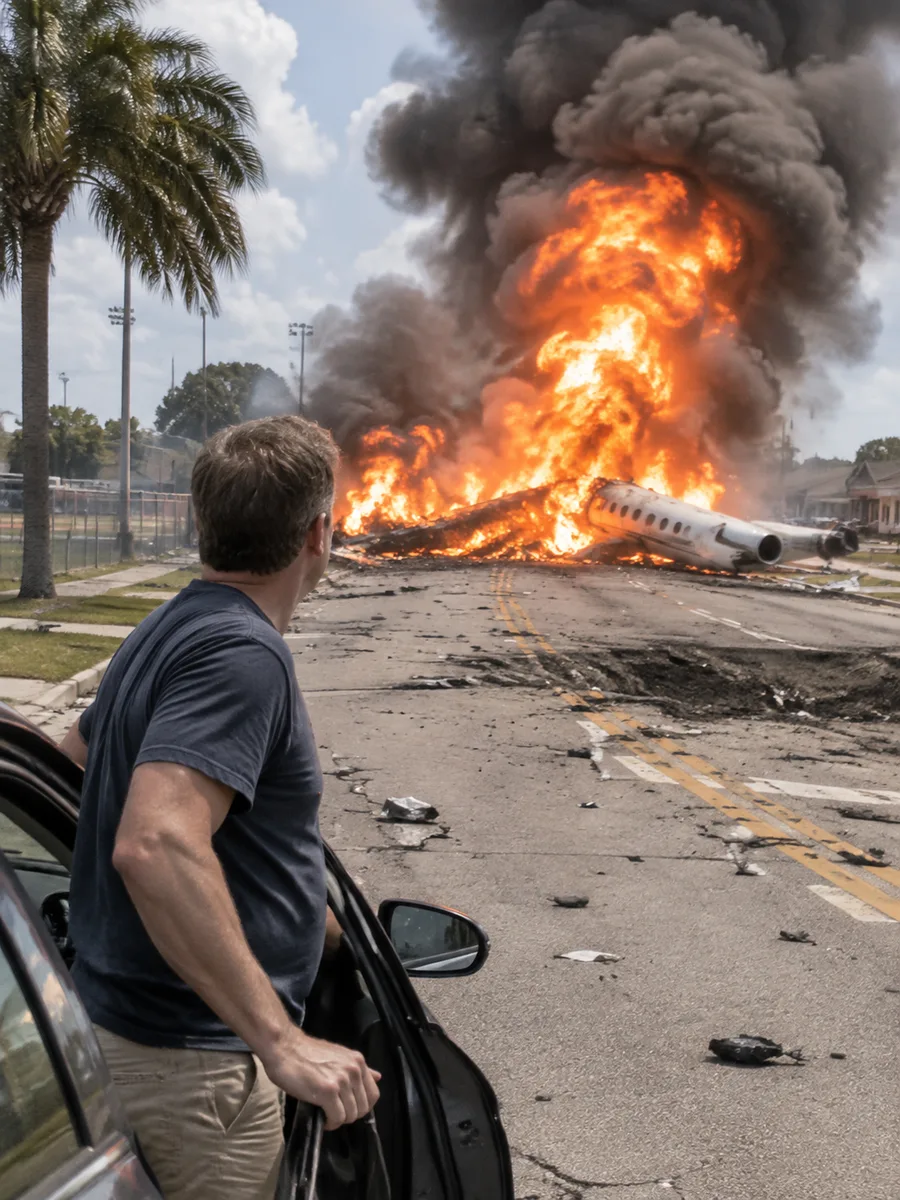
里尔喷气机在佛罗里达坠毁,九人全部遇难
Learjet Crashes in Florida, Killing All Nine Aboard
About this story
A Learjet 60 with nine people aboard crashed into a Palm Beach County street after reporting icing and turbulence, killing everyone on board. HSK 4 Chinese listening practice.
This is an HSK 4 Chinese listening episode that runs about 3 minutes. The full Mandarin script is shown with tap-for-pinyin and a line-by-line English translation, so you can listen and read at once — comprehensible input in the sense of Stephen Krashen's i+1 theory. It teaches 12 key vocabulary words such as 受伤、调查、重点 and walks through 8 grammar patterns, each explained in English with examples. The same news story is retold at 4 difficulty levels — use the level selector above to find the version that is challenging but still understandable for you.
Read at your level
原文Read the complete story in Chinese. Reveal pinyin and English only when you need them.
English transcript reference
The 20-year-old co-pilot said over the radio, "We're going to crash into the ground."
Less than a minute later, the business jet carrying nine people fell into a residential street in Palm Beach County, Florida.
The plane exploded and caught fire; all nine people on board died, seven of them passengers and two crew members.
On the ground, one person sitting in a car was also injured; right next to the crash site are ballfields, shops and homes.
When a plane comes down in a place like this, the price paid is often not just by those on board.
The aircraft involved was a Learjet 60, a type that received certification back in the 1990s.
It took off that morning from an airport in Austin, Texas, bound for North Eleuthera in the Bahamas, and was operated by a company called Aurora Aviation.
Thomas Chapman of the National Transportation Safety Board described what happened during the high-altitude portion.
When the plane climbed to 35,000 feet, the crew reported light icing and moderate turbulence.
The fuselage began pitching up and down by several hundred feet, so the crew requested a climb to 37,000 feet.
But the situation did not improve.
In the mayday call, the pilot said, "We are descending at 10,000 feet per minute."
Right after that he said the plane had entered an overspeed condition, with a descent rate of 20,000 feet per minute.
Co-pilot Nathalia Filgueiras said over the radio that the plane was banking until it was almost on its side.
She said, "We're going to crash into the ground, we're out of time."
From the mayday call to the plane hitting the ground, only about a minute passed.
Chapman said the plane appeared to have broken apart as it fell.
Debris was scattered over an area about half a mile long, and investigators will have to examine it piece by piece.
He said weather is currently a major focus of the investigation.
Another focus is how the pilots and air-traffic controllers decided on that route at the time.
In Chapman's words, they need to establish who knew what and when, and what they did.
Among the dead were Captain Jeff Gregory and the 20-year-old Filgueiras.
Among the passengers was a Texas tech entrepreneur named Adam Robinson, who was on the plane with family and friends.
On the ground, residents of a nearby mobile home community were urgently evacuated.
Investigators have already begun work at the site, examining the wreckage and scattered parts.
The National Transportation Safety Board is an independent agency that specializes in investigating air disasters; it does not determine who is guilty, only what caused the crash.
The board also said it will look into whether this accident has similarities to several past accidents involving the same aircraft type.
Listen again
Try it without the transcript and notice what sounds clearer.
What vocabulary does this episode teach?
词汇HSK 3. 受伤的人 = injured person; 一名坐在车里的人受伤 = one person in a car was injured.
HSK 3. Very common in news; 调查人员 = investigators.
HSK 3. 调查的一个重点 = one focus of the investigation.
HSK 1. 天气是调查的重点 = weather is a focus of the investigation.
HSK 3. 怎么决定这条航线 = how they decided this route.
HSK 3. 查清原因 = find out the cause.
HSK 3. Used for aircraft; opposite is 降落 (land).
HSK 3. 以每分钟一万英尺的速度 = at a speed of 10,000 feet per minute.
HSK 3. Used for deaths in disasters or accidents; 全部遇难 means "all killed."
HSK 3. Common travel word; 七名乘客 = seven passengers.
HSK 3 (机组 + 人员). Refers to pilots and cabin crew; contrasts with 乘客.
Beyond HSK 3. 副 = deputy; 驾驶 = to pilot. The pilot in command is 机长.
* beyond level超纲词
What grammar patterns appear in this episode?
语法在 + Place + 说 / Verb
Marks where an action or statement happens; 在无线电里说 = said over the radio.
二十岁的副驾驶在无线电里说,我们要撞到地上了。
副驾驶娜塔莉亚·菲尔盖拉斯在无线电里说,飞机倾斜得几乎侧了过来。
Verb + 到 + Result
到 indicates the endpoint or result of an action, e.g. 爬到三万五千英尺 (climbed to 35,000 feet), 撞到地上 (crash into the ground).
飞机爬到三万五千英尺的时候,机组报告遇到了轻微的结冰和中等程度的颠簸。
她说,我们要撞到地上了,我们没有时间了。
以 + Rate + 的速度 + Verb
Expresses the rate or speed at which something happens: 以每分钟一万英尺的速度下降.
飞行员在求救信号里说,我们正在以每分钟一万英尺的速度下降。
紧接着他又说,飞机进入了超速状态,下降速度到了每分钟两万英尺。
从 + A + 到 + B
Marks a span from one point to another in time or space: 从发出求救信号到飞机坠地.
从发出求救信号到飞机坠地,中间只有大约一分钟。
是……的 (emphasis construction)
Emphasizes the doer or nature of something: 出事的是里尔60型公务机.
出事的是里尔60型公务机,这种飞机在上世纪九十年代就拿到了认证。
……的时候
Means "when…" and sets up a time clause before the main event.
飞机爬到三万五千英尺的时候,机组报告遇到了轻微的结冰和中等程度的颠簸。
并没有 + Verb
Emphatic negation with 并, often used to contradict an expectation: 情况并没有好转.
但情况并没有好转。
不……只……
Contrasts what something does not do with what it does: 不负责判谁有罪,只负责查清原因.
国家运输安全委员会是一个专门调查空难的独立机构,它不负责判谁有罪,只负责查清原因。
Proper nouns
专有名词Sources
来源Free account
Keep learning from this story
Create a free account to keep saved words and your preferred level together.
- Keep words with their story context
- Remember your preferred level
- Build your vocabulary over time