
A Chinese podcast · Same story, 4 levels
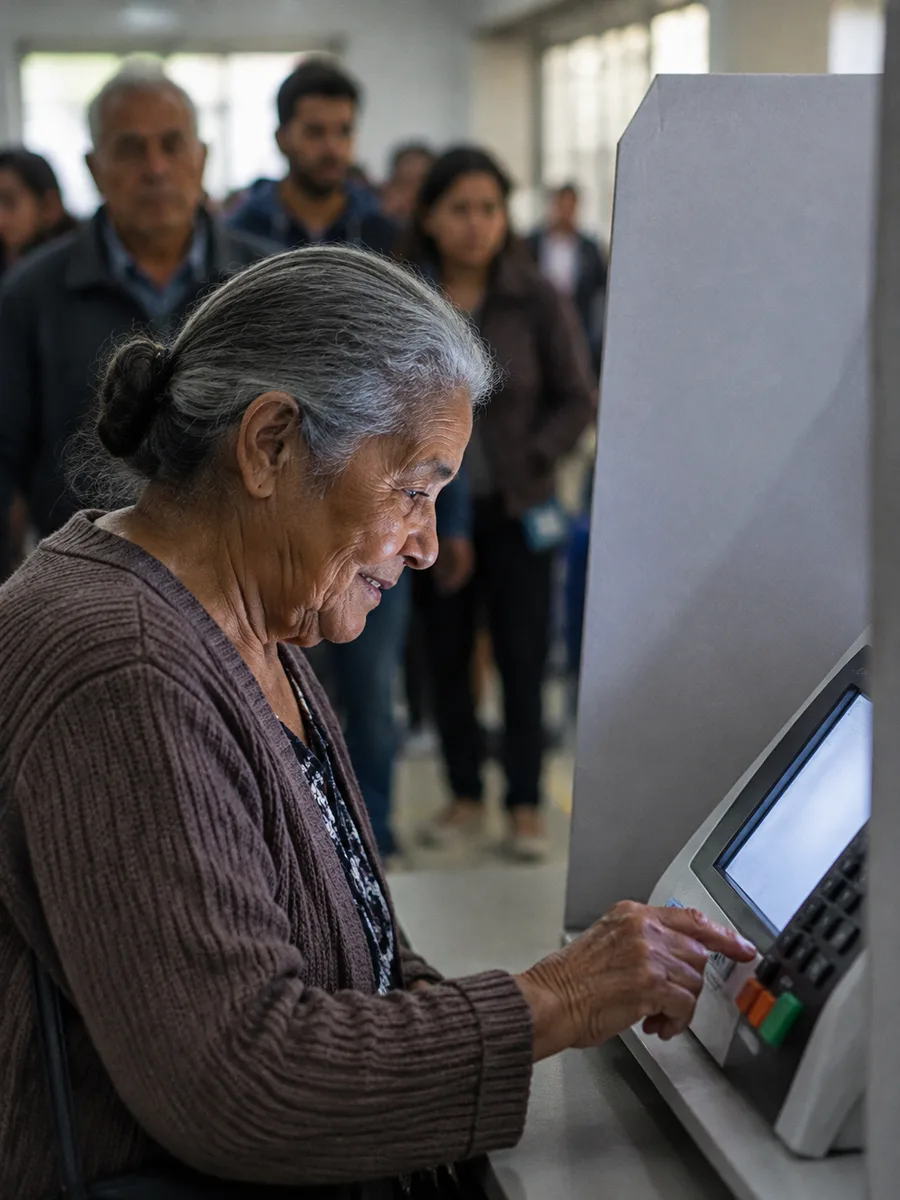
八十岁的卢拉,第四次当上巴西总统
Lula Wins Brazil's Presidency at 80 — A Comeback Over Flávio Bolsonaro by 52% to 48%
About this story
Lula beats Flavio Bolsonaro 52% to 48% in Brazil's runoff — his campaign overhaul, Janones' WhatsApp army, welfare handouts, and Bolsonaro's militia scandals. HSK 4 Chinese listening practice.
This is an HSK 4 Chinese listening episode that runs about 4 minutes. The full Mandarin script is shown with tap-for-pinyin and a line-by-line English translation, so you can listen and read at once — comprehensible input in the sense of Stephen Krashen's i+1 theory. It teaches 12 key vocabulary words such as 调查、支持、原因 and walks through 8 grammar patterns, each explained in English with examples. The same news story is retold at 4 difficulty levels — use the level selector above to find the version that is challenging but still understandable for you.
Read at your level
原文Read the complete story in Chinese. Reveal pinyin and English only when you need them.
English transcript reference
In Brazil's election history, there have rarely been events like this.
On October 4th, Lula lost in the first round of voting.
He had two million fewer votes than Bolsonaro.
At that time, every poll said Bolsonaro would win.
The candidates who did not win the first round received eight percent of the vote.
These candidates later all supported Bolsonaro.
Their votes all went to Bolsonaro.
In 1985, elections returned to Brazil.
Since then, no one who lost the first round has been able to win.
Lula did it.
This is a rare change in Brazil.
The United States had a president named Roosevelt, who also won four times.
In three weeks, Lula gained ten million votes.
Among these people, many had not voted the first time.
Why was there such a change?
The first reason is his campaign method.
Before the first round, Lula's campaign was very disorganized.
The things he talked about, ordinary people could not understand.
After the first round, he changed his campaign.
After the surgery, there was a wound on his head.
A hat was on his head.
So many people could not see this wound.
But this wound was still there.
The hat also made many people feel that he was already very old.
The second reason is the mobile phone.
Lula previously had no mobile phone and did not use a computer.
Later, he began making his own videos on his phone.
His videos were very simple, and many people liked them.
Bolsonaro spent two million dollars on mobile phones.
Lula's campaign used only five hundred thousand dollars.
But many people watched Lula's videos.
The person who helped him was Janones.
Janones is a congressman, forty-two years old.
This congressman made a group on his phone.
This group had ten million people in two weeks.
They posted photos of Lula online.
Lula was very popular in the last few weeks.
The third reason is the government's money.
The government raised the money given to poor people by fifteen percent.
He also got Congress to pass a law.
This law lets Brazilians work one day less per week.
And the salary stays the same.
Taking the bus on weekends is free.
He also does not require some people to pay back money.
One million people who run their own businesses each received one thousand dollars.
Giving things before elections is very common in Brazil.
But Lula gave more than any previous president.
There is also a fourth reason: Bolsonaro's own problems.
Some people suspect he has ties to the militias in Rio.
Militias do bad things.
When he was a congressman, he gave a medal to a militia member.
This person had killed people.
Later, this person's wife and mother also took money from him.
In 2023, he sent more than forty thousand dollars to a person who took part in an assassination.
That person later went to prison.
On television, he also said a name wrong.
That name was the name of a mother's daughter.
That mother was sitting in the audience.
Many women were very unhappy after hearing this.
On October 23rd, the last television program.
After watching this program, many women decided to vote for Lula.
On the evening of October 25th, the result came out.
Lula received fifty-two percent of the vote.
Bolsonaro received forty-eight percent.
Bolsonaro does not accept this result.
He said bad weather and traffic problems kept some people from voting.
So the Supreme Court made voting hours longer.
But Bolsonaro himself had also asked for more time.
He also wants another election.
Trump might help him.
Lula won the presidency, but not many people in Congress support him.
The largest group in Congress is the Bolsonaro family.
Bolsonaro's wife, brother, and two sons all entered Congress.
This makes it very hard for Lula to work.
He is eighty years old, and the law says he cannot be president again.
The economy is the biggest problem.
In Lula's last four years, the government's debt increased by more than ten points.
This number is very high.
The debt makes the market very worried.
He must reduce the debt.
But he gave too many things before the election.
So many people doubt whether he can do a good job.
Many people say neither of the two is a good choice.
An eighty-year-old man won the election.
But can he do this job well?
Listen again
Try it without the transcript and notice what sounds clearer.
What vocabulary does this episode teach?
词汇HSK 3. Here 调查 means opinion polls; 做调查 to conduct a survey.
HSK 3. 支持某人 to back someone; 支持他的人 his supporters.
HSK 3. 第一个原因是… the first reason is…; contrast 结果 result.
HSK 3. 竞选方法 campaign method; 用这个方法 with this method.
HSK 3. 普通人 ordinary people; 普通话 Mandarin.
HSK 3. 很简单 very simple; 不简单 not easy.
HSK 3. 提高了百分之十五 raised by 15 percent; also 提高水平.
HSK 3. 通过法律 to pass a law; 法律规定 the law stipulates.
HSK 3. 选举 history/politics word; 参加选举 to take part in an election.
HSK 3. 投 (cast) + 票 (ballot); 第一次投票 the first round of voting.
HSK 3. 候选 shortlisted + 人 person; used for election candidates.
HSK 3. 工资不变 wages unchanged; 涨工资 to get a raise.
* beyond level超纲词
What grammar patterns appear in this episode?
语法在 + Place/Time + 里
Marks a scope or period: 'within/in' a place or span of time.
巴西的选举历史里,很少有这样的事。
三个星期里,卢拉多了一千万票。
在卢拉的最后四年里,政府的债务增加了十多个点。
比 + Noun + 少/多 + Number + Measure Word
Comparison of quantity: 'has N fewer/more than someone'.
他比博索纳罗少两百万票。
卢拉给得比以前的总统都多。
从…以后,…
'Since…' introduces a starting point after which the statement holds.
从那以后,没有人输掉第一次投票还能赢。
第一次投票以后,他改变了竞选。
让 + Person + Verb Phrase
Causative 'make/let someone do something'.
这个法律让巴西人一个星期少工作一天。
帽子也让很多人觉得,他已经很老了。
这让卢拉很难工作。
还能 / 能不能 + Verb
Potential complement asking or stating whether an action is possible.
没有人输掉第一次投票还能赢。
很多人怀疑他能不能做好。
但是他能做好这个工作吗?
是…的 (emphasis construction)
Highlights the doer or circumstance of a past event.
帮助他的人是雅诺内斯。
国会里人最多的,是博索纳罗家的人。
把 + Object + Verb + 了
Disposal construction: the object is acted upon with a result.
政府把给穷人的钱提高了百分之十五。
每 + Measure Word + Noun
'Every/each' with a measure word, often followed by a per-unit figure.
一百万个自己做生意的人,每人拿到了一千美元。
每一个调查都说博索纳罗会赢。
Proper nouns
专有名词Sources
来源Free account
Keep learning from this story
Create a free account to keep saved words and your preferred level together.
- Keep words with their story context
- Remember your preferred level
- Build your vocabulary over time