
A Chinese podcast · Same story, 4 levels
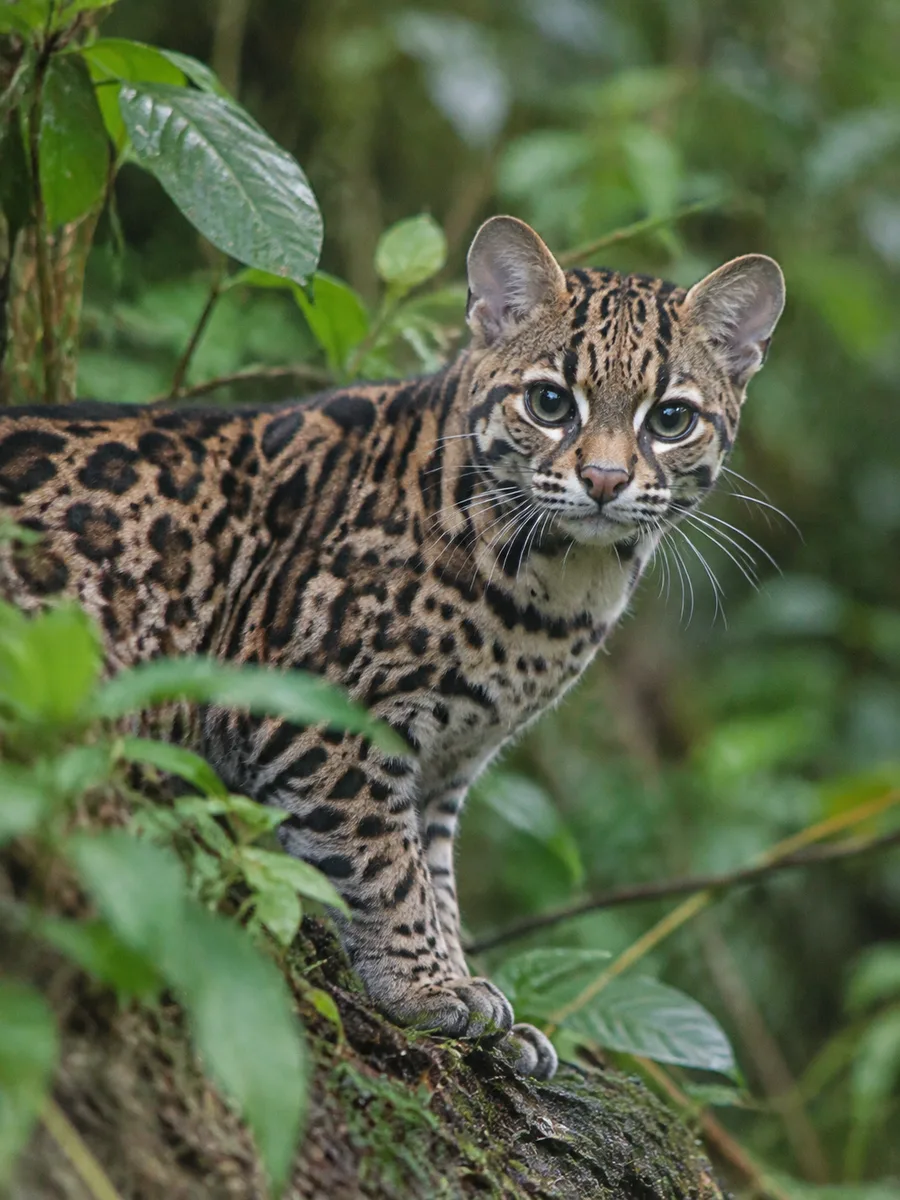
一百年才被发现的新猫
New Wild Cat Species Discovered in Bolivia After 100 Years — The Tilcayo Tiger Cat
About this story
Scientists confirm the Tilcayo tiger cat, a new species from Bolivia's Yungas cloud forest — only two are known, and its habitat is shrinking. HSK 4 Chinese listening practice.
This is an HSK 4 Chinese listening episode that runs about 5 minutes. The full Mandarin script is shown with tap-for-pinyin and a line-by-line English translation, so you can listen and read at once — comprehensible input in the sense of Stephen Krashen's i+1 theory. It teaches 12 key vocabulary words such as 博物馆、保护、环境 and walks through 7 grammar patterns, each explained in English with examples. The same news story is retold at 4 difficulty levels — use the level selector above to find the version that is challenging but still understandable for you.
Read at your level
原文Read the complete story in Chinese. Reveal pinyin and English only when you need them.
English transcript reference
In the museum, there are many animals.
There are some cats that died many years ago.
People put them there and left them for many years.
No one knew that among them was a new kind of cat.
In 2026, a group of scientists reached a conclusion.
This cat is called the Tilcayo.
This story starts with a home.
In a home in Bolivia, there was a small cat.
The family liked this cat very much and lived with it.
They thought it was a house cat.
Later, people who study cats came.
They looked at this cat many times.
After looking, they said: this is not a house cat.
This is a mountain cat.
This is a cat scientists did not know about.
Why did they know?
They looked at the genes of 38 cats.
These 38 cats came from many places in South America.
Among them were also 8 museum specimens.
A specimen is a dead animal that people put in a museum for later people to see.
The data from these 38 cats was put together and compared.
After comparing, they reached a conclusion.
These cats are not one kind; they are five kinds.
The Tilcayo is one of them.
Genes prove that this cat and other cats separated one million four hundred thousand years ago.
Over such a long time, their genes became different.
When scientists look at genes, there is a standard.
If the genes differ enough to reach this standard, it is a new species.
So scientists say: the Tilcayo is a new species.
The last time people discovered a new species was 1923.
From that year to now, one hundred years, people had not discovered another new species.
So this time, many people are very happy.
The Tilcayo is smaller than a house cat, and lighter than a house cat.
From head to body, about 46 centimeters.
It weighs 3 pounds.
Its fur color is not dark, and it has black spots on it.
This cat has another feature: its ears are round.
This cat lives in the mountains of Bolivia.
That place is called the Yungas.
The Yungas has forests, many trees, and also many clouds.
The Yungas is next to La Paz.
The area where it lives is only in Bolivia.
In other countries, people have not seen it.
People there saw this cat a long time ago.
They call it the Tilcayo.
Tilcayo is the local name, not something scientists thought up.
Scientists used this name.
So this cat is now called the Tilcayo.
Now, people know of only two of these cats.
One is male, 10 years old.
When he was very small, someone saw him on the road.
That person took him home and let him live in the home for more than a year.
Later, that person sent him to a place that protects animals.
He lived in that place for many years.
The people there like him very much.
There is another one, a female.
Some people hit her, and her body was in very bad shape.
Later, people rescued her.
People let her return to the mountains.
Now, she is in the mountains.
The two cats people know of are all of them.
Two is too few.
People do not know the number of these cats.
Here there is a problem.
There is an organization in the world that looks at which animals are in danger.
This organization's current view is: this cat is two kinds.
Both kinds are in danger.
But a new study says it is five kinds.
Five kinds, not two.
Two kinds and five kinds are obviously different.
Why do two kinds and five kinds make a difference?
Because when protecting animals, people have to look at them one kind at a time.
If it is one kind, people protect one kind.
If it is five kinds, people have to protect five kinds.
Next time, this organization will look again.
At that time, they may say: the Tilcayo is more endangered.
The key is, people have only seen two, and do not know the number.
The place where this cat lives has shrunk.
The forests on the mountains are fewer year by year.
Some people want more land to grow things, and some people set fires.
There are resources in the mountains, and some people come to dig.
With fewer forests, the environment where the cat lives is not good.
So scientists say, to protect this cat, we must also protect the mountains where this cat lives.
This time, scientists also looked at cats in the mountains of Peru.
There, they discovered another new species.
That kind of cat also has a new name.
So people know more about mountain cats.
But people have only seen two Tilcayos.
Are there more in the mountains? People do not know.
Finding this cat is a very long process.
Scientists still need to search and to look.
If a cat comes to your home, how do you know whether it is a house cat?
Listen again
Try it without the transcript and notice what sounds clearer.
What vocabulary does this episode teach?
词汇HSK 3. Place where specimens and old objects are kept; 博物馆里 = inside the museum.
HSK 3. Used with animals and environment: 保护动物、保护环境.
HSK 3. 猫住的环境 = the environment where the cat lives.
HSK 2. Key verb of the story: 发现新的物种 = to discover a new species.
HSK 2. 毛颜色不深 = the fur color is not dark.
Beyond level here (HSK 5). 世界上有一个组织 = there is an organization in the world.
Beyond level. 有危险 = to be in danger; 更危险 = more endangered.
HSK 3. 科学 (science) + 家 (specialist). 一组科学家 = a group of scientists.
HSK 3. Common collocation: 得出一个结论 = to reach a conclusion.
HSK 3. 基因证明…… = the genes prove that…
HSK 3. 达到这个标准 = to meet this standard.
HSK 3. 还有一个特点 = has one more feature.
* beyond level超纲词
What grammar patterns appear in this episode?
语法把 + Object + Verb + Place
The 把 construction moves the object before the verb, often with a place or result. Used for handling or placing things.
人们把它们放在那里,放了很多年。
从 + Time/Place + 到 + Time/Place
Marks a range in time or space: 'from … to …'.
这件事,要从一个家说起。
从头到身体,大约46厘米。
是……的 (emphasis / identification)
The 是……的 frame highlights or identifies information, often the source or nature of something.
这是山里的猫。
这是科学家不知道的猫。
蒂尔卡约,就是那里的名字,不是科学家想的。
比 + Noun + Adjective
Comparison: 'A is more … than B'. The adjective follows 比 directly.
蒂尔卡约比家里的猫小,也比家里的猫轻。
一年比一年 + Adjective
Fixed pattern meaning 'more … every year', showing gradual change over time.
山上的森林,一年比一年少。
如果……就……
Conditional: 'if …, then …'. 就 introduces the result clause.
如果是一种,人们保护一种。
如果是五种,人们要保护五种。
如果你的家里来了一只猫,你怎么知道,它是不是家里的猫?
要……也要……
Parallel structure listing two things both required: 'need to … and also need to …'.
要保护这种猫,也要保护这种猫住的山。
Proper nouns
专有名词Sources
来源Free account
Keep learning from this story
Create a free account to keep saved words and your preferred level together.
- Keep words with their story context
- Remember your preferred level
- Build your vocabulary over time