
A Chinese podcast · Same story, 4 levels
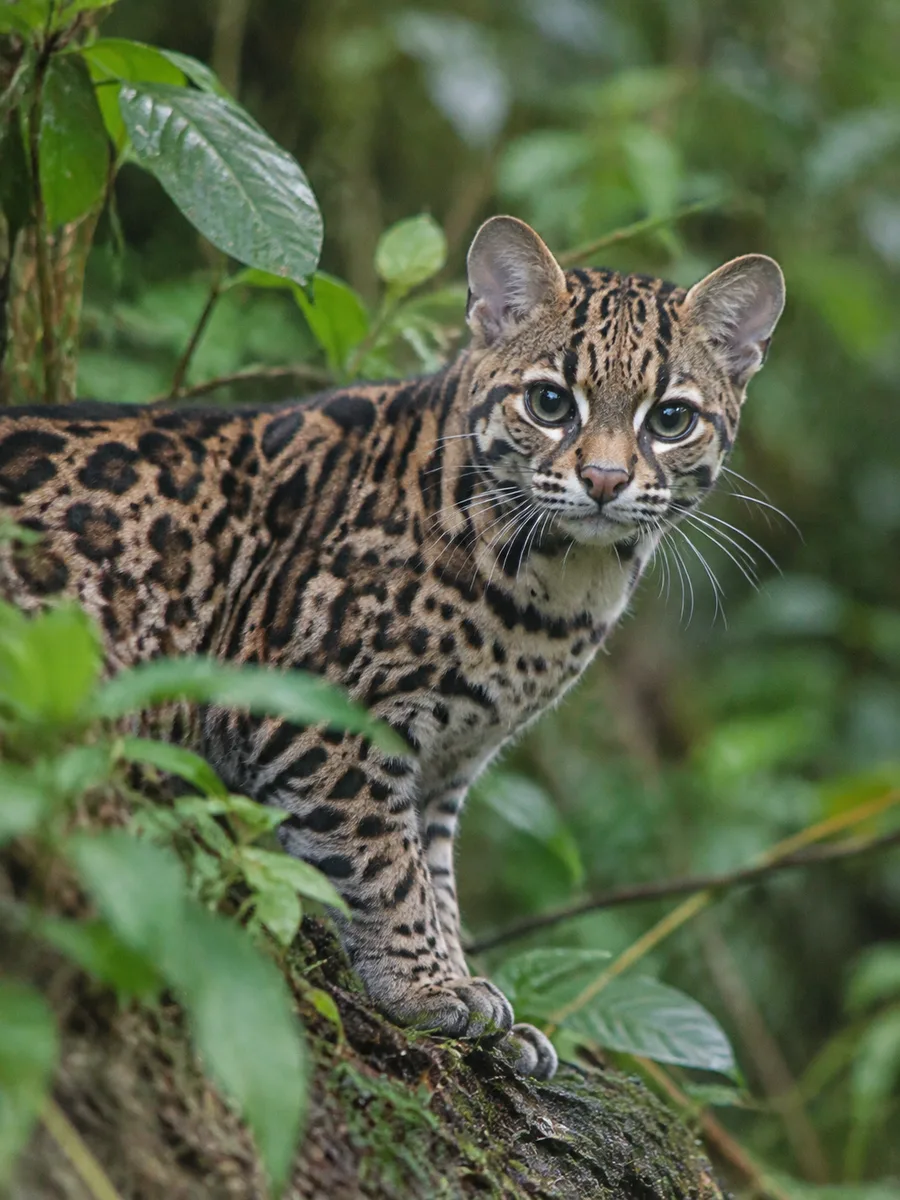
一百年才被发现的新猫
New Wild Cat Species Discovered in Bolivia After 100 Years — The Tilcayo Tiger Cat
About this story
Scientists confirm the Tilcayo tiger cat of Bolivia's Yungas cloud forest is a new species — only two known alive, and its habitat is shrinking. HSK 5+ Chinese listening practice.
This is an HSK 5+ Chinese listening episode that runs about 7 minutes. The full Mandarin script is shown with tap-for-pinyin and a line-by-line English translation, so you can listen and read at once — comprehensible input in the sense of Stephen Krashen's i+1 theory. It teaches 12 key vocabulary words such as 保护、动物、科学 and walks through 6 grammar patterns, each explained in English with examples. The same news story is retold at 4 difficulty levels — use the level selector above to find the version that is challenging but still understandable for you.
Read at your level
原文Read the complete story in Chinese. Reveal pinyin and English only when you need them.
English transcript reference
He is 10 years old and lives in a place that protects animals.
People can see him every day.
But it wasn't until 2026 that people knew what kind of cat he was.
He is a male cat living in the Yungas of Bolivia.
That place is for injured and endangered animals.
When he was very small, he was alone by the side of the road.
A family took him home and kept him as a house cat.
After keeping him for over a year, the family sent him to this animal protection place.
Since then, he has always lived there.
Local people call this kind of cat Tilcayo.
This name later became part of its scientific name.
On September 17, 2026, a study was published.
The study's conclusion was clear: the Tilcayo is a new species.
Scientists confirmed that it is not the same kind as other cats.
This conclusion came from the genes of 38 cats.
Genes are the things that control heredity.
These 38 cats came from several South American countries.
Scientists from several countries worked together.
Among them, 8 were museum specimens.
Some specimens had been in cabinets for many years.
Scientists began this project in 2021.
They compared the genes of the 38 cats together.
The results were different from previous views.
Previously, people thought there were only two species of this kind of cat.
The new data says there are five.
The data also shows that the differences among the five species are very clear.
The Tilcayo is one of these five.
Genes also show that it separated from other cats 1.4 million years ago.
Its ancestors separated from other cats a long time ago.
1.4 million years is a very long time.
With such a long time, genetic changes are great.
So this is not a small difference.
This is a new species.
The last time a new cat was discovered was in 1923.
From that year to 2026 is one hundred years.
In one hundred years, no one discovered a new cat.
So this research is very important in science.
This paper also let more people know about this cat.
After the research was announced, many people began to pay attention to this cat.
One organization says two species; this study says five.
Both views have their own basis.
One uses previous data, the other uses new genetic data.
The new data is more detailed, so more differences were seen.
What is a new species?
Simply put, it is a cat that scientists did not know before and had not named.
The Tilcayo is smaller than a house cat.
From head to body, it is about 46 centimeters.
It weighs 3 pounds.
Its fur color is not dark, with dark spots on it.
Its ears are round.
These features make it look very much like a house cat.
So many people who saw it didn't think much about it.
Local people saw this cat long ago.
They call it Tilcayo.
But scientists never knew it was a new kind of cat.
Because it looks too much like a house cat.
This is why a new species can go undiscovered for a hundred years.
Currently, people have only seen it in the Yungas of Bolivia.
The Yungas is near La Paz and is a mountain area with clouds.
There are many trees and many clouds on the mountain.
Its distribution range may be only in Bolivia.
With such a narrow distribution, protection is even harder.
Other countries have no confirmed records.
This sentence is important: no records does not mean no cats.
There may be more, but no one has seen them.
This is also what scientists most want to know now.
Currently, people know of two living Tilcayos.
One is the male cat mentioned at the beginning, 10 years old, living in the animal protection place.
The other is a female cat.
She was hurt by people, and her injuries were severe.
Later, people rescued her.
People treated her, and she slowly got better.
After she got better, people released her back into the mountains.
Since then, people have not seen her again.
Two is all the records so far.
The known individuals are only two.
But two does not mean there are only two.
Scientists say this number is too small to indicate how many of this cat there are in total.
They need more surveys, more records, and more time.
Scientists said in an interview that they will continue to search.
This is also why, even though the research is published, the questions are not over.
Museum specimens are crucial here.
Without specimens, scientists could only look at living cats.
Of living cats, people only know two.
Two is not enough to compare.
Specimens brought data from long ago.
These data allowed scientists to see the differences among the five species.
This is also a key point of this research.
Museum specimens are the key evidence of this research.
The name Tilcayo was not invented by scientists.
It is what local people have always called it.
Scientists wrote it into the paper.
There is an organization in the world that specifically assesses which animals are in danger.
This organization's current view is to count this kind of cat as two species.
Both are in danger.
The new research says there are actually five.
Five means five different cats.
When protecting, people need to look at each one individually.
In the next assessment, this organization will look at these five separately.
If the Tilcayo is really very few, it may be listed as a more endangered level.
This is an important change for conservation work.
The mountains where the Tilcayo lives are shrinking.
Human activities have reduced the forest.
Forests are turning into land for growing things.
Farmers want more land, and agriculture is expanding.
Some people set fires.
There are also mines in the mountains, and people come to mine.
People also want the resources in the mountains.
These activities are the biggest threat to it.
These activities make the cat's living space smaller and smaller.
When the space is smaller, there are fewer cats.
When there are fewer cats, it is harder to find them.
If this cat disappears, people will never see it again.
So protecting the Tilcayo is not just protecting one cat.
It is also protecting the Yungas forest and the other animals living there.
This research has another finding.
In the Yungas of Peru, scientists also found a new kind of cat.
It is also a new species.
Both new cats live in mountains like the Yungas.
This shows that there are still cats unknown to people in the mountains of South America.
Now, the biggest question is still the population.
People still don't know the status of this cat.
Two is a record, not the whole.
How many are there in the mountains? No one knows.
Can they survive in the future? No one knows either.
What is the relationship between the Tilcayo and the Peruvian cat? Scientists still need to study.
Is the protected area big enough? That also depends on future research.
These questions will not be answered just because of one paper.
But at least now people know: this is a new kind of cat.
Only when you know can you possibly protect.
Next time you see a small cat in the mountains, will you take a second look?
Listen again
Try it without the transcript and notice what sounds clearer.
What vocabulary does this episode teach?
词汇HSK 4. Common verb; 保护动物 means 'protect animals'.
HSK 3. Used in 保护动物 (protect animals).
HSK 4. 科学家 means 'scientist'.
HSK 4. Used as noun and verb; 一项研究 means 'a study'.
HSK 3. 发现新的物种 means 'discover a new species'.
HSK 5. 新的物种 means 'new species'.
HSK 5. 新的数据 means 'new data'.
HSK 4. 区别很明显 means 'the difference is obvious'.
HSK 5. 基因数据 means 'genetic data'.
HSK 5. 最大的威胁 means 'the biggest threat'.
HSK 6. 博物馆里的标本 means 'museum specimens'.
Proper noun; a cloud forest region near La Paz.
* beyond level超纲词
What grammar patterns appear in this episode?
语法从……开始
Indicates the starting point of an action or period. '从' marks the beginning.
科学家从2021年开始做这个项目。
从那一年到2026年,一百年。
被 + verb
Passive voice marker. The subject is the receiver of the action.
她被人伤害过,伤得很重。
如果蒂尔卡约真的很少,它可能会被列为更危险的等级。
越来越 + adjective
Expresses a gradual increase: 'more and more'.
这些活动,让猫住的地方越来越小。
Proper nouns
专有名词Sources
来源Free account
Keep learning from this story
Create a free account to keep saved words and your preferred level together.
- Keep words with their story context
- Remember your preferred level
- Build your vocabulary over time