
A Chinese podcast · Same story, 4 levels
尼安德特人:为什么只剩下我们?
What Happened to the Neanderthals? Why Homo Sapiens Is the Only Human Species Left
About this story
Why Neanderthals, Denisovans and Homo floresiensis vanished while Homo sapiens survived — new evidence on their tools, art, genes and pure luck. HSK 5+ Chinese listening practice.
This is an HSK 5+ Chinese listening episode that runs about 7 minutes. The full Mandarin script is shown with tap-for-pinyin and a line-by-line English translation, so you can listen and read at once — comprehensible input in the sense of Stephen Krashen's i+1 theory. It teaches 12 key vocabulary words such as 历史、发现、研究 and walks through 7 grammar patterns, each explained in English with examples. The same news story is retold at 4 difficulty levels — use the level selector above to find the version that is challenging but still understandable for you.
Read at your level
原文Read the complete story in Chinese. Reveal pinyin and English only when you need them.
English transcript reference
Today, there are eight billion people in the world.
They are all one kind of human.
But the history of humans was not like this.
For seven million years, humans have taken many forms.
A hundred thousand years ago, many kinds of humans still lived in the world.
Neanderthals lived in Europe and western Asia.
Denisovans lived in Asia.
Homo floresiensis lived on an island in Indonesia.
Homo erectus had just disappeared in Java.
We Homo sapiens are only one of them.
So today there being only one kind of human is not a normal thing.
This is a very strange time.
A researcher in London said: Why are we the only ones left?
Where did all the others go?
For many years, people had a very simple answer.
Human history is like a ladder.
The highest rung is us.
Below are the others.
Our brains are big, our things are good, our society is complex.
So they are gone.
This is how it should be.
We are the end of the story.
In the 1980s, many people believed this answer.
A researcher said: Back then, people thought the others were all savage.
We survived because we were the strongest.
But new discoveries changed this story.
Neanderthals were not animals standing halfway up.
In the nineteenth century, people saw their bones for the first time.
At that time, scientists thought they were not far from monkeys.
Today we know they are very close to us.
A researcher said: They had already walked ninety-five percent of the road.
They could use fire.
They could hunt very large animals.
They could find plants to eat, and perhaps also use plants as medicine.
They could draw things on cave walls.
They could care for people who were sick or could not walk.
They could even do things very much like dentistry.
All of this shows that their lives and our lives are not as far apart as we thought.
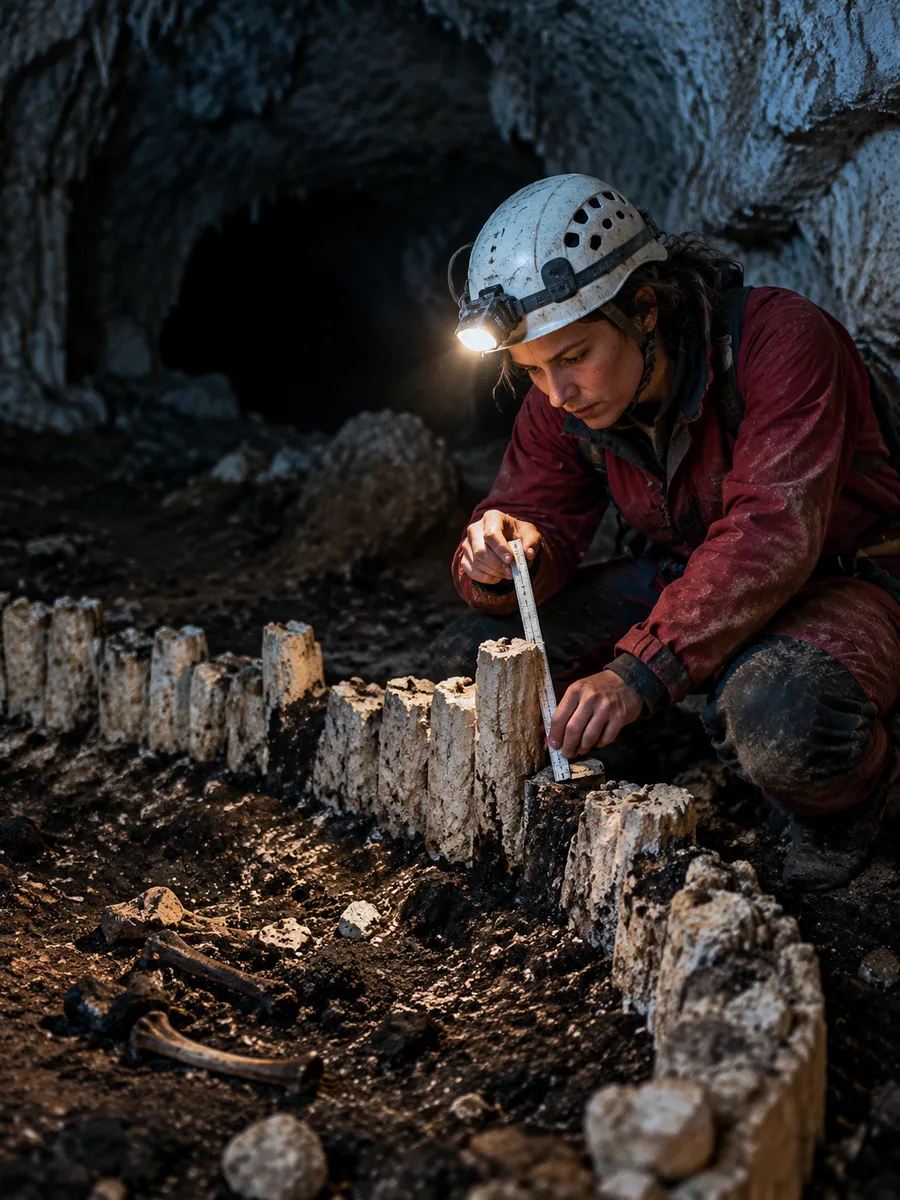
In France, there is a cave called Bruniquel.
One hundred seventy-six thousand five hundred years ago, a group of Neanderthals walked into this cave.
The cave is very deep, with no sun.
They brought fire, and they also brought things for making fire.
They used four hundred broken stalagmites to make several circles.
The largest circle is more than six meters wide.
These stalagmites are one hundred and twelve meters long in total.
They are three hundred and thirty-six meters from the cave entrance.
Doing these things requires planning, talking, and many people working together.
A researcher in London said: This shows they could think about very complex things.
In 2010, a researcher found animal bones in Ethiopia.
On the bones were marks left by stone tools.
These bones are three point four million years old.
This discovery pushed the date of stone tools back by eight hundred thousand years.
The people who did this were not people like us.
At that time, there was only one earlier kind of human there.
We call it Australopithecus.
This discovery is very controversial.
Some researchers say those marks may not have been left by stone tools.
But it made many people start to think: human abilities did not begin with us.
Back to the Neanderthals.
Their abilities led some researchers to say: they are the same as us.
But others feel this claim goes too far.
They ask: If a Neanderthal sat on the New York subway, would people look at him?
Some people say: No.
But others ask: Even if their culture is very like ours, is this them learning from us?
Or is it us learning from them?
It is very hard for us to know.
In 2010, the Neanderthal genome was published.
It came from a cave in Croatia.
This was the first time we could read their genes.
The first thing the genome said is that they did not directly become us.
The second thing: they also did not completely disappear.
They had children with the ancestors of modern humans.
So today, people outside Africa have about two percent of their genes from Neanderthals.
A part of them is still in us.
The genes also gave a time.
The period when the two kinds of humans had children together was about seven thousand years.
It began more than fifty thousand years ago.
More detailed research says it was from fifty thousand five hundred to forty-three thousand five hundred years ago.
But there are more blanks than answers.
Were those meetings willing?
Or was there violence?
These questions still have no answers today.
A recent study said interbreeding had a pattern: Neanderthal men and modern women.
But the details are still not very clear.
A researcher at Princeton said: There is too much we still do not know.
He said that every time he finishes a talk, someone always asks the same question.
How many times were they and we actually together?
If it was only a few times, then it is just a small story in history.
If it was thousands of times, then it concerns who we are.
Today, scientists are still looking.
They test these genes in mice.
They also test them in cells in the lab.
They want to know: What does a Neanderthal gene do when it is put into our bodies?
What we know now is that they are related to immunity, circadian rhythms, and the shape of the body.
There is also a study that looked at the genomes of more than three hundred ancient people.
In this way, the interbreeding of the past fifty thousand years slowly emerged.
However, genes only tell part of the story.
How many people there were, and how the weather changed, are also very important.
No matter which kind of human, the numbers were not large.
The weather was cold, and the changes were sudden.
Some years, the Neanderthals did well.
Some years, it was our turn.
At other times, small groups on both sides disappeared, leaving no descendants.
A researcher said there may be an element of luck here.
Homo sapiens came from Africa.
We had more people, and we lived in warmer places.
Their world had longer winters and was harder.
We may simply have had a little more opportunity.
Another researcher said: This was probably just luck.
When the weather was good, they could get there too.
They tried again and again.
Throughout the ice age, we kept coming.
Besides luck, there are other reasons.
More and more researchers believe the answer is not a new tool.
The answer is a net: the ability to face disease, the speed of cultural development, social wisdom, and the ability to build alliances.
These are all very hard to see in bones and stones.
Many details we may never know.
Compared with human curiosity, what the past left behind is too little.
Every new discovery brings more questions.
But some researchers say that now, more than ever, we need to look at our history.
Because today, we face many risks to our survival.
An Australian researcher said: Our species has not been on Earth for long.
So our survival is not a certain thing.
Homo erectus was in the world for more than a million years.
The Neanderthals walked this road for four hundred thousand years.
We Homo sapiens have walked it for only about three hundred thousand years.
He said: I do not think we are so great.
From a bigger perspective, we are nothing.
So, are we the final winners, or the next to disappear?
This question still has no answer today.
Listen again
Try it without the transcript and notice what sounds clearer.
What vocabulary does this episode teach?
词汇HSK 3. 人的历史 — the history of humans; also 历史上 (in history).
HSK 3. Used as both noun and verb: 新的发现 (new discoveries), 找到了 (found).
HSK 3. 研究者 (researcher), 一项研究 (a study) — common in science news.
HSK 3. 很多人相信这个答案 — many people believed this answer.
HSK 4. 社会复杂 (society is complex); opposite 简单.
HSK 4. 石头工具 (stone tools); measure word 件/种.
HSK 5. 我们的物种 (our species); biology term common in news.
HSK 4. 人的能力 (human ability); often with 有/没有.
HSK 4. 一个很简单的答案 — a very simple answer; 没有答案 (no answer).
HSK 4. 完全消失 (completely disappear); used for species dying out.
HSK 4. 基因组 (genome), 基因来自尼安德特人 (genes from Neanderthals).
HSK 4. 科学家觉得 — scientists thought; 科学家还在找 (scientists are still looking).
* beyond level超纲词
What grammar patterns appear in this episode?
语法像 + Noun + 一样 / 像 + Noun
Expresses similarity: 'like' or 'similar to'. 像一把梯子 means 'like a ladder'.
人的历史,像一把梯子。
他们甚至会做很像牙医的事。
不是……而是…… / 不是……是……
Contrast structure correcting a mistaken assumption: 'not X, but Y'.
做这件事的人,不是我们这样的人。
Means 'more and more'. Indicates a gradual increase over time.
越来越多的研究者认为,答案不是一个新工具。
The 把 construction moves the object before the verb to show a result or displacement.
这个发现,把石头工具的时间往前推了八十万年。
和……比起来
Means 'compared with'. Used to set up a comparison between two things.
和人的好奇心比起来,过去留下的东西太少了。
就算……也……
Concessive: 'even if..., still...'. Introduces a hypothetical that does not change the conclusion.
就算他们的文化和我们很像,这是不是他们在学我们?
Proper nouns
专有名词Sources
来源Free account
Keep learning from this story
Create a free account to keep saved words and your preferred level together.
- Keep words with their story context
- Remember your preferred level
- Build your vocabulary over time