
A Chinese podcast · Same story, 4 levels
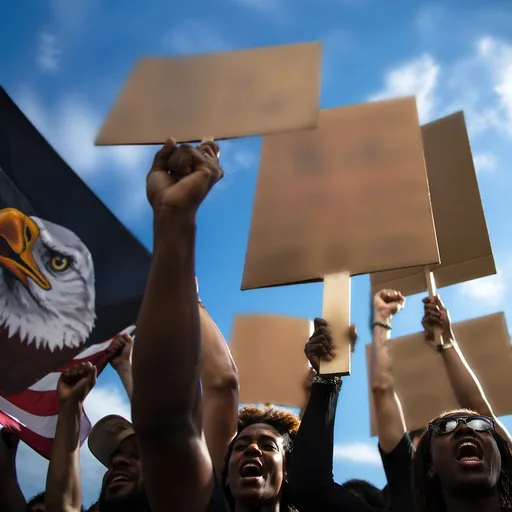
No Kings:当九百万人同时说不
9 Million Join No Kings Protests
About this story
9 million Americans join Indivisible's No Kings protests against ICE and TSA — the largest peaceful US march yet. HSK 5-6 Chinese listening practice.
This is an HSK 5-6 Chinese listening episode that runs about 7 minutes. The full Mandarin script is shown with tap-for-pinyin and a line-by-line English translation, so you can listen and read at once — comprehensible input in the sense of Stephen Krashen's i+1 theory. It teaches 14 key vocabulary words such as 抗议、荒谬、民意 and walks through 6 grammar patterns, each explained in English with examples. The same news story is retold at 4 difficulty levels — use the level selector above to find the version that is challenging but still understandable for you.
Read at your level
原文Read the complete story in Chinese. Reveal pinyin and English only when you need them.
English transcript reference
On March twenty-eighth, American streets witnessed what may become a historic act of political expression.
Protests erupted simultaneously at over three thousand locations nationwide, with an estimated nine million participants.
If that figure holds, it would surpass all previous records to become the largest single-day protest in American history.
The movement's name is concise and powerful: No Kings.
This slogan is itself a political declaration.
One of the founding principles of America is the rejection of monarchy.
Over two hundred years ago, Americans used a war of independence to tell the British king: we don't need you.
Now, protesters believe the current president's governing style is pushing against that very red line.
This is not the No Kings movement's first appearance.
Last June, approximately five million people participated in the first round of protests.
In October, against the backdrop of a government shutdown and intensifying immigration enforcement disputes, the number grew to seven million.
This time it's nine million.
From five million to seven million to nine million — the curve is still climbing.
The sustained expansion of the movement's scale is itself a phenomenon worth analyzing.
The triggers for the protest are multiple and overlapping.
The most direct flashpoint was deaths during immigration enforcement.
ICE caused multiple fatalities during arrest operations.
Renee Good, Keith Porter, Alex Pretti — these three names quickly became symbols of the movement.
Their stories spread widely, igniting public fury over enforcement violence.
But the deaths are just the tip of the iceberg.
The deeper grievance points to the systematic expansion of executive power.
The protesters' core demand can be distilled into one sentence: the president is not a king and cannot decide everything alone.
Specific accusations include: bypassing Congress to issue executive orders at scale.
Ignoring federal court rulings.
Using federal agencies as tools for executing political will.
In the protesters' view, these practices combined already constitute an erosion of the separation of powers.
The ongoing federal government shutdown provided the protest movement with its most vivid material.
Hundreds of thousands of federal employees have gone weeks without pay.
TSA security officers show up every day, run screening, check luggage, maintain order.
But their bank accounts haven't seen a single deposit in weeks.
The absurdity of this picture needs no rhetorical embellishment.
It is, in itself, the most powerful argument for protest.
A government that can't pay its own employees while pouring resources into immigration enforcement.
This misalignment of priorities leaves ordinary people confused, then angry.
This protest has a characteristic that many analysts have noted: the breadth of its geographic distribution.
Approximately two-thirds of protest events took place outside major cities.
This is no longer coastal liberals making routine statements in New York and San Francisco.
Midwestern farming towns, southern suburban communities, even some traditionally conservative districts — all saw demonstrators.
When a movement spreads from coastal metropolises to the inland heartland, its political significance fundamentally changes.
It can no longer be simply categorized as partisan bickering.
It becomes a cross-spectrum expression of popular will.
In Los Angeles, authorities preemptively installed metal barriers at highway on-ramps.
This logistical detail speaks louder than any slogan about how both organizers and law enforcement anticipated the crowd size.
All protests were conducted peacefully.
Participants marched along streets holding signs, maintaining orderly formation.
The organizing group Indivisible established nonviolence as the movement's bottom line from the very beginning.
Maintaining peace with nearly nine million participants is itself a remarkable organizational achievement.
Consider this number from another angle.
Nine million people means one in every thirty-six Americans took to the streets.
In a nation of three hundred thirty million, achieving that participation rate requires more than just anger.
It requires organizational capacity, logistical coordination, and a broadly shared social consensus.
The content of that consensus can be simplified to one sentence: power must have boundaries.
Regardless of whether you personally agree with every one of the protesters' demands.
When this many people stand up on the same day for the same principle.
The event itself constitutes an undeniable political fact.
Any healthy political system needs to seriously confront that fact.
Every large-scale social movement in history erupted because enough grievances had accumulated.
The civil rights movement of the sixties was like this, the anti-war movement during Vietnam was like this, and today's No Kings movement is like this.
The common thread of these movements is that none of them appeared out of thin air.
They are the result of countless individuals deciding to stand up.
Every person who took to the streets had their own reason.
Some were angry because they lost their wages.
Some were fearful because they witnessed enforcement violence.
Some were anxious because they felt democracy was being eroded.
Nine million reasons converging together form a force that cannot be ignored.
What happens next?
No one can predict with certainty.
But one thing is clear.
When roughly three percent of a country's population simultaneously takes to the streets to express the same demand.
That demand is no longer noise that can be dismissed.
It becomes a signal that must be answered.
How it is answered will determine America's trajectory going forward.
From an international observer's perspective, this protest carries yet another layer of meaning worth considering.
Globally, democratic systems are undergoing an unprecedented stress test.
From Europe's populist waves to Latin America's political polarization, from Asia's authoritarian resurgence to the Middle East's instability.
Nearly every continent is experiencing some form of governance crisis.
America's No Kings movement, viewed through this broader framework, is not an isolated event.
It is a microcosm of the collective anxiety facing democratic systems worldwide.
But unlike many countries, American protesters chose peaceful expression.
Nine million people took to the streets without a single serious incident of violence reported.
This restraint is itself a demonstration of institutional resilience.
Streets are not battlefields, slogans are not weapons, signs are not declarations of war.
When a society can accommodate dissent on this scale and keep it within a peaceful framework.
That itself is a practice of the democratic ideal.
The ultimate test is not how large the protest grows, but how power responds to it.
Listen, or suppress?
Adjust, or confront?
The answer to that question is still being written.
Listen again
Try it without the transcript and notice what sounds clearer.
What vocabulary does this episode teach?
词汇To publicly express disagreement with authority.
Completely unreasonable or ridiculous.
The views and wishes of the general public.
Holding back from excessive action.
HSK 1-4. percent.
HSK 1-4. society.
HSK 1-4. politics.
To become a significant historical event.
A system where a king or queen rules.
A directive issued by the president without congressional approval.
Dividing government into branches to prevent abuse.
To gradually weaken or undermine.
The ability to recover from difficulties.
Holding a different opinion from the majority or authority.
* beyond level超纲词
What grammar patterns appear in this episode?
语法Proper nouns
专有名词Sources
来源Free account
Keep learning from this story
Create a free account to keep saved words and your preferred level together.
- Keep words with their story context
- Remember your preferred level
- Build your vocabulary over time