
A Chinese podcast · Same story, 4 levels
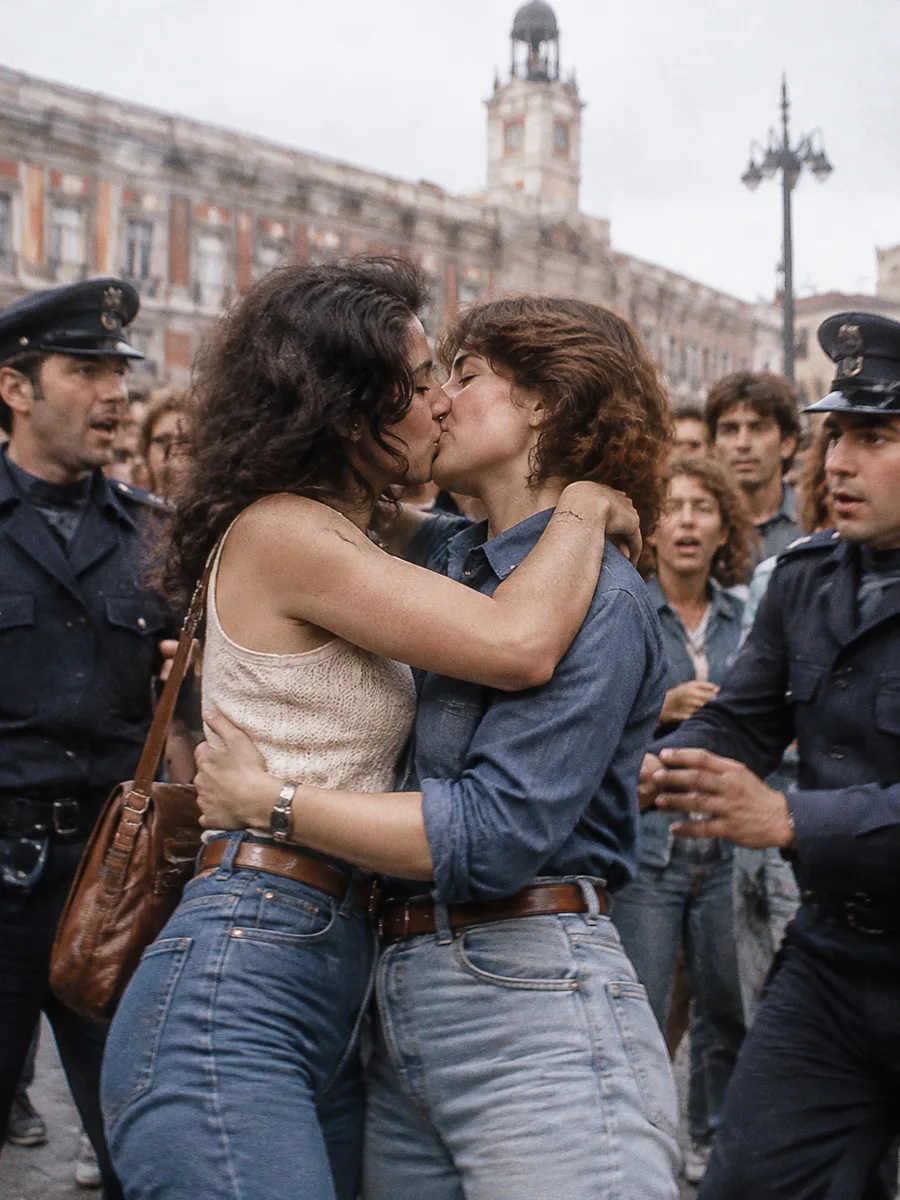
太阳门广场的吻
Why Public Kissing Is Everywhere in Spain: From Franco's Repression to the Streets of Madrid
About this story
HSK 1: How public kissing in Spain went from Franco-era police arrests to a 1987 Madrid kiss-in that changed the law, plus why housing shapes intimacy.
This is an HSK 2 Chinese listening episode that runs about 2 minutes. The full Mandarin script is shown with tap-for-pinyin and a line-by-line English translation, so you can listen and read at once — comprehensible input in the sense of Stephen Krashen's i+1 theory. It teaches 12 key vocabulary words such as 女人、回家、看见 and walks through 8 grammar patterns, each explained in English with examples. The same news story is retold at 4 difficulty levels — use the level selector above to find the version that is challenging but still understandable for you.
Read at your level
原文Read the complete story in Chinese. Reveal pinyin and English only when you need them.
English transcript reference
Two women kissed on the street, and the police came.
The police took them away.
They couldn't go home for two days.
This happened in Madrid in 1986.
At that time, kissing on the street was not allowed.
If the police saw it, they could arrest people.
When Franco was around, it was like this.
Franco ruled Spain from 1939 to 1975.
If two people kissed on the street, they also had to pay money.
In 1975, Franco died.
After he died, more people kissed on the street.
But kissing on the street was still not allowed.
So the police arrested those two women.
Many people were unhappy.
In 1987, many people went to a very big square in Madrid.
They kissed together in the square.
They wanted everyone to see.
In 1988, things changed.
The police could no longer arrest people for kissing.
Now, many people kiss on the streets in Spain.
Many people in Spain live in apartment buildings.
Out of every 100 Spanish people, 65 live in apartment buildings.
In a home, there are often only a few rooms.
Houses are very expensive, and not big.
It is not easy for young people to have their own home.
There is a woman named Isabel, 28 years old.
She lived abroad and moved back to her mom and dad's home three years ago.
She says: In Spain, kissing on the street is very common.
There is a female teacher who teaches at a university in Madrid.
She says: Home space is small, so many people go outside.
She also says: Not everyone is the same.
When two men kiss, there are still a few more people watching.
It's the same when two women kiss.
Today, on the streets, in parks, and in squares in Spain, there are people kissing everywhere.
Listen again
Try it without the transcript and notice what sounds clearer.
What vocabulary does this episode teach?
词汇HSK 1. Refers to a female person. Used in the script as 两个女人 (two women).
HSK 1. Verb-object compound meaning to return home. Used in 不能回家 (cannot go home).
HSK 1. Resultative verb meaning to see. Used in 警察看见了 (the police saw).
HSK 1. Used in phrases like 那时候 (at that time) and 佛朗哥在的时候 (when Franco was around).
HSK 1. Used in comparisons and descriptions, e.g., 很多人 (many people), 多起来了 (more and more).
HSK 1. Verb meaning to live or stay. Used in 住在楼里 (live in apartment buildings).
HSK 1. Used in 一个家里 (in a home) and 自己的家 (one's own home).
HSK 1. Used to introduce quotes: 她说 (she says).
HSK 1. Common noun for police. Appears multiple times: 警察来了 (the police came).
HSK 1. Means outside. Used in 去外面 (go outside).
Beyond HSK 1. Colloquial verb meaning to kiss on the lips. Central to the script's theme.
Beyond HSK 1. Verb-object phrase meaning to arrest or catch people. Used in 就可以抓人 (can arrest people).
* beyond level超纲词
What grammar patterns appear in this episode?
语法Place + 有 + Number + Measure Word + Noun
Expresses existence or quantity in a place. Used to state how many people live in apartments.
一百个西班牙人里,有六十五个住在楼里。
从 + Time + 到 + Time
Indicates a time range from one point to another.
佛朗哥管西班牙,从一九三九年到一九七五年。
Noun + 的时候
Means 'when' or 'at the time of' a noun or action.
佛朗哥在的时候,就是这样。
不能 + Verb
Expresses prohibition or inability: 'cannot' do something.
她们两天不能回家。
警察不能再因为亲嘴抓人。
让 + Person + Verb
Causative construction meaning 'let/make someone do something'.
他们要让所有人看见。
还是 + Verb/Adjective
Means 'still' or 'nevertheless', indicating a continuing state.
但是在街上亲嘴,还是不行。
看的人还是多一点。
因为 + Noun/Verb Phrase + 抓人
Expresses reason with 因为 (because). Here: arrest people because of kissing.
警察不能再因为亲嘴抓人。
Proper nouns
专有名词Sources
来源Free account
Keep learning from this story
Create a free account to keep saved words and your preferred level together.
- Keep words with their story context
- Remember your preferred level
- Build your vocabulary over time