
A Chinese podcast · Same story, 4 levels
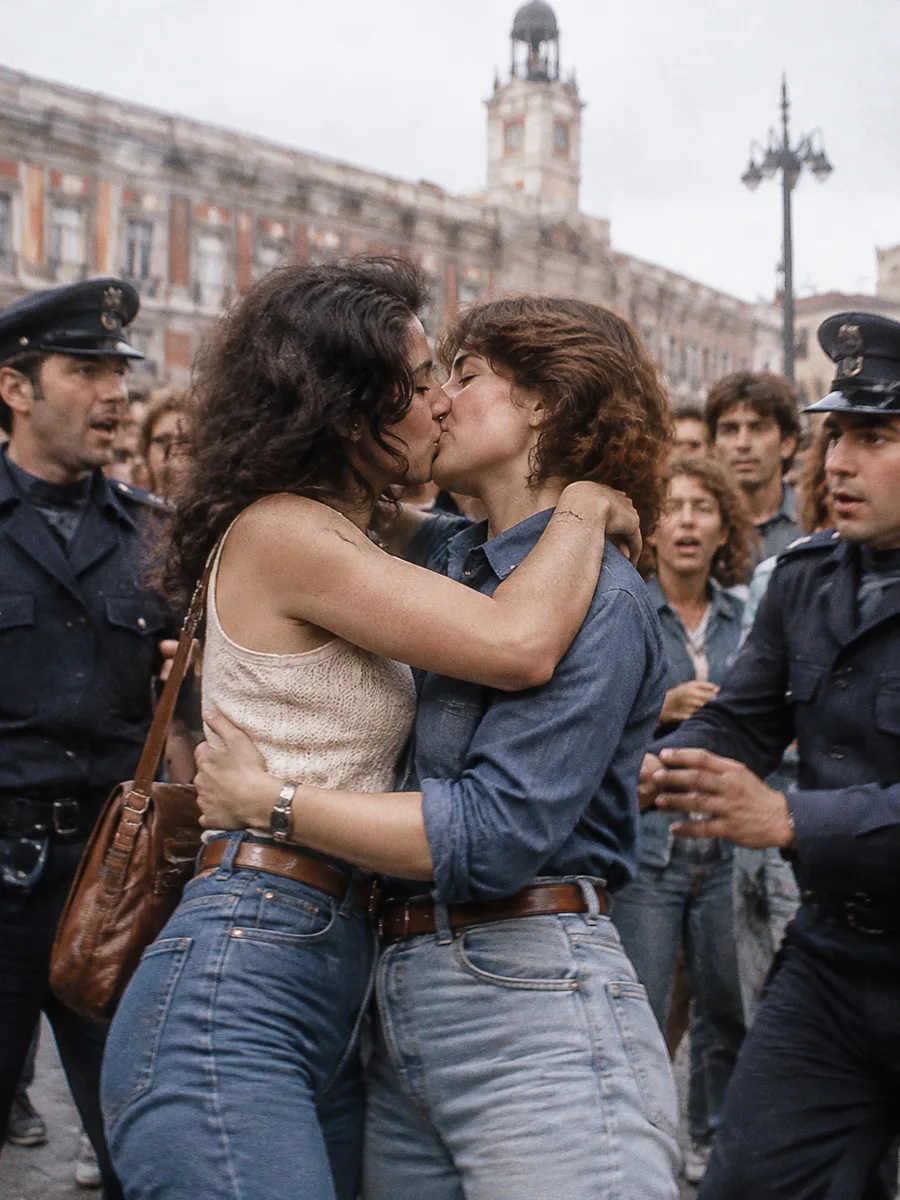
太阳门广场的吻
Why Public Kissing Is Everywhere in Spain: From Franco's Repression to the Streets of Madrid
About this story
Spain's public kissing culture, from Franco-era arrests under the Public Scandal Law to 1987's Puerta del Sol kiss-in and today's housing crisis. HSK 5+ Chinese listening practice.
This is an HSK 5+ Chinese listening episode that runs about 2 minutes. The full Mandarin script is shown with tap-for-pinyin and a line-by-line English translation, so you can listen and read at once — comprehensible input in the sense of Stephen Krashen's i+1 theory. It teaches 12 key vocabulary words such as 依据、通常、延续 and walks through 7 grammar patterns, each explained in English with examples. The same news story is retold at 4 difficulty levels — use the level selector above to find the version that is challenging but still understandable for you.
Read at your level
原文Read the complete story in Chinese. Reveal pinyin and English only when you need them.
English transcript reference
In 1986, two women in Madrid were taken away by police for kissing each other in the street and were held at the police station for two days.
The legal basis for detaining them was Article 431 of the Criminal Code, commonly known as the Public Scandal Law.
This charge bore the mark of Franco's dictatorship, which lasted from 1939 to 1975.
During those decades, public affection was subject to regulation, and couples kissing in the street could be fined.
Franco died in 1975, and Madrid soon saw a counterculture movement called La Movida Madrileña.
Freedom and self-expression became the keywords of those years, and gestures like kissing increasingly appeared in public spaces.
LGBT rights groups had been protesting for years, and in 1987 several groups organized a mass kiss-in at Madrid's Puerta del Sol.
That mass kiss-in was aimed precisely at the arrests of the previous year.
Until around the 1990s, every Pride parade in Madrid ended with a kiss in Puerta del Sol.
In 1988, the Public Scandal Law was officially abolished.
From two days in a police station to a mass kiss-in in a square to the article disappearing from the Criminal Code, only a few years passed.
In 2024, 65.3 percent of Spain's population lived in apartments, the highest proportion among EU member states.
Private space in apartments is already limited, and at the same time high housing prices make it hard for young people to move out of their parents' homes.
Amparo Lasén, a sociology professor at Complutense University of Madrid, says there's no private space to spare at home.
So couples move their dates to the street and find a bench to sit on.
She also says that if no one gives them a strange look, or the people involved simply don't care, this kind of public expression becomes much easier.
Isabel Nieto Tous, 28, returned from abroad three years ago and moved back in with her parents.
She says that in Spain, kissing in the street is generally widely accepted.
Lasén also points out that not everyone is equally comfortable displaying their intimate relationships, and same-sex couples tend to receive more stares.
Paula Furió, a former wedding photographer in Valencia, says kissing is just the tip of the iceberg.
Today, kissing can be seen everywhere on Spain's streets, in parks and in squares.
For today's Spaniards, a kiss in the street requires neither explanation nor permission.
Listen again
Try it without the transcript and notice what sounds clearer.
What vocabulary does this episode teach?
词汇HSK 5. 依据… means 'on the basis of…'; often used in legal or formal contexts.
HSK 5. 通常所说的… means 'what is commonly called…'.
HSK 5. 从…延续到… means 'to last from… to…'.
HSK 4. 公开的亲昵 means 'public affection'; 公开 can be adjective or adverb.
HSK 5. 处以罚款 means 'to impose a fine'.
HSK 4. 组织了一场集体接吻 means 'organized a mass kiss-in'.
HSK 5. 这个比例在…中最高 means 'this proportion is the highest among…'.
HSK 5. 成员国 means 'member state'.
HSK 5. 当街 + verb means doing something openly in the street, e.g. 当街亲吻.
HSK 5. Legal term for police detention; 被拘留 means to be detained.
HSK 5. 刑 means punishment; 刑法 is the criminal code.
HSK 5. 独裁时期 means 'dictatorial period'.
* beyond level超纲词
What grammar patterns appear in this episode?
语法被 + verb
Passive voice marker. The object becomes the subject and the agent may be introduced with 被 + agent + verb.
公共丑闻罪被正式废除。
从…到…
Expresses a range from one point to another, in time or space.
那场独裁从一九三九年延续到一九七五年。
从警局里的两天,到广场上的一场集体接吻,再到条文从刑法中消失,前后只隔了几年。
让 + person + verb
Causative construction meaning 'to make/let someone do something'.
高房价让年轻人很难搬出父母家。
以…为… / 以…收尾
以…收尾 means 'to end with…'; 以 introduces the ending or means.
马德里每一场骄傲游行都以太阳门广场上的一次接吻收尾。
既…也…
Correlative structure meaning 'both… and…' or 'neither… nor…' depending on context.
街头的一个吻既不需要解释,也不需要许可。
是…的
Emphatic construction highlighting a fact or circumstance, often with 是 before the focus and 的 at the end.
那场集体接吻针对的正是前一年的逮捕。
对…来说
Means 'for…' or 'to…', expressing a perspective or standpoint.
对今天的西班牙人来说,街头的一个吻既不需要解释,也不需要许可。
Proper nouns
专有名词Sources
来源Free account
Keep learning from this story
Create a free account to keep saved words and your preferred level together.
- Keep words with their story context
- Remember your preferred level
- Build your vocabulary over time