
A Chinese podcast · Same story, 4 levels
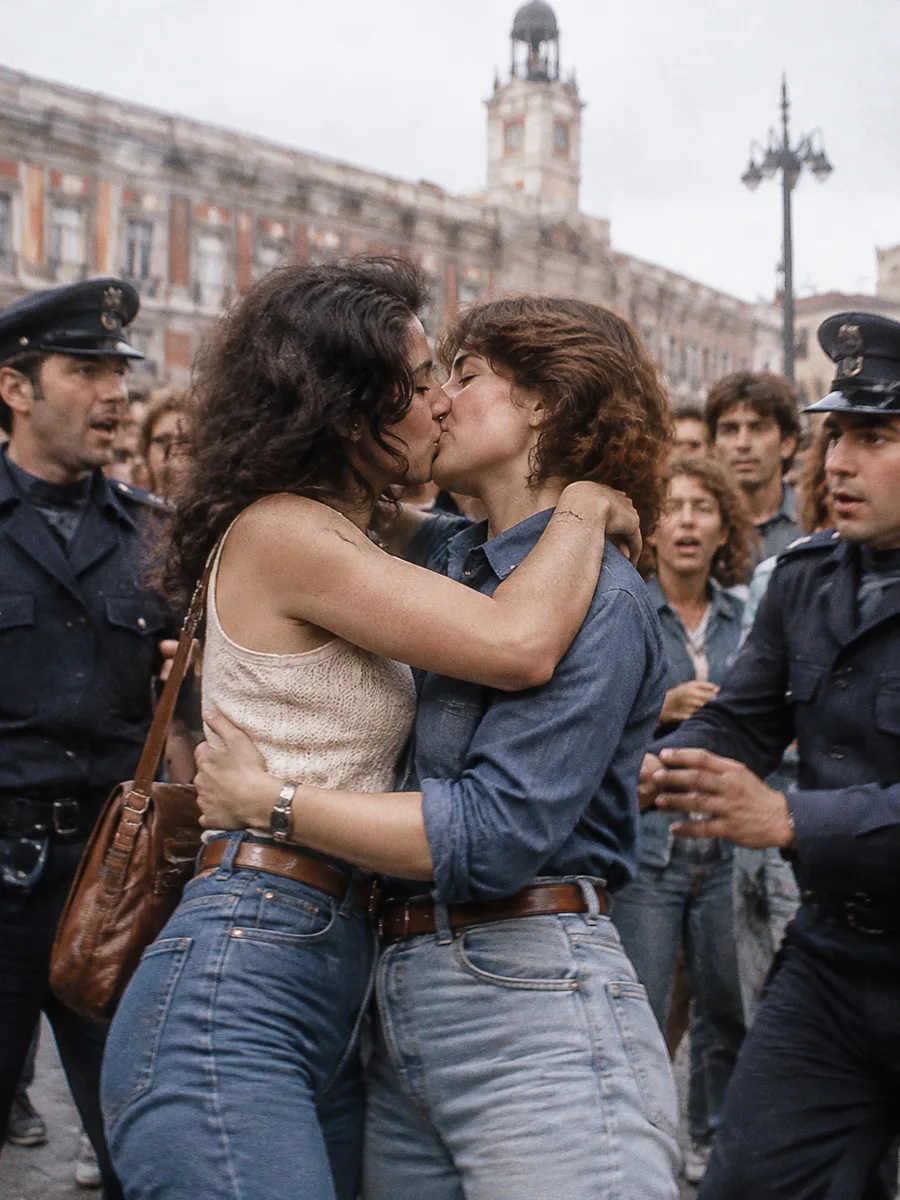
太阳门广场的吻
Why Public Kissing Is Everywhere in Spain: From Franco's Repression to the Streets of Madrid
About this story
Easy Chinese listening: Spain's old 'public scandal' law, the 1987 Sun Gate Square kiss-in, and why public kissing is now common in Spain. HSK 3 Chinese listening practice.
This is an HSK 3 Chinese listening episode that runs about 3 minutes. The full Mandarin script is shown with tap-for-pinyin and a line-by-line English translation, so you can listen and read at once — comprehensible input in the sense of Stephen Krashen's i+1 theory. It teaches 12 key vocabulary words such as 警察、大家、以前 and walks through 6 grammar patterns, each explained in English with examples. The same news story is retold at 4 difficulty levels — use the level selector above to find the version that is challenging but still understandable for you.
Read at your level
原文Read the complete story in Chinese. Reveal pinyin and English only when you need them.
English transcript reference
In 1986, police in Madrid took away two women.
They hadn't stolen anything, and they hadn't hit anyone.
They had only kissed each other once on the street.
At that time, Spain had a very old law.
This law was called the 'public scandal' offense.
If two people kissed in front of everyone, the police could take them away.
The two women stayed at the police station for two days.
Only after two days were they released.
This law was left over from Franco.
From 1939 to 1975, Franco alone had the final say.
In those years, a man and a woman kissing on the street could also be fined.
In 1975, Franco died.
After he died, young people began making new music and new films.
They increasingly wanted to express themselves in front of everyone.
But that old law was still there.
To change this law, many people had already been going out on the streets for many years.
In 1987, a group of men and women who liked the same sex went together to Puerta del Sol square.
Puerta del Sol is a big square in Madrid.
By that time, many couples kissed each other together.
A lot of people gathered around to watch.
Later, every year they went out on the streets and ended with kissing.
Around the 1990s, Madrid's parades still ended this way in Puerta del Sol.
In 1988, the 'public scandal' offense was finally abolished.
After this, the police could no longer use this law to arrest people.
Now, Spain's situation is very different.
Sixty-five percent of Spaniards live in apartment buildings.
This proportion is the highest in Europe.
Apartments are small and housing is expensive, so it's hard for young people to move out.
Isabel is 28, returned from abroad, and moved back into her parents' home.
She has already lived in her parents' home for three years.
She says that in Spain, people generally accept kissing in public.
Amparo Lasén, a professor in Madrid who studies society, says this has to do with where people live.
Home space is small, so if couples want to be alone together, they can only go out.
They go to parks and find a seat to sit down.
Lasén says that if no one gives you a dirty look, this is much easier.
She also says that not every couple is equally comfortable.
When two men or two women are together, others look more.
In Valencia, Paula Furió, who used to photograph weddings, thinks further.
She says kissing is just the tip of the iceberg.
The iceberg only shows a small piece above the water; below there is a much bigger piece.
Now, on Spain's streets, in parks, and in squares, kissing is a very ordinary thing.
Listen again
Try it without the transcript and notice what sounds clearer.
What vocabulary does this episode teach?
词汇HSK 2. Common noun; appears in '警察带走了两个女人'.
HSK 2. Refers to 'everyone' or 'all people'; '在大家面前' = in front of everyone.
HSK 2. Time noun; '以前给婚礼拍照' = used to photograph weddings.
HSK 2. Time noun; '两天以后' = two days later.
HSK 2. Verb; '开始做新的音乐' = began making new music.
HSK 2. Verb; '表达自己' = express oneself.
HSK 2. Adjective; '这件事就容易多了' = this matter is much easier.
HSK 2. Adjective; '是很平常的事' = is a very ordinary thing.
HSK 2. Used for laws and regulations; '一条法律' (a law).
HSK 5/6. Noun; '公共丑闻罪' = public scandal offense.
HSK 5. Noun; '很多对情侣' = many couples.
HSK 5. Noun/verb; '马德里的游行' = Madrid's parade.
* beyond level超纲词
What grammar patterns appear in this episode?
语法在 + Place + Verb
Indicates the location where an action takes place.
她们只是在街上亲了对方一下。
两个女人在警察局里待了两天。
被 + Verb + Complement
Passive voice; indicates something is done to the subject.
两天以后,她们才被放出来。
一九八八年,公共丑闻罪终于被取消了。
越来越 + Adjective/Verb
Expresses a gradual increase: 'more and more'.
他们越来越想在大家面前表达自己。
为了 + Verb Phrase, Subject + Verb
Expresses purpose: 'in order to'.
为了改这条法律,很多人已经上街很多年了。
如果 + Clause, 就 + Clause
Conditional: 'if..., then...'.
如果没有人给你难看的眼神,这件事就容易多了。
从 + Time + 以后
Means 'from (a time) onward'.
从这以后,警察不能再用这条法律抓人。
Proper nouns
专有名词Sources
来源Free account
Keep learning from this story
Create a free account to keep saved words and your preferred level together.
- Keep words with their story context
- Remember your preferred level
- Build your vocabulary over time