
A Chinese podcast · Same story, 4 levels
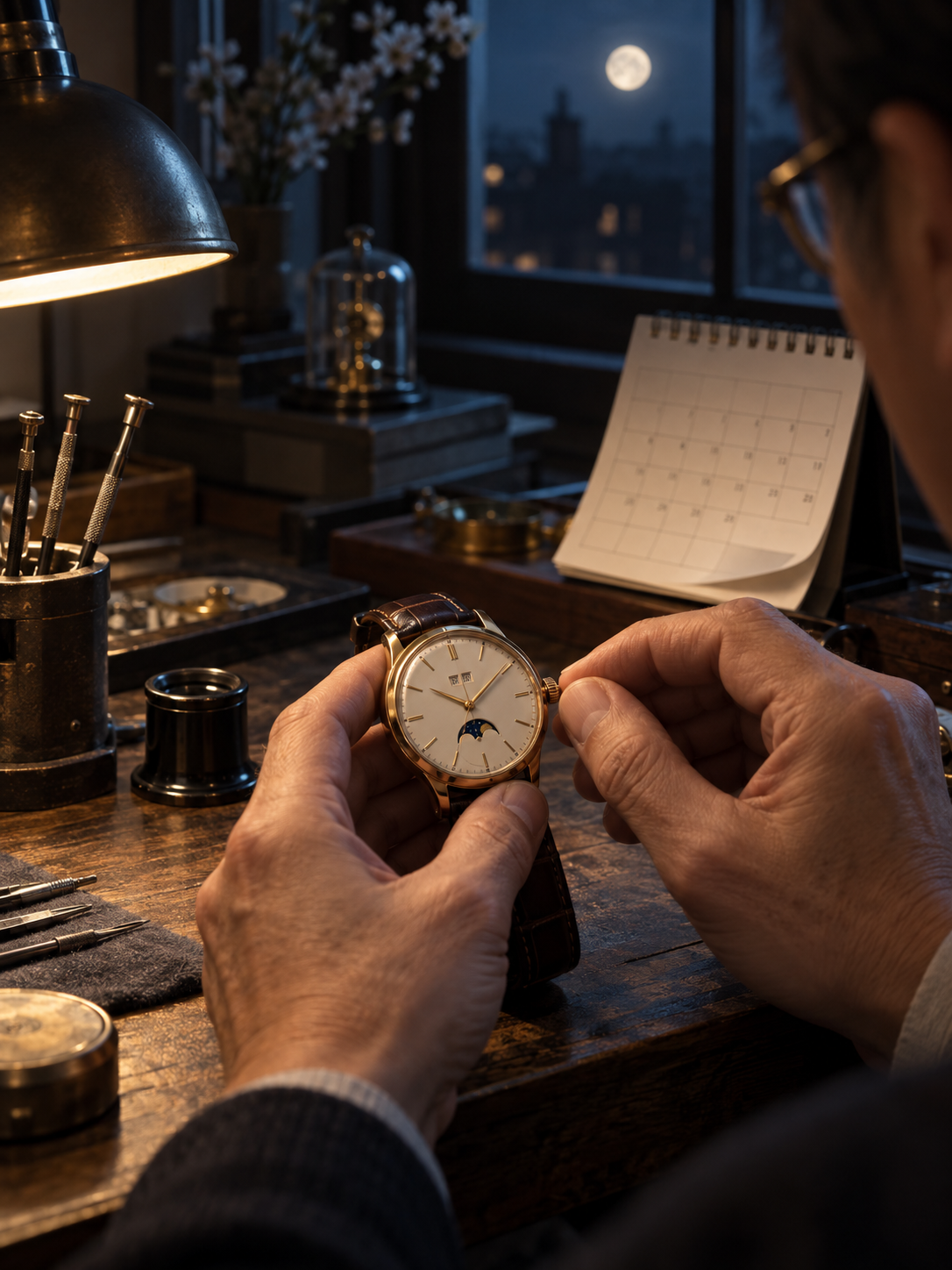
劳力士帕德洛尼一年只需调一次日期
Rolex Padellone Needs One Date Fix a Year
About this story
Rolex's new Padellone watch uses the Haplos system to automatically adjust for months with 30 or 31 days, though February still requires manual correction. HSK 3 Chinese listening practice.
This is an HSK 3-4 Chinese listening episode that runs about 3 minutes. The full Mandarin script is shown with tap-for-pinyin and a line-by-line English translation, so you can listen and read at once — comprehensible input in the sense of Stephen Krashen's i+1 theory. It teaches 20 key vocabulary words such as 普通、正确、问题 and walks through 5 grammar patterns, each explained in English with examples. The same news story is retold at 4 difficulty levels — use the level selector above to find the version that is challenging but still understandable for you.
Read at your level
原文Read the complete story in Chinese. Reveal pinyin and English only when you need them.
English transcript reference
On the evening of April 30th, the date on an ordinary watch is completely correct.
After midnight, however, it might display 'April 31st'.
The problem is not with timekeeping, but with the calendar: ordinary date mechanisms count numbers but do not know that months vary in length.
Rolex's Padellone, launched this year, was designed starting from this small inconvenience.
It uses a complete annual calendar that can distinguish between months with thirty days and those with thirty-one.
When April ends, the date jumps directly from the 30th to May 1st.
Since May has thirty-one days, the mechanism waits one more day before moving into June.
The wearer does not need to take out their phone to reset the date every short month.
Rolex calls this design the Haplos system.
The month disk transmits 'which month it is now' to the date mechanism.
Therefore, the date mechanism knows whether the month should end on the 30th or the 31st.
A very simple calendar rule has been transformed into mechanical actions inside the watch.
This watch has a second feature: the calendar jumps simultaneously at midnight.
The day of the week, month, and date all enter the new day in an instant.
The day of the week and the month are displayed in two windows at the twelve o'clock position.
A blue hand points to the date on the outer ring of the dial.
At the six o'clock position, there is also a moon phase disk, showing the moon going from a thin crescent to full, and then slowly back to a thin crescent.
Thus, the calendar month and the lunar cycle are placed on the same dial.
However, an 'annual calendar' is not the same as a 'perpetual calendar'.
The Padellone can handle thirty-day and thirty-one-day months, but it cannot judge February on its own.
February has twenty-eight days in common years and twenty-nine days in leap years.
Every year when late February transitions into March, the wearer still needs to manually adjust it once.
This is also its capability boundary: most month-ends in a year are handled by mechanics, while the shortest month, February, is left to humans.
The name Padellone also comes from a historical full-calendar wristwatch by Rolex.
Collectors call the 1949 Model 8171 the Padellone, and the new watch has reused this name.
Both the old and new watches allow people to see the complete calendar at a glance, but the new watch adds a new instantaneous jumping mechanism.
Its Caliber 7190 movement runs at five hertz, and Rolex says the related design involves thirty patent applications.
These numbers are complex, but what the wearer can truly see is still that moment at midnight: three calendar informations changing simultaneously.
Updating the date on a mobile phone is easy, so much so that you might not even notice it.
Mechanical watches, however, turn calendar rules into gears, levers, and hands, making the moment of date change visible.
By the end of February next year, will you wait for it to change on its own, or remember to help it adjust first?
Listen again
Try it without the transcript and notice what sounds clearer.
What vocabulary does this episode teach?
词汇HSK 3. Used to describe something standard or not special, e.g., 'an ordinary watch'.
HSK 3. Often used for facts, answers, or settings, e.g., 'the date is correct'.
HSK 2. Refers to an issue or difficulty, e.g., 'the problem is not with timekeeping'.
HSK 2. Common noun for cell phones.
HSK 3. Describes something easy to understand or do.
HSK 3. A distinctive quality or trait of something.
HSK 3. Often used for screens, instruments, or data presentation.
HSK 3. To make small changes to improve or fix something.
HSK 3. The study of past events or the past of an organization.
HSK 3. To become part of something or to include something new.
HSK 2. Opposite of difficult.
HSK 2. To focus on or be aware of something.
HSK 3. Can be a noun or verb referring to a shift in state.
Beyond HSK 3. A mechanical or electronic setup designed for a specific function.
Beyond HSK 3. Someone who wears an accessory like a watch or jewelry.
Beyond HSK 3. A year with 366 days, occurring every four years.
Beyond HSK 3. The internal mechanism of a clock or watch.
Beyond HSK 3. Exclusive rights granted for an invention.
Beyond HSK 3. A rotating circular part with teeth, used in machinery.
Beyond HSK 3. A rigid bar resting on a pivot, used to move heavy objects.
* beyond level超纲词
What grammar patterns appear in this episode?
语法不在 A,而在 B
Used to correct a misconception by stating that the issue lies not in A, but in B. Structure: 'The problem is not in A, but in B.'
问题不在走时,而在日历
Indicates the starting point of an action, process, or design. Structure: 'Start from [point].'
就是从这个小麻烦开始设计的
把 A 变成 B
The 'Ba' construction indicating transformation. It means 'to turn A into B' or 'to transform A into B.'
一个很简单的日历规则,被变成了手表里的机械动作
机械表却把日历规则做成齿轮、杠杆和指针
等于
Means 'to equal' or 'to be equivalent to.' Often used in negative forms to clarify distinctions.
“年历”不等于“万年历”
能...却不能...
A contrastive structure meaning 'can do X, but cannot do Y.' It highlights limitations despite capabilities.
帕德洛尼能处理三十天和三十一天,却不能自己判断二月
Proper Nouns
专有名词Sources
来源Free account
Keep learning from this story
Create a free account to keep saved words and your preferred level together.
- Keep words with their story context
- Remember your preferred level
- Build your vocabulary over time