
A Chinese podcast · Same story, 4 levels
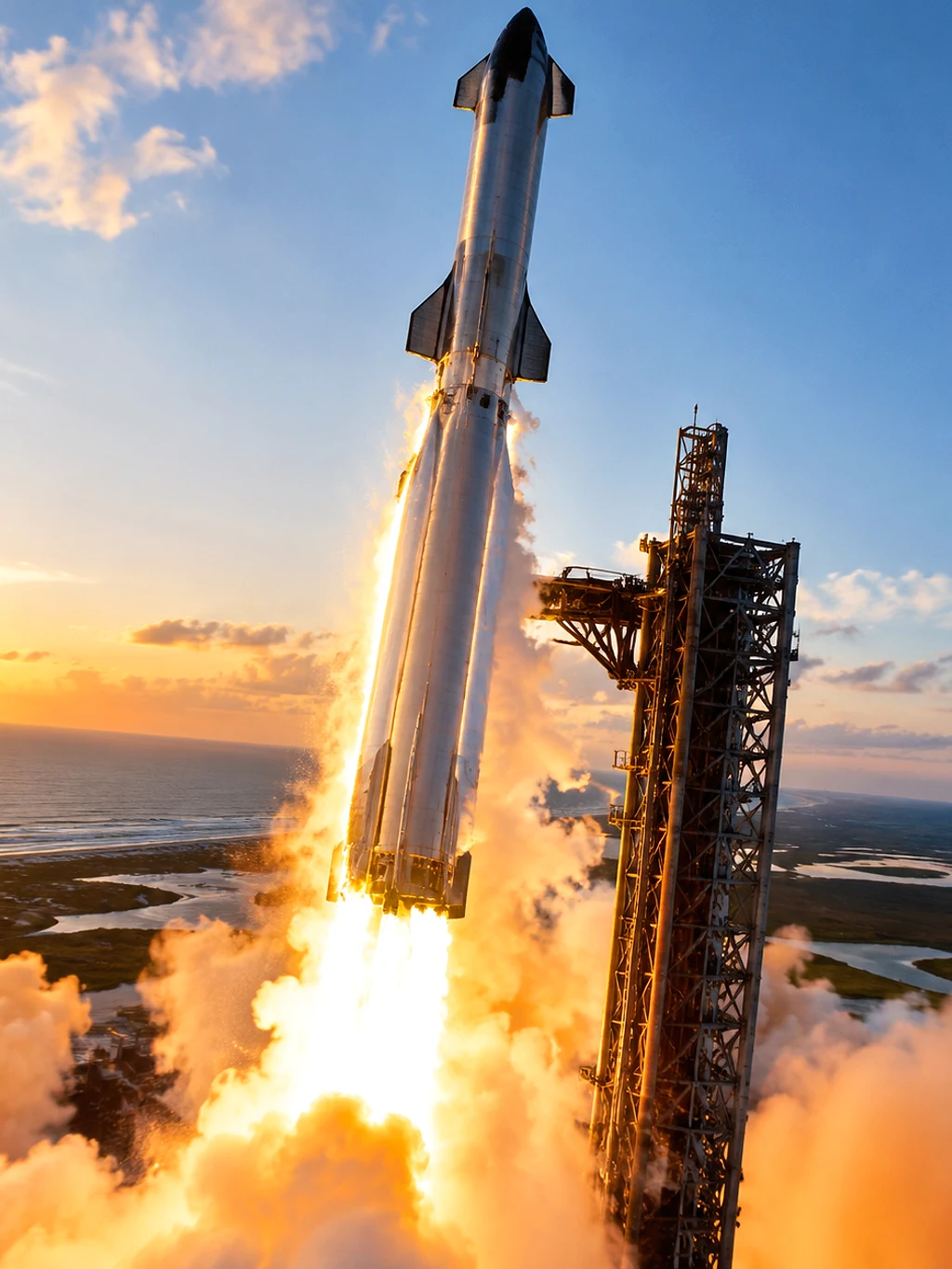
星舰第一次进入轨道:放出二十六颗星链卫星,飞了三小时就提前返回
Starship Reaches Orbit for the First Time, Deploys 26 Starlink Satellites — Then Comes Home Early
About this story
On its 14th test flight on Sept. 28, 2026, SpaceX's Starship finally reached orbit despite losing an engine on the way up, and released 26 working Starlink satellites. SpaceX then cut the planned ten-hour mission to about three, splashing down north of Hawaii without saying why. What orbit means for reuse, NASA's moon plans and SpaceX's new shareholders. Chinese listening practice at four levels. HSK 5-6 Chinese listening practice.
This is an HSK 5-6 Chinese listening episode that runs about 4 minutes. The full Mandarin script is shown with tap-for-pinyin and a line-by-line English translation, so you can listen and read at once — comprehensible input in the sense of Stephen Krashen's i+1 theory. It teaches 12 key vocabulary words such as 关键、证明、规模 and walks through 3 grammar patterns, each explained in English with examples. The same news story is retold at 4 difficulty levels — use the level selector above to find the version that is challenging but still understandable for you.
Read at your level
原文Read the complete story in Chinese. Reveal pinyin and English only when you need them.
English transcript reference
On Monday morning, September 28, US Eastern time, SpaceX's Starship lifted off from Starbase in Texas.
It was Starship's fourteenth test flight, and the first time it truly entered orbit around the Earth.
Why does reaching orbit matter so much?
Because whether it's launching satellites, flying to the moon, or fulfilling Musk's dream of sending people to Mars, the first step is to reach orbit.
But after liftoff, everyone waited nervously for several minutes.
One of the six engines on the upper-stage ship shut down early, and the others had to burn a little longer to make up for it.
A company spokesperson at one point announced that it wouldn't go into orbit this time, but a few minutes later mission control changed its mind.
About twenty-five minutes after liftoff, the ship fired one engine and entered a circular orbit about 275 kilometres above the Earth.
Mission control confirmed: Starship is in orbit!
Musk wrote on social media: Starship's first orbital flight was a success!
On the thirteen test flights before this, Starship took off from Texas and, if it didn't explode along the way, came down half a world away in the Indian Ocean.
That way, if the ship spun out of control in space, the debris would fall into the sea, far from people.
But a rocket that comes down as soon as it goes up isn't much use.
To put something as big as Starship into orbit, both the company and the Federal Aviation Administration, which regulates launches, have to be sure it can leave orbit safely and come down at a chosen spot.
That's because the density of the upper atmosphere keeps changing, and if something falls uncontrolled, nobody knows where it will land.
The thirteenth test flight in July proved that Starship could relight an engine in space, the most crucial ability for a controlled return.
This time, after the Super Heavy booster pushed the ship up, it made a controlled splashdown in the Gulf of Mexico about seven minutes later.
Once in orbit, the ship released twenty-six next-generation Starlink satellites, the first time Starship has put Starlink satellites into an orbit where they can be used.
Three of the satellites also carry cameras that can turn back and photograph the ship's heat-shield tiles to check for damage.
Under the original plan, the ship was to stay in space for nearly ten hours, circle the Earth about six times, and then come down in the Pacific west of Chile.
But after assessing the ship's condition at the first checkpoint, the company decided to bring it back early, without explaining why.
The ship re-entered the atmosphere, flipped and slowed down, and about three hours after liftoff splashed down in the Pacific north of Hawaii.
Reports said the ship burst into flames a few seconds after hitting the water.
Starship is 124 metres tall, the biggest and most powerful rocket ever built, and its booster has thirty-three engines.
The goal is for both stages to be fully reusable, and eventually for giant mechanical arms on the launch tower to catch them directly.
Musk says it should not only be reusable, but able to fly again quickly, like a plane.
This flight also matters to NASA, which has hired the company to use Starship to carry astronauts from lunar orbit down to the surface of the moon.
To do that, Starship will have to launch several times in a short period and refuel a ship in space, things nobody has done yet.
For investors, this success is good news too.
The company went public in June in the largest initial public offering in history, and its share price has recently climbed back to around 150 dollars, a little above the 135-dollar offer price.
If one day you could ride Starship into space, would you go to the moon first, or to Mars?
Listen again
Try it without the transcript and notice what sounds clearer.
What vocabulary does this episode teach?
词汇HSK 4. 控制返回最关键的能力.
HSK 4. 证明了星舰可以在太空中重新点燃发动机.
HSK 4. 规模最大的首次公开募股.
HSK 4. 对投资者来说.
HSK 3. 安全地离开轨道.
HSK 4. 有报道说.
进入绕地球的轨道.
高层大气的密度一直在变.
失 (lose) + 控 (control).
碎 (broken) + 片 (piece).
重复使用 = reuse.
评估了飞船的状态.
* beyond level超纲词
What grammar patterns appear in this episode?
语法万一
In case…, just in case (something bad happens).
这样安排,是为了万一飞船在太空中失控,碎片也会掉进大海,离人很远。
不光……,还……
Not only…, but also…
马斯克说,它不光要能重复使用,还要像飞机一样,很快就能再飞。
还没有人 + verb + 过
Nobody has ever… yet.
要做到这一点,星舰还得在短时间内连续发射,并且在太空中给飞船加注燃料,这些都还没有人做到过。
Proper Nouns
专有名词Free account
Keep learning from this story
Create a free account to keep saved words and your preferred level together.
- Keep words with their story context
- Remember your preferred level
- Build your vocabulary over time