
A Chinese podcast · Same story, 4 levels
湖北男子照盗墓小说挖古墓,被判十二年
A Hubei Man Copies Tomb-Robbing Novels and Gets Twelve Years in Prison
About this story
A Hubei man who learned tomb robbing from novels dug two Eastern Zhou tombs in Zaoyang and was sentenced to 12 years. HSK 3 Chinese listening practice.
This is an HSK 3-4 Chinese listening episode that runs about 5 minutes. The full Mandarin script is shown with tap-for-pinyin and a line-by-line English translation, so you can listen and read at once — comprehensible input in the sense of Stephen Krashen's i+1 theory. It teaches 12 key vocabulary words such as 喜欢、告诉、已经 and walks through 4 grammar patterns, each explained in English with examples. The same news story is retold at 4 difficulty levels — use the level selector above to find the version that is challenging but still understandable for you.
Read at your level
原文Read the complete story in Chinese. Reveal pinyin and English only when you need them.
English transcript reference
There was a person whose surname was Yu; we call him Yu.
He especially liked reading tomb-robbing novels.
Tomb robbing means digging up ancient people's tombs.
The stories in the novels have a lot of exaggeration and fantasy.
Yu read a great many of them.
He did not just read the novels.
He also taught himself how to dig tombs.
In September 2023, he and several people agreed to dig up an ancient tomb.
They went to Zaoyang City in Hubei Province.
Zaoyang is in Hubei; it is a place.
They first looked for tombs.
Looking for tombs means seeing where there are ancient people's things underground.
They found two tombs.
These two tombs were from the Eastern Zhou period.
The Eastern Zhou was a very, very long time ago.
How long ago?
About more than two thousand years from now.
These two tombs are in the Guojiamiao tomb complex.
The Guojiamiao tomb complex is a place protected by Hubei Province.
Protection means the state says: the things here cannot be touched.
They dug into these two tombs.
The first time was late September; the second time was early November.
They dug out 23 items.
There were bronze ge dagger-axes; a bronze ge is a kind of ancient weapon.
There were jade ornaments; jade ornaments are pretty stones ancient people wore on their bodies.
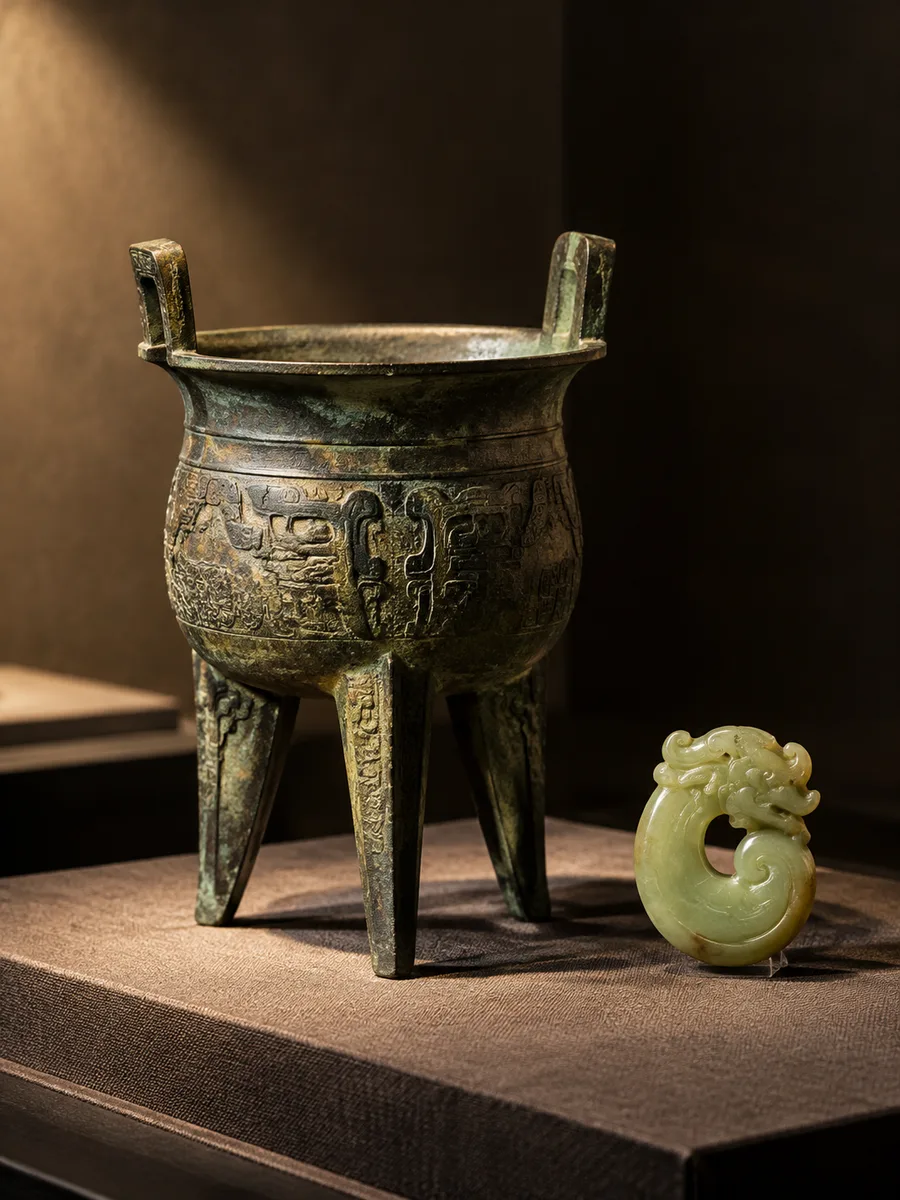
There were bronze hu vessels; bronze hu vessels were used by ancient people to hold water and wine.
There were bronze ding vessels; bronze ding vessels were large pots ancient people used to cook things.
These things are all from the Spring and Autumn period.
The Spring and Autumn period was also a very, very long time ago.
Among these 23 items, 22 are cultural relics of grade three or above.
This is the grade of cultural relics, showing that they are very precious.
Cultural relics are things left behind by ancient people; they are very old and very historical.
They can tell us how ancient people lived.
So they are not just a matter of money.
They have historical value, artistic value, and scientific value.
Yu and those several people dug the things out and took them away.
The court tried this case.
The court is in Fancheng District, Xiangyang City, Hubei Province.
The court said: Yu committed the crime of robbing ancient tombs.
The crime of robbing ancient tombs means secretly digging up ancient people's tombs; this is a crime.
Yu was the principal offender.
A principal offender is the person who leads and mainly does this thing.
He must bear the main responsibility.
However, after he was brought to justice, he told the truth.
He said what he had done.
This is called making a confession.
He also said: I plead guilty and accept punishment.
Pleading guilty and accepting punishment means admitting one was wrong and being willing to accept punishment.
So the court could give him a lighter punishment.
Lighter means sentencing a little less.
On March 9, 2026, the court sentenced him.
He was sentenced to twelve years.
Twelve years is a very long time.
He also has to pay a fine.
A fine means giving the state a sum of money.
After the sentencing, he did not appeal.
Appealing means saying one is not convinced and wants to go to court again.
So this judgment has already taken effect.
The judgment has already taken effect; he has to serve twelve years in prison.
Why was the sentence so heavy?
Because digging up ancient tombs is a very bad crime.
It is not just stealing things.
It damaged the ancient people's tombs.
So the law's punishment for digging up ancient tombs is very heavy.
Yu read tomb-robbing novels and thought digging tombs was very cool.
But a novel is a novel.
Novels are made-up stories.
The people in them and the things in them are mostly fake.
Real archaeology is another matter.
Archaeology is scientists studying ancient people's things.
They dig very carefully, bit by bit.
They must protect the things well and also record them.
They are not going to steal; they are going to research.
Archaeology is legal; it is permitted by the state.
Tomb robbing is illegal; it is not permitted by the state.
These two are completely different.
Yu treated the novels as real.
He copied the way things were in the novels and went to dig tombs.
As a result, he committed a crime.
This case tells us that reading novels is fine, but you cannot copy them.
The law is a line; you cannot cross it.
If you cross the line, you will be punished.
Yu was sentenced to twelve years, which means he crossed the line.
Think about it: if you really like a story, would you also want to copy it?
Listen again
Try it without the transcript and notice what sounds clearer.
What vocabulary does this episode teach?
词汇HSK 1. Used as a verb: 喜欢 + noun/verb phrase. In the script: 他特别喜欢看盗墓小说.
HSK 3. Pattern: 告诉 + person + information. In the script: 它们能告诉我们,古人怎么生活.
HSK 2. Often with 了: 已经……了. In the script: 这个判决已经生效了.
HSK 3. Common collocations: 法律保护, 法律规定. In the script: 法律是一条线,不能过.
HSK 3. Used as a noun or modifier: 历史价值, 很有历史. In the script: 它们有历史的价值.
HSK 3. Measure word: 一个地方. In the script: Zaoyang在Hubei,是一个地方.
Beyond HSK 3. Literally 'steal tomb'. In the script: 他特别喜欢看盗墓小说.
Beyond HSK 3. 古 means ancient, 墓 means tomb. In the script: 说好去挖古墓.
Beyond HSK 3. Common in news and history contexts. In the script: 有22件是三级以上的文物.
Beyond HSK 3. Literally 'examine antiquity'. In the script: 真正的考古,是另一回事.
Beyond HSK 3. Legal term. In the script: 这个判决已经生效了.
Beyond HSK 3. Legal term. In the script: 判了以后,他没有上诉.
* beyond level超纲词
What grammar patterns appear in this episode?
语法就是 (explaining a term)
Used to define or explain what something means, often in the pattern 'A 就是 B'.
盗墓,就是去挖古人的墓。
找墓,就是看哪里地下有古人的东西。
保护,就是国家说:这里的东西,不能动。
是……的 (identifying time or period)
Used to state that something belongs to or happened in a certain time/period.
这两个墓,是东周时期的。
这些东西,都是春秋时期的。
把 + object + verb + result
The 把 construction moves the object before the verb to emphasize the result or disposal of the object.
Yu和那几个人,把东西挖走了。
它把古人的墓弄坏了。
Yu把小说当成了真的。
从轻处罚
A fixed legal expression meaning 'to give a lighter punishment'. 从轻 means 'to be lighter'.
所以,法院可以从轻处罚。
从轻,就是少判一点。
Proper nouns
专有名词Sources
来源Free account
Keep learning from this story
Create a free account to keep saved words and your preferred level together.
- Keep words with their story context
- Remember your preferred level
- Build your vocabulary over time