
A Chinese podcast · Same story, 4 levels
湖北男子照盗墓小说挖古墓,被判十二年
A Hubei Man Copies Tomb-Robbing Novels and Gets Twelve Years in Prison
About this story
A Hubei man who learned tomb-robbing from novels dug two Eastern Zhou tombs, stole 23 relics, and got 12 years in prison. HSK 5-6 Chinese listening practice.
This is an HSK 5-6 Chinese listening episode that runs about 4 minutes. The full Mandarin script is shown with tap-for-pinyin and a line-by-line English translation, so you can listen and read at once — comprehensible input in the sense of Stephen Krashen's i+1 theory. It teaches 12 key vocabulary words such as 保护、法律、历史 and walks through 4 grammar patterns, each explained in English with examples. The same news story is retold at 4 difficulty levels — use the level selector above to find the version that is challenging but still understandable for you.
Read at your level
原文Read the complete story in Chinese. Reveal pinyin and English only when you need them.
English transcript reference
In Hubei there was a man surnamed Yu; we call him Yu Moucai.
He was especially fond of reading tomb-robbing novels; the characters and plots in these stories contain a lot of exaggeration and fantasy.
He read them obsessively, and even taught himself how to dig up tombs, buying quite a few tools.
In September 2023, he arranged with others to go dig up an ancient tomb together.
They went to Zaoyang, Hubei, and searched for ancient tombs near a village.
In early November, they went to another village and kept digging.
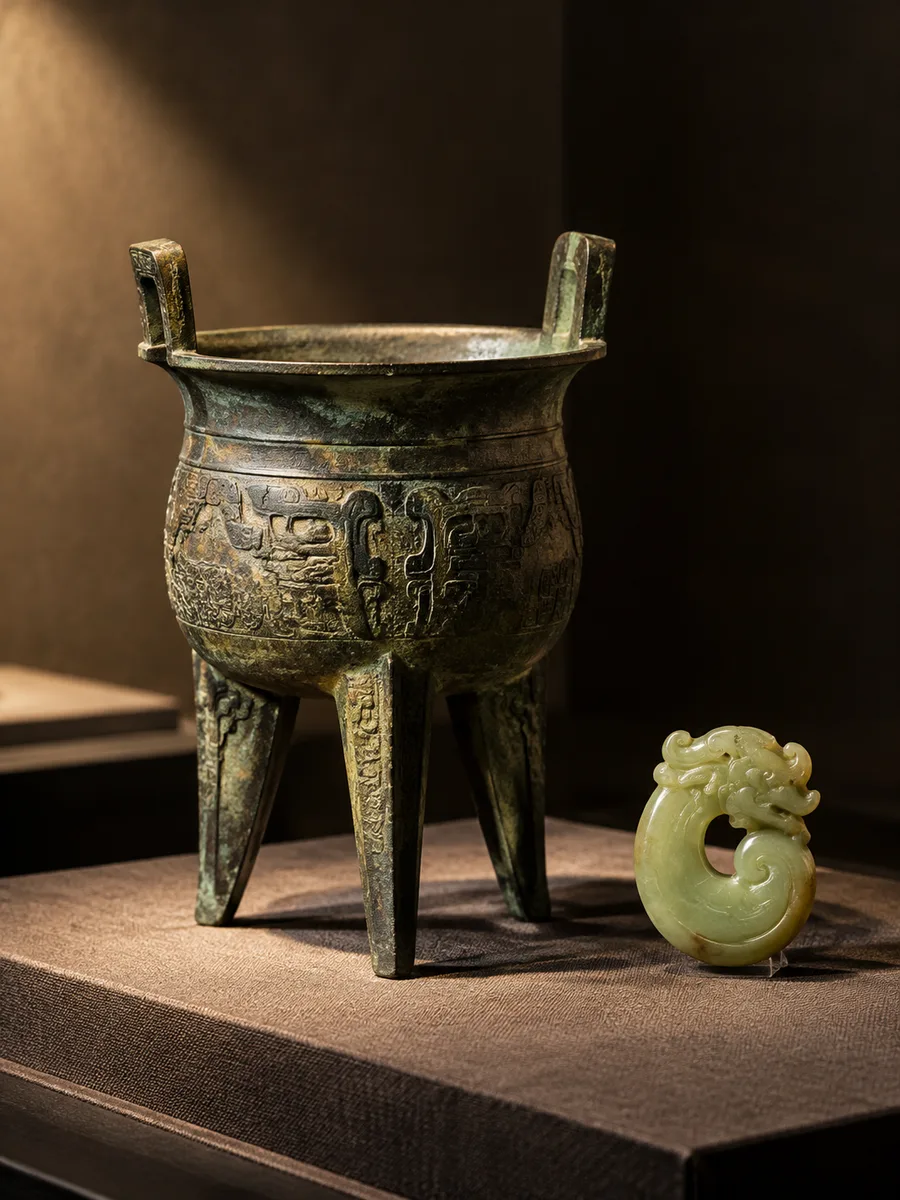
They dug open two ancient tombs and took away twenty-three cultural relics.
There were bronze dagger-axes with writing on them; jade ornaments; bronze pots; and bronze ding vessels.
These relics date to the Spring and Autumn period, more than two thousand years ago.
Of the twenty-three items, twenty-two are Grade 3 or above cultural relics — extremely precious.
Those two ancient tombs date to the Eastern Zhou period and lie within the protection zone of the Guojiamiao tomb cluster, a Hubei provincial cultural relic protection site.
They have important historical, artistic, and scientific value.
Yu Moucai dug together with others, and he was the main person — that is, the principal culprit.
After being brought in, he truthfully described what he had done and pleaded guilty and accepted punishment.
On March 9, 2026, the Fancheng District People's Court in Xiangyang, Hubei sentenced him to twelve years and also imposed a fine.
He did not appeal, and the judgment has already taken effect.
Why was the sentence so heavy?
Because robbing and digging up ancient tombs is a very serious crime.
It is not just taking a few objects — what it destroys is history, is culture.
Cultural relics are underground, together with the soil and their positions; once dug open, a lot of information is lost.
For example, which layer of soil an object was in and what it was placed together with can both help research the lives of ancient people.
If you only take the objects out, the original positions are destroyed, and part of the historical information is lost.
Moreover, tomb robbing also brings follow-on crimes: reselling and smuggling.
That is why the law punishes this kind of crime more heavily than ordinary theft.
Some people may wonder: the tomb-robbing novels make it sound really cool — is it true?
Novels are literary creations; the characters and stories in them are largely exaggeration and fantasy.
Archaeological work in reality is stipulated and protected by law, and is completely different from tomb robbing.
Archaeologists must apply for approval and dig slowly using scientific methods, recording the position of every layer of soil and every object; the purpose is to research history, not to take things and sell them.
Drilling, digging, or blasting with your own tools can all be crimes.
Yu Moucai read novels, taught himself, and even called in others to go dig up relics protected at the provincial level.
Although he had mitigating circumstances such as confessing and pleading guilty and accepting punishment, the circumstances of the crime were serious, and the court still sentenced him to more than ten years.
His willingness to plead guilty does not mean he did not do wrong.
The court had to consider both the truth he told after being brought in and what he had done before.
After reading the books, he taught himself, bought tools, and then went digging with others.
The two tombs that were dug lie within the scope of a provincial-level cultural relic protection site and are protected by law.
In this announcement, the court laid out clearly the actual actions and consequences.
Also note two dates.
The judgment was made on March 9, 2026.
The Supreme People's Court published this case on October 10, explaining its typical significance.
October is when the public saw the case, not when the sentence was just handed down.
Knowing these two dates keeps you from treating an already-effective judgment as something that happened that very day.
This case tells everyone that the legal bottom line for cultural relic protection cannot be crossed.
You can read tomb-robbing novels, but you cannot treat them as a textbook for crime.
Think about it: if you really liked a story, would you also want to go and do the same?
Listen again
Try it without the transcript and notice what sounds clearer.
What vocabulary does this episode teach?
词汇HSK 4. Common collocations: 文物保护 (cultural relic protection), 保护环境 (protect the environment). Appears here in 文物保护单位 (cultural relic protection site).
HSK 4. Used for laws and legal matters: 法律规定 (stipulated by law), 法律底线 (legal bottom line).
HSK 4. Often paired with 文化: 历史文化 (history and culture). Also 历史信息 (historical information).
HSK 4. Used as noun or adjective: 科学方法 (scientific methods), 科学研究 (scientific research).
HSK 4. Takes objects like 历史 (history) or 问题 (problems): 研究历史 (research history).
HSK 4. Common in formal writing: 历史信息 (historical information), 信息丢失 (information is lost).
HSK 4. Describes problems, crimes, or illness: 严重的犯罪 (a serious crime), 情节严重 (the circumstances are serious).
HSK 5. Here in 文物保护单位, meaning a designated heritage protection site. Also means one's workplace in everyday Chinese.
Beyond level. 盗 means to steal/rob; 墓 is a tomb. Related: 盗墓小说 (tomb-robbing novels), 盗掘 (to illegally excavate).
Beyond level. A key heritage term: 文物保护 (relic protection), 珍贵文物 (precious relics).
Beyond level. 古 = ancient, 墓 = tomb. Related: 古墓葬 (ancient burial sites), 墓葬群 (tomb cluster).
Beyond level. 考古学家 means archaeologist; 考古工作 is archaeological work.
* beyond level超纲词
What grammar patterns appear in this episode?
语法把 + Object + Verb + Result/Complement
The 把 construction moves the object before the verb to emphasize how something is handled or what happens to it. The verb must be followed by a result, direction, or other complement.
如果只把东西拿出来,原来的位置被破坏,就会失去一部分历史信息。
这次公告里,法院把实际的行动和后果都说清楚了。
被 + Agent + Verb (passive)
The 被 construction marks a passive sentence, often with an unfortunate or disruptive result. The agent can be omitted when it is unknown or unimportant.
如果只把东西拿出来,原来的位置被破坏,就会失去一部分历史信息。
被挖的两座墓,在省级文物保护单位的范围内,受到法律保护。
虽然……但(是)……
A concessive pair meaning 'although ... still ...'. The 虽然 clause concedes a point, and the 但/但是 clause gives the contrasting main result.
他虽然有坦白、认罪认罚这些可以从轻的情节,但犯罪情节严重,法院还是判了十年以上。
如果……就……
A conditional pattern: 'if ..., then ...'. 如果 introduces the condition and 就 introduces the consequence.
如果只把东西拿出来,原来的位置被破坏,就会失去一部分历史信息。
知道这两个日期,就不会把一个已经生效的判决,当成当天才发生的事。
Proper nouns
专有名词Sources
来源Free account
Keep learning from this story
Create a free account to keep saved words and your preferred level together.
- Keep words with their story context
- Remember your preferred level
- Build your vocabulary over time