
A Chinese podcast · Same story, 4 levels
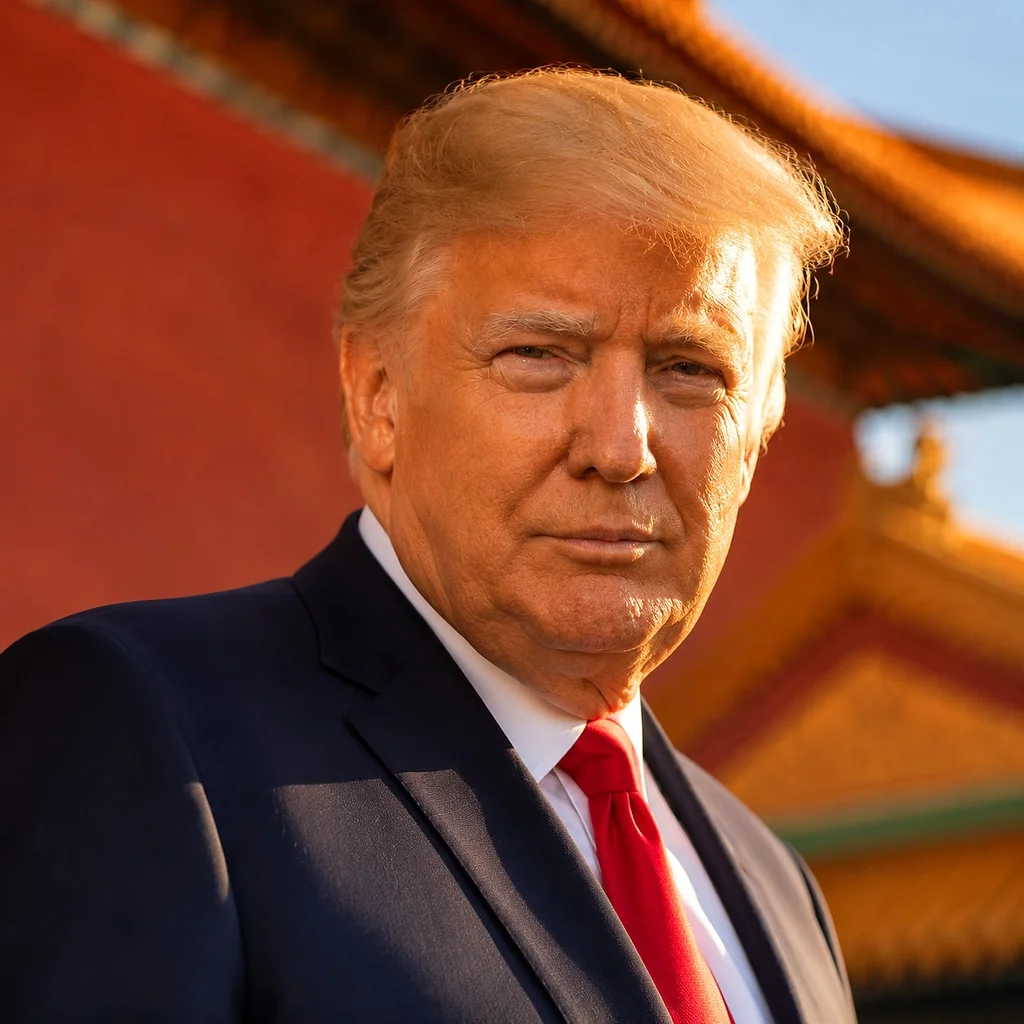
特朗普访华三天:到底说了什么?
Trump Visits China Amid US–China Tensions
About this story
Trump Visits China Amid US–China Tensions. HSK 2 Chinese listening practice.
This is an HSK 2 Chinese listening episode that runs about 6 minutes. The full Mandarin script is shown with tap-for-pinyin and a line-by-line English translation, so you can listen and read at once — comprehensible input in the sense of Stephen Krashen's i+1 theory. It teaches 12 key vocabulary words such as 新闻、公司、比如 and walks through 4 grammar patterns, each explained in English with examples. The same news story is retold at 4 difficulty levels — use the level selector above to find the version that is challenging but still understandable for you.
Read at your level
原文Read the complete story in Chinese. Reveal pinyin and English only when you need them.
English transcript reference
Today we're talking about a really big news story.
It's about the US and China.
You've heard of both countries, right?
The US is far away.
On the other side of the ocean.
China is right here where we are.
These two countries are the biggest in the world.
When they speak, the whole world listens.
When they act, the whole world watches.
This week, something big happened.
The US president came to China.
The US president is named Trump.
He's the head of the US.
He came by plane.
He came to Beijing.
What did he come for?
He came to meet China's president.
China's president is named Xi Jinping.
The leaders of the two countries,
were meeting face to face,
to talk about many things.
This is a big deal.
Why?
Because the two of them don't meet often.
For nine years, no US president had been to China.
Nine years is a long time.
So the whole world is watching.
Everyone wants to know what they said.
How many days did Trump stay?
He stayed three days.
Arrived May 13.
Left May 15.
He didn't come alone.
He brought many people.
Some were government people.
Some were bosses of big companies.
For example,
there's a man named Musk.
He's the boss of Tesla.
Tesla makes electric cars.
There's also a man named Cook.
He's the boss of Apple.
Apple is the company that makes iPhones.
There's also a man named Jensen Huang.
He's the boss of Nvidia.
Nvidia makes AI chips.
These three are all very famous.
They're all very rich.
Why did they also come?
Because they want to do business in China.
Their companies all want to sell things to Chinese people.
They also want to buy things from China.
They flew together.
With the president.
This is a signal.
What signal?
It's saying:
American big companies,
still want to be friends with China.
They don't want to split.
OK.
Let's talk about what they discussed.
First, they discussed business.
The two countries signed many agreements.
Worth 250 billion dollars.
How much is 250 billion?
It's an enormous amount of money.
Mostly China investing in the US.
For example:
China will invest in West Virginia, USA,
84 billion dollars.
They'll build gas and chemical plants there.
Also Alaska.
China will also invest there.
43 billion dollars.
They'll build an LNG plant there.
Sounds big, right?
Yes, really big.
Second, they discussed peace.
They talked about the Middle East.
The Middle East has been having problems.
There's a place called the Strait of Hormuz.
That place is very important.
Because a lot of oil goes through there.
Both leaders said:
That place must stay open.
No war.
No blockade.
Third, they discussed the relationship.
"Relationship" means how the two countries are getting along.
Trump said:
"My relationship with Xi is very good.
"Our relationship is better than at any time in history."
Xi Jinping said:
"We want to build a new kind of relationship.
"This relationship,
"is called 'Constructive Strategic Stability Relationship.'"
If you don't get it, that's OK.
Let me explain.
It means:
We aren't necessarily good friends.
But we don't fight either.
We talk it out.
We do business properly.
Take it slow.
Don't rush.
This is a new term.
For the next three years,
US-China relations will use this term.
OK.
Sounds good.
But some people don't quite believe it.
Why?
Because:
They didn't issue a joint statement.
A joint statement is a document the two countries sign together.
This time there wasn't one.
They just spoke separately.
The US said its things.
China said its things.
This means:
They talked a lot.
But what was actually settled,
wasn't that much.
Many things still need to be worked out slowly.
Not everything could be solved this time.
But however you put it,
the leaders of the two countries met.
They didn't argue.
They talked for three days.
This is much better than before.
Last I want to say one thing.
What does this tell us?
Two big countries,
don't necessarily have to be best friends.
But they also can't fight.
If they fight, the whole world has a problem.
So talking slowly,
doing business slowly,
that's the best it can be.
Not perfect.
But real.
OK.
Today's story ends here.
Talk again tomorrow.
Listen again
Try it without the transcript and notice what sounds clearer.
What vocabulary does this episode teach?
词汇Reports about what is happening in the world. 听新闻 / 看新闻 = listen to / watch the news.
An organization that makes or sells things. 大公司 = big company. 苹果是一个公司.
Used to introduce an example. 比如说 = for instance.
Mattering a lot. 霍尔木兹海峡很重要 = the Strait of Hormuz is very important.
Doing something with someone else. 他们一起坐飞机 = they fly together.
What has happened in the past. 比历史上任何时候都好 = better than at any time in history.
The head of state in the US. China's equivalent is called 国家主席 = state chairman.
To meet someone face to face. 两国领导人见面 = the two leaders meet.
A formal document where both sides agree on something. 签协议 = sign a deal.
To put money into a project hoping to make more money. 投资八百四十亿 = invest 84 billion.
How two sides get along. 中美关系 = US-China relations. Whether they are good friends or not.
Something that sends a message without saying it directly. 这是一个信号 = this is a signal.
* beyond level超纲词
What grammar patterns appear in this episode?
语法因为...所以...
Because... therefore... Expresses cause and effect.
因为他们想在中国做生意,所以他们也来了。
是不是 + clause
Turns a statement into a yes/no question.
美国是不是中国的朋友?
你是不是听过这两个国家?
不一定
Not necessarily. Often used to soften a claim.
我们不一定是好朋友。
两个大国不一定要做最好的朋友。
...的话, ...的话
Each says their own. The structure 'X 说 X 的, Y 说 Y 的' means each side speaks separately.
美国说美国的话。中国说中国的话。
Proper nouns
专有名词Free account
Keep learning from this story
Create a free account to keep saved words and your preferred level together.
- Keep words with their story context
- Remember your preferred level
- Build your vocabulary over time