
A Chinese podcast · Same story, 4 levels
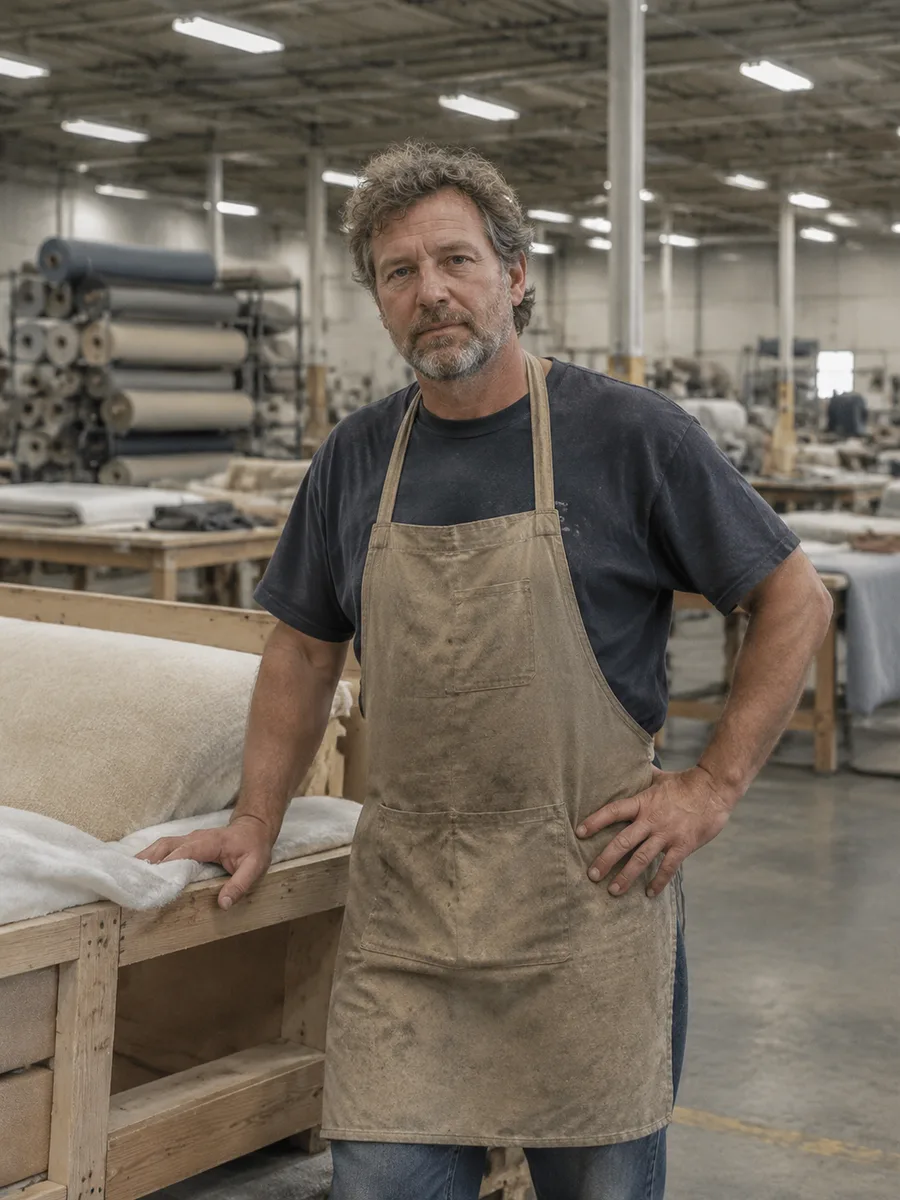
特朗普关税下,海波因特的沙发厂只开了十个月
Trump Tariffs Backfire: TOV's Zero-Dollar High Point Sofa Factory Shuts After 10 Months
About this story
HSK 3: Bruce Krinsky spent $3 million to move sofa production from Vietnam to High Point, North Carolina, but closed after 10 months, cutting 45 jobs.
This is an HSK 4 Chinese listening episode that runs about 3 minutes. The full Mandarin script is shown with tap-for-pinyin and a line-by-line English translation, so you can listen and read at once — comprehensible input in the sense of Stephen Krashen's i+1 theory. It teaches 12 key vocabulary words such as 工厂、生产、工人 and walks through 6 grammar patterns, each explained in English with examples. The same news story is retold at 4 difficulty levels — use the level selector above to find the version that is challenging but still understandable for you.
Read at your level
原文Read the complete story in Chinese. Reveal pinyin and English only when you need them.
English transcript reference
Bruce Krinsky's sofa factory in the United States was open for only ten months before it closed.
To move sofa production from Asia back to the United States, he paid a price of about three million dollars.
The factory was located in High Point, North Carolina.
When it closed, about forty-five workers lost their jobs.
What's even more unexpected is that he originally bought this factory for zero dollars.
Krinsky and his wife Chaya founded the furniture company TOV together, initially selling sofas made in China.
The company grew fairly large, selling a sofa for nine hundred dollars.
Later, the United States imposed tariffs on Chinese goods, making it more and more expensive to source from China.
So he went to his long-term supplier Zhiwei Furniture and urged them to open a factory in Vietnam.
Last March, Zhiwei opened a new factory in Dong Nai Province, outside Ho Chi Minh City, and hired one hundred thirty workers.
Nguyen Van Hai works there doing the job of upholstering sofas.
He has to work ten hours a day, six days a week, and earns about eight thousand dollars a year.
This income is considered high in Vietnam, and he himself said this wage is 'really high.'
But just at this time, the United States proposed adding a forty-six percent tariff on Vietnamese goods.
Krinsky did the math and felt it would be better to move part of production back to the United States, so he bought the High Point factory.
Buying the factory cost not a single penny, but after starting operations, money was needed everywhere.
In the United States, the materials and labor for one sofa cost about one thousand dollars.
For the same sofa, in Vietnam it only costs two hundred eighty dollars.
Moreover, American workers can only make two or three sofas a day, while his partners in Asia can make ten a day.
He originally wanted to set the retail price at around one thousand five hundred dollars, but this price was simply impossible to achieve in the United States.
According to his calculations, a sofa would have to sell for at least two thousand dollars to break even.
In his own words, if we sell for two thousand dollars, there's no need for us to exist.
For every sofa sold, he still had to put money in.
By summer, he decided to close, saying he had voted for this president three times.
He also asked in retort, what exactly are American businesses supposed to do?
However, in High Point, there are also people who have made American manufacturing work.
George Jordan is the president of Michael Thomas Furniture Company, and his factory is small in scale.
The sofas they make sell for several thousand dollars each, and this price point can support American wages and materials.
Jordan said that wanting to push the price below two thousand dollars is indeed very difficult.
Krinsky's troubles don't stop there.
Goods sent from the Vietnamese factory to the United States were stopped by customs, and the subsequent bill was one hundred thirty-five thousand dollars.
He did not accept it and has already hired a lawyer to appeal.
After closing the American factory, about seventy percent of TOV's furniture is again produced in Vietnam.
By next January, the tariff on sofas imported from Vietnam will be raised even further.
Listen again
Try it without the transcript and notice what sounds clearer.
What vocabulary does this episode teach?
词汇HSK 3. A place where goods are manufactured. Measure word: 家 (yī jiā gōngchǎng).
HSK 3. Often used as a verb or noun. Common collocations: 生产产品, 生产成本.
HSK 3. Refers to manual or industrial workers. Measure word: 名/个.
HSK 3. Often used with abstract nouns: 失去工作 (lose a job), 失去机会 (lose an opportunity).
HSK 3. Measure word: 家. Common phrases: 创办公司 (found a company), 公司总裁 (company president).
HSK 3. Refers to money received, especially from work. Common phrases: 高收入, 收入水平.
HSK 3. The amount of money expected for something. Common collocations: 零售价 (retail price), 价格高/低.
HSK 3. Substances used to make things. Also means 'data' or 'material' in other contexts.
HSK 3. Literally 'close the door'; used for businesses shutting down.
HSK 3. A tax on imports or exports. Common collocations: 加关税 (impose tariffs), 关税战 (trade war).
HSK 4. A business that provides goods. Common collocations: 长期供应商 (long-term supplier).
HSK 4. The price at which goods are sold to the public. Opposite: 批发价 (wholesale price).
* beyond level超纲词
What grammar patterns appear in this episode?
语法为了 + Verb Phrase, Subject + Verb Phrase
Expresses purpose: 'in order to...'. The clause after 为了 states the goal.
为了把沙发生产从亚洲搬回美国,他付出了大约三百万美元的代价。
越来越 + Adjective
Indicates a gradual increase: 'more and more...'.
从中国进货越来越贵。
把 + Object + Verb Phrase
The 把 construction moves the object before the verb to emphasize the result or action.
为了把沙发生产从亚洲搬回美国,他付出了大约三百万美元的代价。
不过在海波因特,也有人把美国制造做了下来。
按 + Noun + 的 + 说法/算法
Means 'according to...'. Used to cite someone's words or method.
按他的算法,一张沙发至少要卖两千美元才能保本。
用他的原话说,卖到两千美元,我们就没必要存在了。
才 + Verb Phrase
Emphasizes that something is only possible under certain conditions or after effort; often implies difficulty.
一张沙发至少要卖两千美元才能保本。
再也 + 不/没 + Verb
Means 'no longer' or 'never again'. Emphasizes a complete cessation.
到了明年一月,从越南进口沙发的关税还要再往上调。
Proper nouns
专有名词Sources
来源Free account
Keep learning from this story
Create a free account to keep saved words and your preferred level together.
- Keep words with their story context
- Remember your preferred level
- Build your vocabulary over time