
A Chinese podcast · Same story, 4 levels
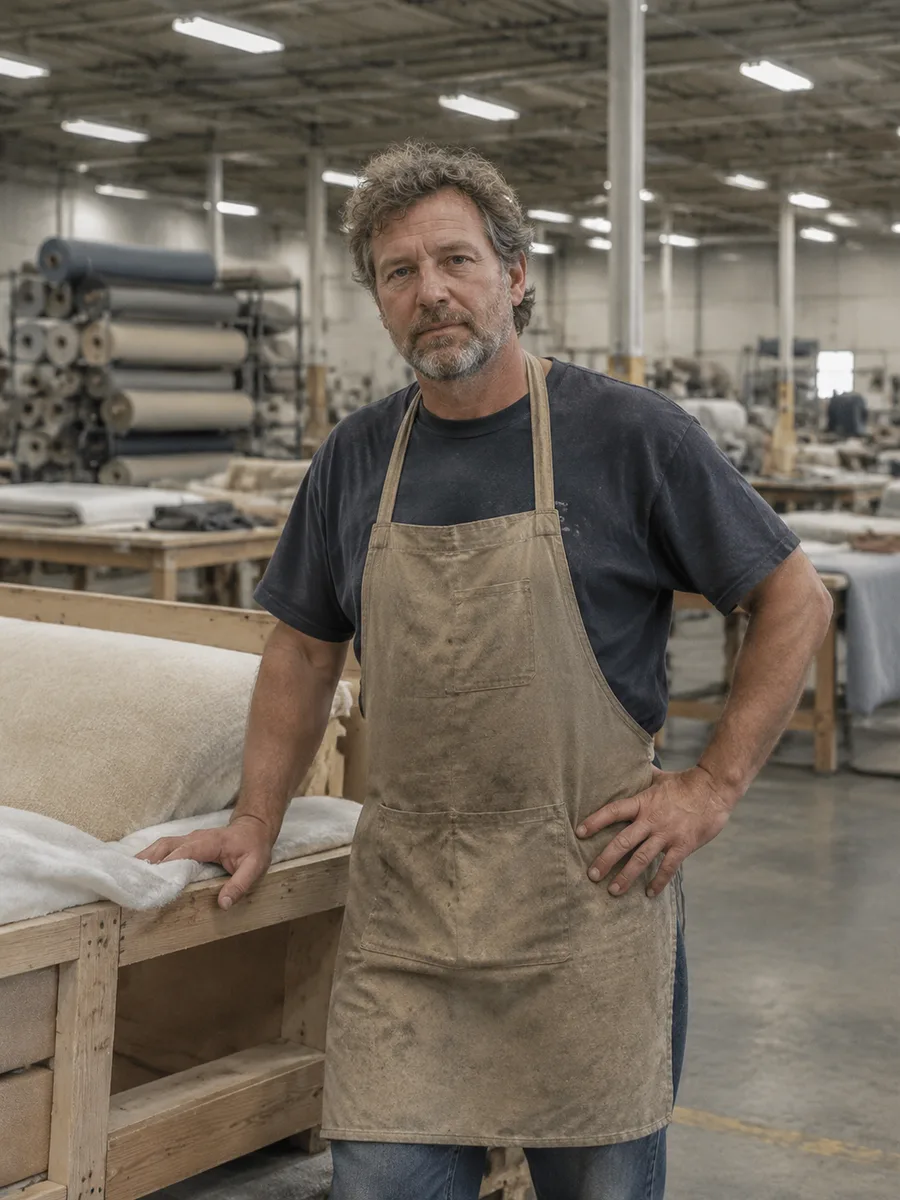
特朗普关税下,海波因特的沙发厂只开了十个月
Trump Tariffs Backfire: TOV's Zero-Dollar High Point Sofa Factory Shuts After 10 Months
About this story
HSK 1: Bruce Krinsky moved sofa production from China to Vietnam to the US, but high costs forced him to close his High Point factory after 10 months.
This is an HSK 2 Chinese listening episode that runs about 2 minutes. The full Mandarin script is shown with tap-for-pinyin and a line-by-line English translation, so you can listen and read at once — comprehensible input in the sense of Stephen Krashen's i+1 theory. It teaches 12 key vocabulary words such as 公司、卖、钱 and walks through 7 grammar patterns, each explained in English with examples. The same news story is retold at 4 difficulty levels — use the level selector above to find the version that is challenging but still understandable for you.
Read at your level
原文Read the complete story in Chinese. Reveal pinyin and English only when you need them.
English transcript reference
An American boss opened a factory in the US, making sofas.
Ten months later, he closed this factory.
This boss is called Bruce Krinsky.
He and his wife started a company together, selling sofas.
Their sofas were previously made in China, selling for 900 dollars each.
Later, the US made things coming from China pay more money.
So, he asked a Chinese company to go to Vietnam to open a factory.
After a few months, the Vietnam factory opened.
There are 130 people in the factory.
There is a worker named Nguyen Van Hai, he makes sofas.
He works ten hours a day, six days a week.
A year, he can get 8,000 dollars.
He says: this money is really high.
But later, the US said, things coming from Vietnam also have to pay more money.
Krinsky thought: then I'll go back to the US to make sofas.
He found a factory in High Point, North Carolina.
He bought this factory, spending zero dollars.
In the US, to make a sofa, the workers' pay is a lot.
The money to buy cloth and wood is also a lot, adding up to 1,000 dollars.
In Vietnam, a sofa only costs 280 dollars.
American workers make two or three sofas a day.
In Vietnam, workers make ten a day.
He originally thought, sell a sofa for 1,500 dollars.
But this way, he would lose more than 100 dollars per sofa.
The money from selling is less than the money to make the sofa.
A sofa has to sell for 2,000 dollars for him not to lose money.
He said: selling for 2,000 dollars, we have no reason to keep doing it.
On the last day of July, he closed this factory.
45 people have no job.
In ten months, he lost 3 million dollars.
He said: "An American company, what should it do now?"
In High Point, there is another factory making sofas, selling for 3,000 to 5,000 dollars each.
Now, seven out of ten of Krinsky's sofas are made in Vietnam.
Listen again
Try it without the transcript and notice what sounds clearer.
What vocabulary does this episode teach?
词汇HSK 1. Measure word: 家 (yì jiā gōngsī).
HSK 1. Opposite: 买 (mǎi) to buy.
HSK 1. Used in phrases like 很多钱 (a lot of money).
HSK 1. Often refers to factory or manual workers.
HSK 1. Used in time expressions like 一天 (one day).
HSK 1. Used in dates and durations, e.g., 十个月 (ten months).
HSK 1. Country name.
HSK 1. Used for making things or doing work.
HSK 1. Place where things are made. Measure word: 家 (yì jiā gōngchǎng).
HSK 1. Common for shop owner or company head.
HSK 1. Country name.
HSK 1. Country name.
* beyond level超纲词
What grammar patterns appear in this episode?
语法Place + 有 + Object
Expresses existence: 'there is/are ... in/at ...'.
工厂里有一百三十个人。
Subject + 叫 + Name
Used to state someone's name.
这个老板叫布鲁斯·克林斯基。
Subject + 做 + Object + 做 + Duration
Expresses doing something for a duration of time.
他一天做十个小时,一个星期做六天。
Subject + 能 + Verb + 到 + Object
Expresses ability to obtain or achieve something.
一年,他能拿到八千美元。
Subject + 想 + Clause
Expresses what someone thinks or plans.
克林斯基就想:那我就回美国做沙发。
他本来想,一个沙发卖一千五百美元。
Subject + 花 + Amount + (买 + Object)
Expresses spending money or time on something.
他买这家工厂,花了零美元。
Number + 个 + 里 + 有 + Number + 个
Expresses a proportion: 'out of X, there are Y'.
十个里有七个在越南做。
Proper nouns
专有名词Sources
来源Free account
Keep learning from this story
Create a free account to keep saved words and your preferred level together.
- Keep words with their story context
- Remember your preferred level
- Build your vocabulary over time