
A Chinese podcast · Same story, 4 levels
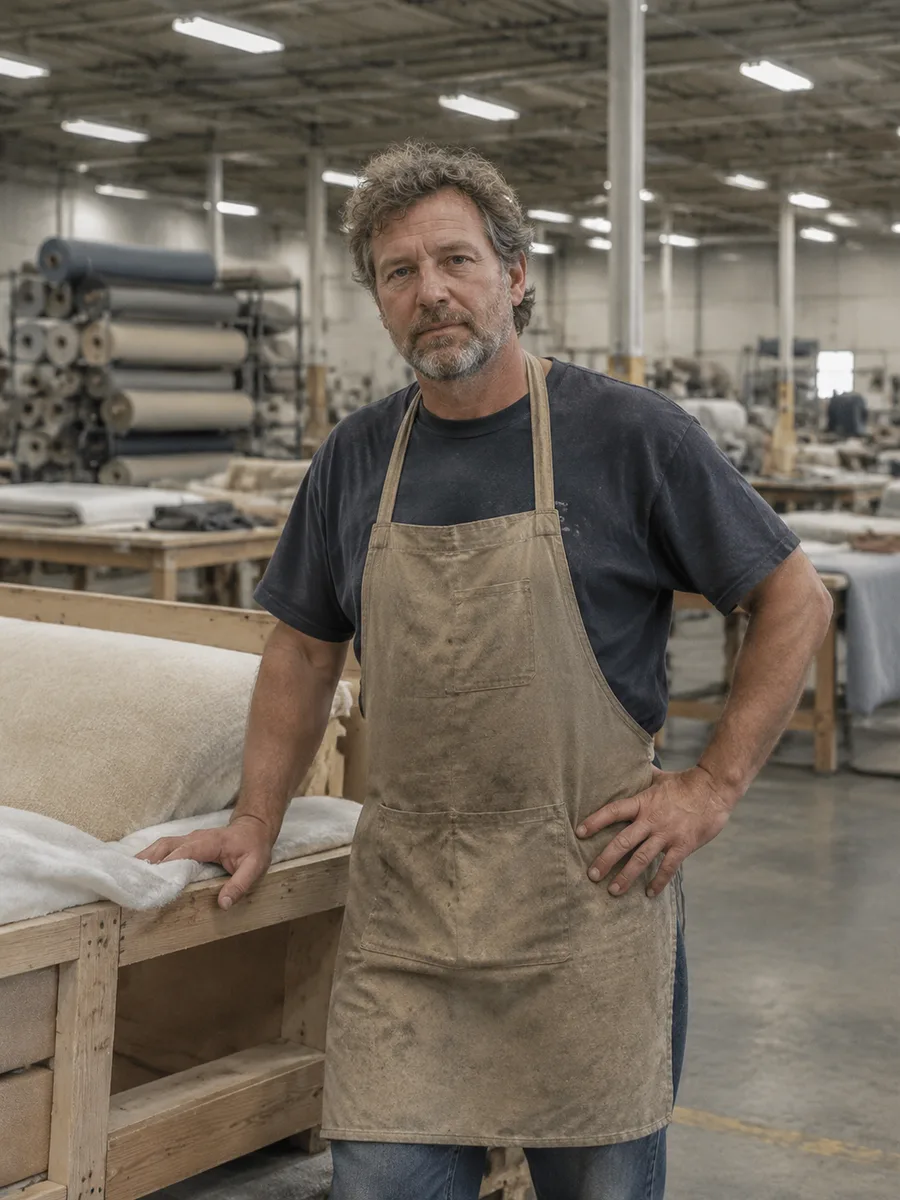
特朗普关税下,海波因特的沙发厂只开了十个月
Trump Tariffs Backfire: TOV's Zero-Dollar High Point Sofa Factory Shuts After 10 Months
About this story
Normal-level Chinese listening: TOV Furniture's Bruce Krinsky bought a High Point sofa plant for $0, lost $3 million in 10 months, and moved production back to Vietnam. HSK 5+ Chinese listening practice.
This is an HSK 5+ Chinese listening episode that runs about 4 minutes. The full Mandarin script is shown with tap-for-pinyin and a line-by-line English translation, so you can listen and read at once — comprehensible input in the sense of Stephen Krashen's i+1 theory. It teaches 12 key vocabulary words such as 工厂、大约、消失 and walks through 8 grammar patterns, each explained in English with examples. The same news story is retold at 4 difficulty levels — use the level selector above to find the version that is challenging but still understandable for you.
Read at your level
原文Read the complete story in Chinese. Reveal pinyin and English only when you need them.
English transcript reference
A sofa factory bought for zero dollars shut its doors just ten months after starting up; after running the numbers, the founder had lost about three million dollars.
The man who closed the factory is named Bruce Krinsky; together with his wife Chaya he founded the American furniture brand TOV.
On July 31, the Revival factory in High Point, North Carolina, stopped production, and roughly forty-five jobs disappeared with it.
North Carolina's furniture industry once supported ninety-one thousand people — that was in 1990; by this year, the number was down to just twenty-seven thousand.
When TOV started out it sold sofas made in China, nine hundred dollars apiece, relying on Asian supply chains to push costs as low as possible.
After the United States imposed tariffs on Chinese goods, Krinsky set his sights on Vietnam.
He persuaded his long-time supplier Zhiwei Furniture to head south and build a new plant in Dong Nai Province, outside Ho Chi Minh City.
The new plant went into production in March 2025, with about one hundred and thirty workers, thirty of whom were transferred over from China.
Nguyen Van Hai wraps fabric onto sofas at the factory, working up to ten hours a day, six days a week, earning about eight thousand dollars a year.
His assessment of this income was just one sentence: really high.
The turning point came when the United States proposed a forty-six percent tariff on Vietnamese goods, and Krinsky began looking for factory space back home in the US.
In High Point he bought a ready-made factory; the purchase price was zero dollars.
He named the factory Revival, planning to move sofa manufacturing from Asia back to the United States.
The math quickly became impossible: in High Point, the materials and labor for one sofa come to about one thousand dollars.
The same materials and labor cost only two hundred and eighty dollars in Vietnam.
Add in the other expenses, and the total cost of making one sofa in the US is about one thousand two hundred and thirty dollars, versus about six hundred and fifty-five in Vietnam.
The efficiency gap is just as obvious: according to Krinsky, workers in High Point make two to three sofas a day.
At his Asian partner's operation, it is ten a day.
He set the retail price at around one thousand five hundred dollars, yet he still lost more than one hundred dollars on every sofa sold.
He said that once the price reached two thousand dollars, the company would have no reason to exist.
Two thousand dollars is roughly this factory's break-even point.
The losses could not be stopped; on July 31 he shut the factory, having lost about three million dollars over ten months.
He said he had voted for this president three times, yet now he could not say clearly what an American business could still do.
In High Point, another furniture company offered a different answer.
George Jordan, president of Michael Thomas Furniture, said his sofas retail between three thousand and five thousand dollars.
Only at that price level can American labor and factory space be supported.
This factory employs one hundred and fifty people; in High Point, the starting wage for a skilled sofa worker is about forty-five thousand dollars, and the best can exceed ninety thousand.
Jordan said that pushing sofa prices below two thousand dollars would be very difficult.
The trouble does not stop at costs: US Customs intercepted seventeen shipments sent from Dong Nai, about forty-five containers.
The resulting bill was one hundred and thirty-five thousand dollars; Krinsky hired a lawyer and is preparing to dispute the charge.
After the closure, about seventy percent of TOV's furniture went back to being made in Vietnam; the company's annual revenue exceeds one hundred million dollars.
Tariffs are still climbing: the rate on Chinese-made upholstered furniture is fifty percent, and on Vietnamese twenty-five percent.
According to plan, in January next year these two numbers will become fifty-five and thirty percent.
The factory is closed, orders have returned to Vietnam, and the next step in tariffs is already scheduled for January next year.
Listen again
Try it without the transcript and notice what sounds clearer.
What vocabulary does this episode teach?
词汇HSK 3. Common noun for a manufacturing plant; appears throughout as 沙发工厂, 新厂.
HSK 4. Used before numbers: 大约三百万美元, 大约四十五个岗位.
HSK 4. Here of jobs: 岗位随之消失.
HSK 5. Business term for production cost; 把成本压到最低.
HSK 5. 效率的差距同样明显 — the efficiency gap is equally obvious.
Beyond HSK 5. 美国海关拦下了… — US Customs intercepted…
HSK 5-ish trade word central to this story: 加征关税, 征收百分之四十六关税.
HSK 5. 长期合作的供应商 — a long-term partner supplier.
HSK 5. Contrasts with 成本; 把零售价定在…
HSK 5. 亏损止不住 — the losses could not be stopped.
HSK 5 business term: 一年的营收超过一亿美元.
Beyond HSK 5. 新厂二零二五年三月投产 — the plant began production in March 2025.
* beyond level超纲词
What grammar patterns appear in this episode?
语法把 + Object + Verb + Complement
The 把 construction moves the object before the verb to show what is done to it, often with a result complement.
靠亚洲的供应链把成本压到最低。
他把工厂命名为Revival,打算把沙发从亚洲搬回美国制造。
据 + Source + 说
'According to (someone)' — 据 introduces the source of information.
据克林斯基说,海波因特的工人一天做两到三张沙发。
一旦…就…
'Once… then…' — 一旦 marks a hypothetical condition whose result follows immediately with 就.
价格一旦卖到两千美元,公司就没有存在的理由了。
只有…才…
'Only if… then…' — 只有 sets an exclusive condition, 才 introduces the result.
只有这样的价位,才撑得起美国的人工和厂房。
在…之间
'Between…' — 在 A 和 B 之间 expresses a range or interval.
他的沙发零售价在三千到五千美元之间。
随之 + Verb
'Following that / along with it' — 随之 links a consequence to the preceding event.
大约四十五个岗位随之消失。
再也 / 说不清 — Verb + 不清
Potential complement 不清 means 'cannot … clearly'; 说不清 = cannot say clearly.
如今却说不清一家美国企业究竟还能做什么。
A 是 B,B 是 C (topic chain with 就是)
就是 is used to define or equate: 'X is exactly Y'.
两千美元,大致就是这家工厂的盈亏平衡点。
Proper nouns
专有名词Sources
来源Free account
Keep learning from this story
Create a free account to keep saved words and your preferred level together.
- Keep words with their story context
- Remember your preferred level
- Build your vocabulary over time