
A Chinese podcast · Same story, 4 levels
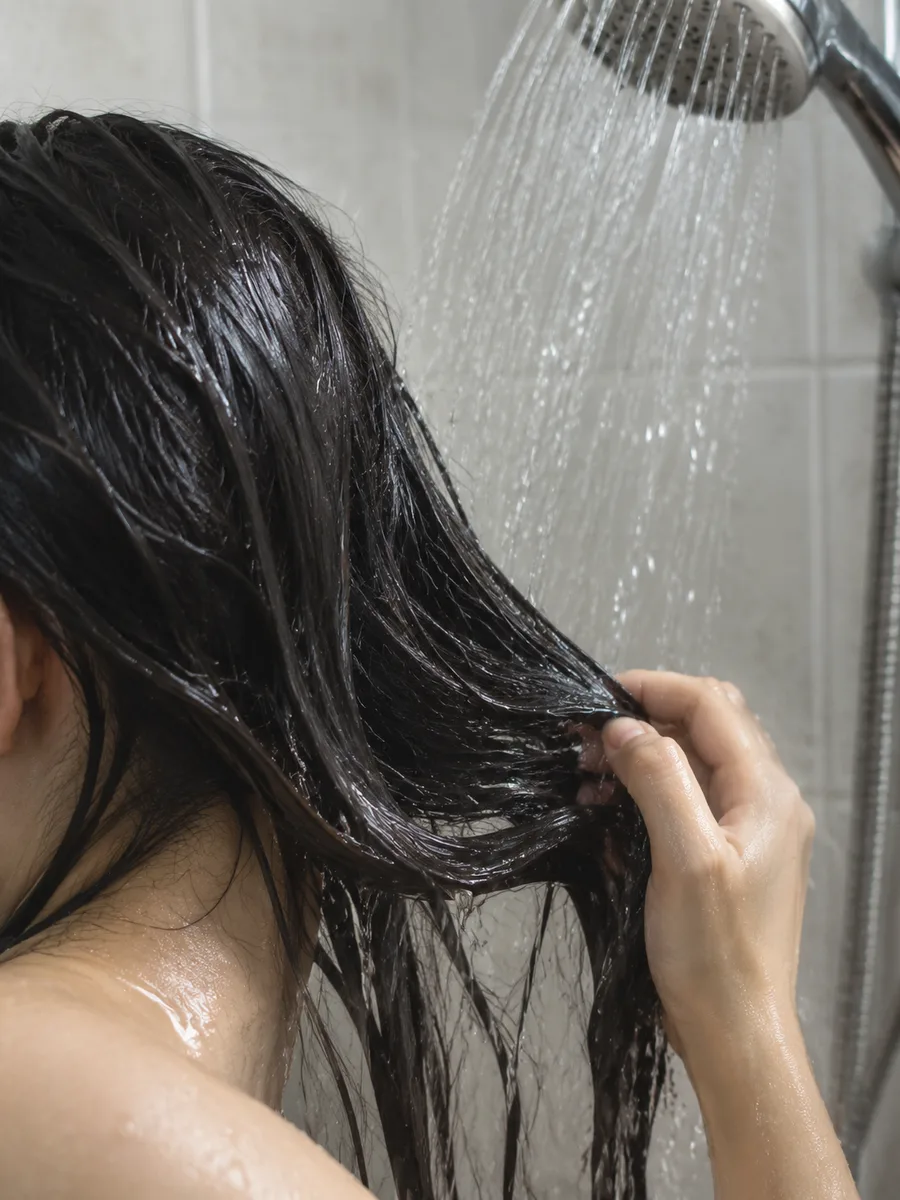
《纽约时报》请皮肤科医生查证冷水洗发神话
Dermatologists Debunk the Cold-Water Hair Rinse Myth: It Won't Boost Shine
About this story
Dermatologists fact-check the viral cold-water hair rinse myth. Experts say water temperature doesn't affect shine; proper conditioning and gentle handling do. HSK 5+ Chinese listening practice.
This is an HSK 5+ Chinese listening episode that runs about 3 minutes. The full Mandarin script is shown with tap-for-pinyin and a line-by-line English translation, so you can listen and read at once — comprehensible input in the sense of Stephen Krashen's i+1 theory. It teaches 12 key vocabulary words such as 否定、解释、表面 and walks through 3 grammar patterns, each explained in English with examples. The same news story is retold at 4 difficulty levels — use the level selector above to find the version that is challenging but still understandable for you.
Read at your level
原文Read the complete story in Chinese. Reveal pinyin and English only when you need them.
English transcript reference
Rinsing your hair with cold water after washing will make it shinier—this claim, which has circulated for decades, was recently refuted face-to-face by several dermatologists.
According to the popular explanation, cold water can tighten the hair's cuticle, making it smooth.
Once the surface is smooth, light reflects more uniformly, creating what appears to be shine.
From the magazine era to the short-video era, this claim has been repackaged in several ways, but the core has always been cold water.
Dr. Paradi Mirmirani, a dermatologist at Kaiser Permanente in Northern California, put it more bluntly.
She said that whether it's cold or hot water, there is no solid research proving that water temperature makes hair shinier.
Dr. Teresa Song, a dermatologist in New York, was equally direct: cold water probably won't make much difference to shine.
Her assessment of the claim was that it is absolutely not valid.
Dr. Lilia Correa Selm, an associate professor of dermatology at the University of South Florida, recommended lukewarm water.
She believes the ideal water temperature is close to body temperature.
If the water temperature is too low, its cleansing power decreases, making it easier for oil, dirt, and hair product residue to remain on the scalp.
Dr. Jacob Beer, a dermatologist in West Palm Beach, Florida, warned about the other extreme.
Water that is too hot can dry out the scalp and easily cause irritation.
His advice is to use a silicone-based conditioner to smooth the cuticle, and shine will naturally emerge.
As for how often to wash, according to the American Academy of Dermatology, it depends on hair type and scalp.
People with straight hair and an oily scalp can wash once a day without issue.
Those with dry, thick, curly, or coarse hair can go two to three weeks between washes.
Returning to shine itself, Dr. Song said what really works is daily hair care habits, especially conditioner.
A cold water rinse is not on that list.
Dermatologist Dr. Hope Mitchell compared the cuticle to overlapping shingles on a roof.
This layer wraps the inside of the hair and reflects incoming light.
The so-called shine we see is this reflected light.
Fine, straight hair reflects light more uniformly, making the shine concentrated.
Thick, curly hair scatters light, presenting a soft, subtle sheen.
Mitchell reminds us that shiny hair does not equal healthy hair; the two cannot be equated.
Dr. Song added another aspect: friction damages the cuticle, and shine is compromised as a result.
Brushing too vigorously or rubbing wet hair hard with a towel are both forms of this friction.
Rather than obsessing over water temperature, it's better to use conditioner and be gentle when brushing and drying.
As for the cold water rinse step, you can skip it.
Listen again
Try it without the transcript and notice what sounds clearer.
What vocabulary does this episode teach?
词汇HSK 5. Often used in formal contexts to reject a claim or idea.
HSK 3. Can be used as both verb and noun. 按照…的解释 = according to the explanation of...
HSK 4. Literal or figurative surface. 表面上 = on the surface.
HSK 3. Can be used as verb or noun. 能证明 = can prove.
HSK 3. Adverb or adjective. 说得直接 = speak directly.
HSK 3. 起作用 = to have an effect; 起不了多大作用 = won't have much effect.
HSK 4. Can be verb or noun. 给…的评价 = the assessment given to...
HSK 3. 给出的标准 = the standard given.
HSK 5. 皮肤科 (dermatology) + 医生 (doctor). Common compound for medical specialists.
HSK 5. Used for light, sound, etc. 反射光线 = reflect light.
HSK 5. Often describes research, knowledge, or work: 扎实的研究 = solid research.
HSK 5. Often used in the phrase 纠结于… = get hung up on...
* beyond level超纲词
What grammar patterns appear in this episode?
语法按照 + Noun + 的说法/解释
Means 'according to the statement/explanation of...'. Used to introduce a source or viewpoint.
据美国皮肤病学会的说法,要看发质和头皮。
起(不了)作用
Means 'to have (no) effect'. 起不了多大作用 = won't have much effect.
冷水对光泽恐怕起不了多大作用。
并不/并不在…
Emphasizes negation, meaning 'not at all' or 'not really'. 并不在这个清单上 = is not on this list at all.
冷水冲一遍,并不在这个清单上。
Proper nouns
专有名词Sources
来源Free account
Keep learning from this story
Create a free account to keep saved words and your preferred level together.
- Keep words with their story context
- Remember your preferred level
- Build your vocabulary over time