
A Chinese podcast · Same story, 4 levels
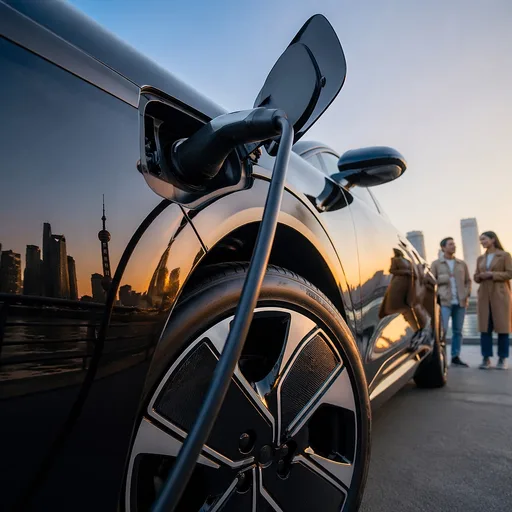
中国电动车成本优势的真相:超越补贴的结构性力量
Chinese EVs Beat Tesla on Manufacturing Cost
About this story
Why BYD's Seal beats Tesla's Model 3 on cost — Shanghai supply chains, scale, and the structural edge beyond subsidies. HSK 5-6 Chinese listening practice.
This is an HSK 5-6 Chinese listening episode that runs about 7 minutes. The full Mandarin script is shown with tap-for-pinyin and a line-by-line English translation, so you can listen and read at once — comprehensible input in the sense of Stephen Krashen's i+1 theory. It teaches 15 key vocabulary words such as 成本、竞争、趋势 and walks through 5 grammar patterns, each explained in English with examples. The same news story is retold at 4 difficulty levels — use the level selector above to find the version that is challenging but still understandable for you.
Read at your level
原文Read the complete story in Chinese. Reveal pinyin and English only when you need them.
English transcript reference
Regarding why Chinese electric vehicles can achieve such low prices, there always seems to be a simplistic explanation circulating in the market — government subsidies.
Whenever people discuss the price competition between BYD and Tesla, they habitually focus on the government's wallet, as if any industrial miracle can be easily replicated with subsidies.
However, this seemingly reasonable intuition is actually concealing a deeper and more brutal business truth.
Let's first look at a set of striking data comparisons: taking BYD's Seal and Tesla's Model 3 as examples, these two models are direct competitors in the market.
In the short span from 2022 to 2025, the BYD Seal's retail price dropped all the way from over thirty thousand dollars to around twenty-four thousand dollars — an astonishing decline.
In contrast, despite Tesla Model 3 having started localized production at its Shanghai Gigafactory as early as 2019, its price barely budged during the same period, with only a token adjustment of just over two hundred dollars.
This enormous scissors gap in price trajectories is enough to send chills down the spine of any Western automotive executive.
This raises a core question: if it were merely relying on subsidies, could BYD really sustain such a prolonged and aggressive pricing offensive?
A latest in-depth report from Rhodium Group, a New York-based consultancy, has given us a paradigm-shifting answer.
The report points out that among BYD's per-vehicle cost advantage of up to 4,700 dollars over Tesla, the proportion contributed by government subsidies is a mere 5%.
Yes, you heard that right — the so-called 'unfair competitive advantage' repeatedly hyped by Western media turns out to be just the tip of the iceberg when viewed against the real cost structure.
So where does the remaining 95% come from?
The answer lies in three more fundamental business logics: extreme economies of scale, full supply chain vertical integration, and an irreplicable low-cost talent dividend.
First, let's talk about so-called 'vertical integration' — this is by no means just a supply chain management term, but rather the secret weapon of Chinese automakers.
Unlike Western automakers who are accustomed to global sourcing and assembly production, BYD is more like an all-encompassing industrial behemoth.
From mining battery raw materials, to manufacturing chips, to stamping and final assembly of vehicles, they control virtually every link in the chain.
This high degree of self-sufficiency not only greatly compresses the margins of middlemen, but more importantly, it gives the company extremely strong risk resistance when facing market fluctuations.
Rhodium's analysts even discovered that Chinese automakers also hold absolute leverage in their negotiations with suppliers.
By extending payment cycles to suppliers, giants like BYD effectively obtain a huge pool of interest-free working capital.
According to estimates, this single strategy of 'payment term management' alone can save approximately 214 dollars in financial costs per vehicle.
In the auto industry where cash flow is king, this is undoubtedly a brilliant financial lever.
Second, we cannot ignore the human factor — China's enormous engineer dividend.
Although BYD's absolute R&D spending has been climbing year after year, even surpassing many legacy automakers, when spread across millions of units in annual sales, the per-vehicle R&D cost is greatly diluted.
More crucially, China possesses the world's largest pool of STEM talent with relatively reasonable salaries.
The same R&D budget can hire a massive, round-the-clock engineering team in China, while in Germany or the United States, it might only sustain a small core group.
This dual advantage in R&D efficiency and labor costs gives Chinese automakers a suffocating competitive pressure in the speed of technological iteration.
Of course, we are not trying to completely deny the existence of subsidies.
In fact, data shows that the proportion of government subsidies to BYD's net profit has indeed been rising, but this is more reflected in the company's overall financial statements rather than directly determining the material cost of each vehicle at the factory gate.
This distinction is crucial, because it means that even if subsidies are completely phased out in the future, Chinese automakers will still possess a cost moat that leaves competitors far behind.
This pushes Western automakers into an extremely awkward position — one might even call it an unsolvable strategic deadlock.
To bridge this enormous cost gap, Volkswagen, GM, or Ford must make a painful choice.
Either they need to more thoroughly 'go Chinese' — relocating more R&D centers and supply chains to China, leveraging its efficiency and talent to reduce costs.
Or they can only watch helplessly as their market share is nibbled away bit by bit.
However, the current political and economic environment makes the first option extraordinarily difficult.
Western governments, out of concern for protecting domestic employment and supply chain security, are constructing various regulatory barriers to try to keep manufacturing at home.
This creates a paradox: to survive commercially, Western automakers need to embrace globalized division of labor; but to comply politically, they are forced to go against globalization.
Rhodium Group's report offers an extremely incisive observation on this: if Western automakers want to match Chinese competitors on cost, they must carry out painful layoffs and cost cuts domestically while increasing investment in China.
But this clearly runs counter to their own governments' industrial policies.
This dilemma of being caught between a rock and a hard place is the real crisis facing the Western auto industry behind China's EV rise.
When we talk about the 'price war' in China's new energy vehicles, we see not just the fluctuation of numbers on price tags, but a grand narrative about industrial systems, talent structures, and the restructuring of global supply chains.
Once, Western automakers relied on brand premiums and technological barriers to earn handsomely in the Chinese market, occupying two-thirds of the landscape.
Now, that proportion has slid to one-third, with no signs of the decline slowing down.
This is not merely a redistribution of market share, but a dramatic seismic shift in the global automotive industry's power map.
When we strip away the simple label of 'subsidies' and delve into the factory assembly lines, the lights of R&D laboratories, and the fine details of financial statements, we discover that the competitiveness of Chinese EVs
has already taken deep root in the unique industrial soil of this land.
This structural advantage, cultivated jointly by scale, efficiency, and talent, is far more solid and far more formidable than any subsidy policy.
Listen again
Try it without the transcript and notice what sounds clearer.
What vocabulary does this episode teach?
词汇A standard HSK 5 business term referring to the expenses incurred in production or operation.
Common HSK 4 word. In business contexts, it refers to market rivalry.
HSK 5 word used to describe the general direction in which something is developing.
HSK 5 verb meaning to pay no attention to something.
HSK 5 adjective often used to introduce a specific term or to cast doubt on a designation.
HSK 1-4. economy.
HSK 1-4. politics.
HSK 1-4. government.
Financial aid extended to an economic sector (or institution, business, or individual).
Describes harsh realities or behavior. HSK 6 level.
Business term referring to the full sequence of processes involved in the production and distribution of a commodity.
Economic term describing the combination in one company of two or more stages of production normally operated by separate companies.
Cost advantages that enterprises obtain due to their scale of operation.
Originally a defensive ditch around a castle; in business (Warren Buffett term), it refers to a competitive advantage that protects a company's market share.
Idiom meaning 'advancing or retreating is both difficult'.
* beyond level超纲词
What grammar patterns appear in this episode?
语法以...为例 (yǐ... wéilì)
A formal pattern meaning 'Taking... as an example'. It introduces specific cases to support an argument.
以比亚迪的海豹车型和特斯拉的Model 3为例
绝不仅仅是...而是... (jué bùjǐnjǐn shì... érshì...)
A structure meaning 'It is absolutely not just... but rather...'. It emphasizes the second part of the sentence as the true or more important definition.
这绝不仅仅是一个供应链管理的术语,而是中国车企克敌制胜的法宝。
要么...要么... (yàome... yàome...)
A conjunction pattern meaning 'Either... or...'. It presents two distinct choices or possibilities.
要么,他们需要更彻底地“中国化”...
要么,他们只能眼睁睁看着市场份额被一点点蚕食。
仿佛... (fǎngfú...)
Meaning 'as if' or 'seemingly'. It often introduces a hypothetical or perceived situation that might not be true.
仿佛只要有了补贴,任何工业奇迹都能被轻易复制。
即便...依然... (jíbiàn... yīrán...)
Meaning 'Even if... still...'. It indicates that the result remains unchanged despite a hypothetical condition.
即便未来补贴完全退坡,中国车企依然拥有令对手望尘莫及的成本护城河。
Proper nouns
专有名词Sources
来源Free account
Keep learning from this story
Create a free account to keep saved words and your preferred level together.
- Keep words with their story context
- Remember your preferred level
- Build your vocabulary over time